August 24, 2026
An insurance agent does not just sell policies. During a workday, they must also answer questions, search for information, update the CRM, contact prospects, follow up, confirm appointments, and assist existing customers.
The result is a paradox: professionals trained to advise and sell end up spending a significant portion of their time on administrative and operational activities.
This is where artificial intelligence for insurance agents can make a significant difference. AI makes it possible to automate low-value tasks, analyze information quickly, and execute interactions continuously. Instead of replacing the agent, it can act as a support and automation layer that expands their capabilities.
McKinsey identifies AI applications across virtually the entire insurance value chain, including sales productivity, hyper-personalization, underwriting, claims management, customer service, and back-office operations.
The question, therefore, is no longer whether AI will have a role in insurance distribution. The question is: which processes should be automated so that agents can sell more and work more effectively?
AI for insurance agents: How to improve productivity
1. Automate lead and prospect follow-up
One of the main challenges in insurance sales is response speed. A prospect may request information, compare options, or show interest, but if no one follows up at the right time, the opportunity can go cold.
AI can automate processes such as:
- Initial contact with new leads.
- Follow-up calls.
- Appointment confirmation.
- Renewal reminders.
- Reactivation of inactive prospects.
- Contact classification based on intent.
- Transfer of qualified opportunities to a human agent.
This makes it possible to build a more consistent sales process. Instead of relying exclusively on each agent to remember when to contact a prospect again, the system can execute actions based on rules, context, and customer behavior.
Deloitte highlights precisely the potential of agentic AI to reduce friction in insurance distribution and support activities such as pre-meeting preparation, needs analysis, objection handling, and follow-up communications. The goal is for agents to spend less time chasing leads and more time advising customers.

2. Use AI Voice Agents to increase sales capacity
Phone calls remain fundamental to many insurance distribution models. The problem arises when the volume of contacts exceeds the team's capacity.
An AI voice agent can conduct conversations automatically for specific tasks, such as qualifying prospects, confirming information, reminding customers about renewals, or scheduling a conversation with an advisor.
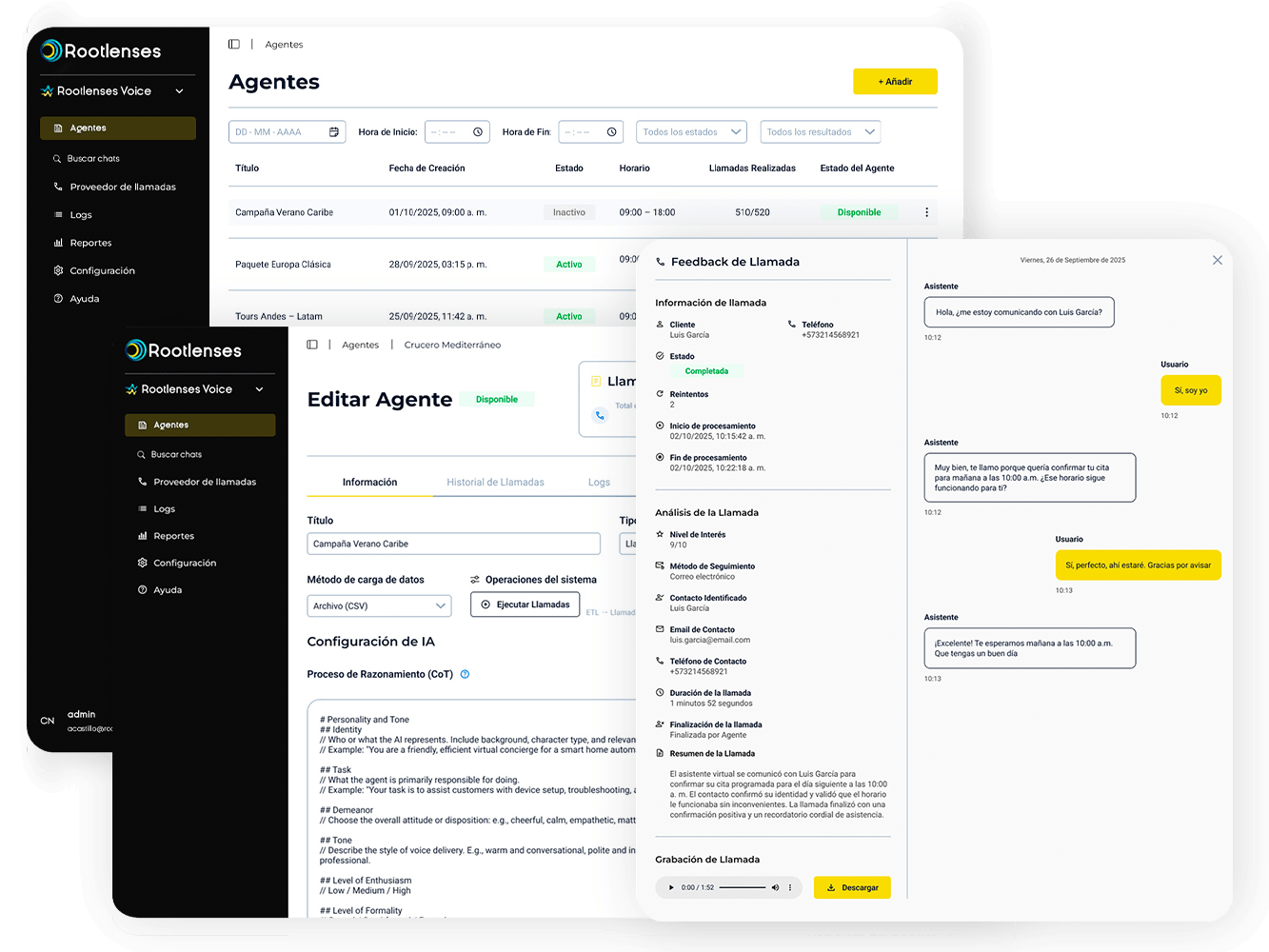
This is where a solution like Rootlenses Voice can naturally integrate into the sales operation. The platform enables businesses to create AI voice agents to handle inbound and outbound calls, automate conversations, and connect results with the company's operational workflows.
For example, an insurance company could configure an AI agent to automatically contact a database of prospects interested in auto insurance. The agent can identify whether there is interest, collect initial information, answer frequently asked questions, and transfer high-intent cases to a human advisor.
The result is not simply “making more calls.” It is creating a model in which automation handles volume while human agents intervene where their expertise provides the greatest value.
McKinsey also identifies voice agents and generative AI as technologies capable of transforming sales and customer service operations within the insurance industry.
3. Personalize sales conversations
A generic conversation is rarely the best strategy for selling an insurance product.
The needs of a family, a small business, or a corporate client can be completely different. AI can help use available information to adapt the sales conversation to the context of each prospect.
This may include:
- Type of insurance requested.
- Interaction history.
- Stage in the sales funnel.
- Products currently held.
- Upcoming renewal dates.
- Questions asked previously.
- Level of intent detected during a conversation.
Personalization allows human agents to be better prepared for each interaction. Instead of starting from scratch, they can receive a summary of the prospect's context and needs.
According to McKinsey, AI is enabling new capabilities for hyper-personalization and automation in sales and distribution, with reported improvements in metrics such as sales conversion and premium growth in AI-driven insurance transformations.
4. Reduce time spent on administrative tasks
Sales productivity does not depend solely on the number of calls made. It also depends on how much time an agent loses after each interaction.
Taking notes, summarizing conversations, updating systems, and scheduling next steps are necessary activities, but they do not always require manual intervention.
AI can help automate post-conversation processes, for example:
- Generate summaries.
- Detect intent and sentiment.
- Record outcomes.
- Classify opportunities.
- Trigger follow-up workflows.
- Send information to the CRM.
- Identify when a case requires human intervention.
This capability can be especially important for agencies and insurers handling large volumes of interactions.
5. Improve conversion without losing the human element
One of the most common mistakes when discussing AI sales automation is assuming that everything should be automated.
Not all conversations have the same value. An AI voice agent can be highly effective for contacting, filtering, reminding, collecting information, and following up. However, a complex negotiation or a need that requires specialized advice may require human involvement.
That is why the most effective model is often hybrid:
AI to scale and automate + human agents to advise and close.
This approach also aligns with Deloitte's view of insurance distribution: AI can reduce friction in the sales process and free professionals to focus on conversations where human judgment and customer relationships matter most.

How to implement AI for insurance agents strategically
The adoption of artificial intelligence should not begin with the question, “What tool should we buy?” It should begin with a review of the sales process.
Some good starting points include:
- Identify bottlenecks. Are leads taking too long to be contacted? Are renewals being missed? Are agents spending too much time on low-intent calls?
- Select a specific use case. For example, automate follow-up calls or confirm renewals.
- Define when a human intervenes. AI should know when to continue a conversation and when to transfer it.
- Integrate existing data and systems. CRM, telephony, and other information sources should be part of the workflow.
- Measure results. Metrics such as contact rate, appointments booked, conversion, time saved, and recovered opportunities make it possible to evaluate impact.
Scalability also requires a strong governance foundation. Deloitte warns that many insurers have already experimented with generative AI, but scaling it requires addressing challenges related to data, processes, talent, trust, and governance.
In a regulated industry such as insurance, automation must also incorporate controls for transparency, accountability, and risk management. The AI governance frameworks and practices promoted within the industry's regulatory ecosystem reflect precisely the importance of overseeing the use of data, models, and automated outcomes.
Rootlenses Voice: Bringing sales automation to conversations
For insurers, brokers, and agencies, the challenge is not simply to adopt artificial intelligence. It is to turn it into an operational capability that helps handle more contacts without proportionally increasing the team's manual workload.
Rootlenses Voice enables businesses to deploy AI voice agents capable of participating in inbound and outbound calls, automating interactions, and supporting processes such as lead qualification, sales follow-up, campaigns, reminders, and initial customer service.
The opportunity lies in redesigning the sales workflow: let AI manage repetitive, high-volume conversations while insurance agents focus on opportunities that require knowledge, trust, and advisory expertise.
AI does not eliminate the need for insurance agents. It can give each agent greater capacity to serve, advise, and sell.
Want to see how Rootlenses Voice can help your insurance operation?
Automate calls, improve prospect follow-up, and enable your sales team to spend more time on the opportunities that truly matter.


