
October 16, 2026
Customers no longer compare your service only with that of your direct competitors. They compare it with the best experience they have had with any company: immediate responses, no waiting in line, no having to repeat their problem three times, and access at any hour.
In this context, AI-powered customer service is no longer an experiment. It has become one of the most important operational decisions for support, sales, and customer experience teams.
We explain what AI-powered customer support is, how modern AI agents work, what real benefits they offer, and how to implement them without losing the human touch.
What is AI-Powered customer service?
AI-powered customer service is the use of artificial intelligence to answer inquiries, resolve requests, and support customers throughout their entire journey, whether through chat, email, messaging, or phone calls.
Unlike older chatbots based on menus and predefined responses, today's AI agents understand natural language, interpret a person's intent, access internal systems, and perform specific actions.
This difference is crucial. A traditional chatbot answers "frequently asked questions." A conversational AI agent can check an order's status, reschedule an appointment, update information in the CRM, or escalate a complex case to a human representative, with all the context already summarized.

Why companies are adopting AI-powered customer support
The reasons are consistent across almost every industry:
- 24/7 availability. AI agents handle inquiries at night, on weekends, and during peak hours without increasing headcount.
- Shorter response times. Simple inquiries are resolved in seconds, reducing wait times and improving customer satisfaction.
- Scalability. When volume increases due to a campaign or peak season, customer service automation absorbs the demand without overwhelming the team.
- Consistency. Every customer receives the same information, tone, and policies, regardless of the shift or the representative handling the interaction.
- Teams focused on higher-value work. By delegating repetitive tasks, human representatives can dedicate their time to complex cases, customer retention, and high-value relationships.
From chatbots to AI voice agents
For years, support automation focused on text. However, many customers still prefer to call, especially when the issue is urgent, sensitive, or complex: an unexpected charge, a service problem, or a last-minute reservation.
This is where AI voice agents come in. Thanks to advances in speech recognition, language models, and natural-sounding speech synthesis, it is now possible to hold fluid phone conversations with low latency and the ability to handle interruptions, clarify information, and adapt to the caller's pace. Calls are no longer a bottleneck but become an automatable channel without sacrificing quality.
Rootlenses Voice, Rootlenses' AI voice agent solution, belongs to this category. It is designed to help companies automate inbound and outbound calls through natural conversations connected to their systems, with clear rules for determining when to resolve an issue and when to transfer it to a human representative.
For a support team, this means handling frequently asked questions, following up on open cases, and confirming information or appointments without requiring a live representative for every call.
Use cases for AI in customer service
The scenarios in which AI-powered customer service works best typically share three characteristics: high volume, repeatable processes, and clear rules. Some examples include:
- Status inquiries. Orders, shipments, procedures, requests, or account balances resolved in a single interaction.
- Scheduling and rescheduling. Appointments, technical visits, and reservations synchronized with the team's calendar.
- First-level support. Initial diagnosis, step-by-step guidance, and information gathering before escalation.
- Post-sale follow-up. Satisfaction surveys, delivery confirmations, and proactive reminders.
- Intelligent routing. Identifying the customer's needs and directing them to the right department or representative with the full context.
In all these cases, the goal is not to replace people but to free up human capacity for the areas where it matters most.

How to implement AI in customer service without losing the human touch
A good AI-powered support strategy does not start with technology but with the process. These practices make the difference:
Start with a well-defined use case. Choose a high-volume workflow with clear rules, measure its performance, and then expand. Automating a broken process only scales the problem.
Define when to hand off to a human. Customers are comfortable with automation when they know they can speak to a person if needed. Establish escalation criteria (emotional state, complexity, and risk) from the outset.
Integrate agents with your systems. An agent that cannot access the CRM, ticketing system, or knowledge base can only hold a conversation; an integrated agent can resolve issues.
Prioritize governance and security. Record every interaction, control the information the agent can access, and ensure compliance with the data protection regulations in your market.
Measure and optimize. Metrics such as first-contact resolution rate, average handling time, customer satisfaction (CSAT), and escalation rate will show you where improvements are needed.
The future: AI agents that resolve issues, not just answer questions
The trend is clear: conversational AI is moving toward autonomous agents capable of reasoning, using tools, and completing tasks from beginning to end. Companies that adopt this approach early will gain a hard-to-match advantage: more predictable service costs, more satisfied customers, and human teams dedicated to building relationships rather than repeating answers.
The question is no longer whether AI-powered customer service is worthwhile, but how to do it right: with the right use case, the appropriate integration, and an experience customers perceive as an improvement rather than an obstacle.
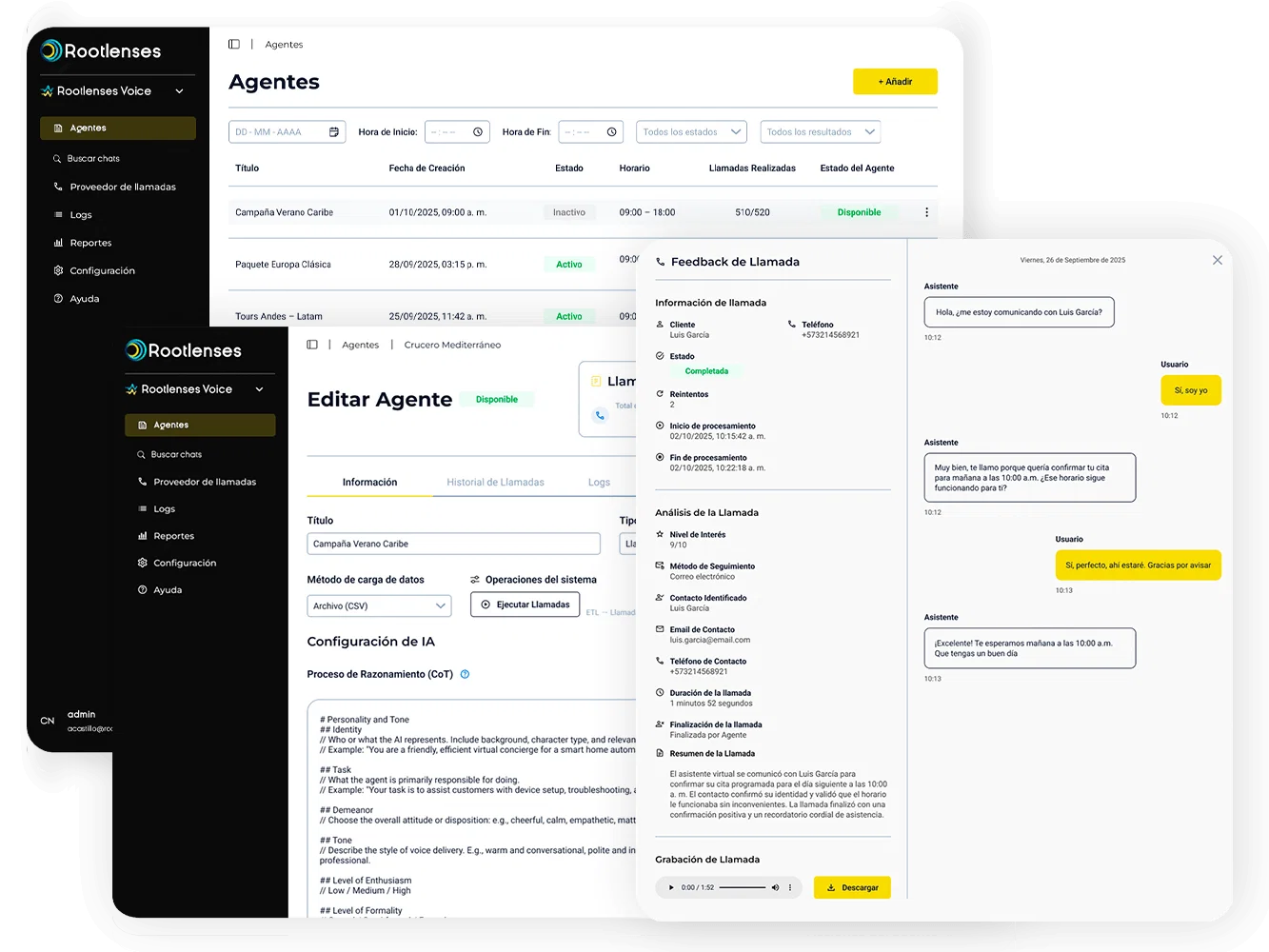
See Rootlenses Voice in action
If you want to see how AI voice agents can handle your company's calls, resolve inquiries, and escalate important cases to your team, Rootlenses Voice can demonstrate how it works with your own use case.
Request your Rootlenses Voice demo and discover how to transform your customer service with AI.


