
September 29, 2026
When a person speaks with an AI voice agent, they expect an almost immediate response. A pause that is too long can make the conversation feel artificial, cause interruptions, or even lead the user to abandon the call.
That is why AI voice agent latency has become one of the most important factors when implementing Voice AI in business processes. However, reducing latency does not simply mean choosing the fastest AI model. The final experience depends on the entire architecture between the user's voice and the agent's response.
What is latency in an AI voice agent?
Voice agent latency is the time that elapses from when a person finishes speaking until they hear the agent's response.
In a traditional AI voice agents architecture, the conversation goes through several stages:
- Audio capture and transmission.
- Speech-to-Text (STT) to convert speech into text.
- Processing through an LLM.
- Execution of tools, rules, or integrations.
- Text-to-Speech (TTS) to convert the response into audio.
- Transmission and playback of the response.
Each component adds a few milliseconds. The accumulated result determines the end-to-end latency experienced by the user.
Twilio, for example, uses the concept of mouth-to-ear latency to measure the time between when the user finishes speaking and when the response reaches their ears. Its published benchmarks use approximately 1,115 ms of end-to-end latency as an initial reference for a voice agent based on a cascaded architecture.
This demonstrates something important: latency does not belong to a single component. It is the result of the entire technology chain.
Why does latency matter so much in Voice AI?
Human conversations have a dynamic rhythm. People pause, interrupt each other, change topics, and respond quickly.
When an AI voice agent introduces prolonged silences, the user may interpret it as meaning that:
- The call was disconnected.
- The system did not understand what they said.
- The response is being processed.
- They are speaking with an inefficient automated system.
The issue is even more relevant in business applications such as AI customer service, lead qualification, phone sales, appointment scheduling, automated collections, and outbound campaigns.
In these scenarios, response speed is part of the customer experience.
OpenAI has pointed out that real-time voice applications require low latency and stable connectivity to avoid awkward pauses, interruptions, and issues during barge-in, meaning when the user starts speaking while the agent is still responding.

The main factors that affect latency
1. Speech-to-Text
The first step is converting audio into text. A slow STT system can delay the entire conversation.
To achieve low-latency voice agents, it is important to use speech recognition capable of processing audio continuously and delivering results quickly.
Streaming can also reduce waiting time compared with a model that needs to receive and process the entire audio before starting.
2. LLM Response Time
The language model is another critical component.
Not every conversation requires an extremely large model. For tasks such as confirming information, qualifying a prospect, or checking an order status, a model optimized for speed may be more suitable than one designed for much more complex reasoning.
An effective Voice AI latency optimization strategy is to use the right model for each task.
3. Text-to-Speech
Even when the LLM generates a response quickly, the user still needs to hear it.
That is why low-latency TTS is essential. The time until the first fragment of audio starts playing can be more important than the time required to generate the entire response.
Streaming makes it possible to start playing a response while the rest is still being processed.
4. Integrations and Tool Calls
This is where one of the most important challenges for businesses appears.
A voice agent may need to query a CRM, validate information, schedule an appointment, update a record, or access an internal system before responding.
Each integration can introduce additional waiting time.
Therefore, designing enterprise voice agents is not simply about connecting an LLM to a phone. It is also necessary to optimize the tools, APIs, databases, and workflows used by the agent.
Whenever possible, operations can be executed in parallel or anticipated to reduce response time.
5. Network and Service Location
The distance between the user and the technology services also matters.
If telephony, AI processing, APIs, and other services are distributed across different regions, each network hop can increase latency.
OpenAI highlights the importance of low-latency connectivity, stability, low jitter, and reduced initial connection time for real-time voice applications.
Therefore, the architecture of real-time Voice AI should consider not only the model, but also the infrastructure and location of the services.
Latency does not simply mean "Responding Quickly"
There is a difference between a fast response and a natural conversation. An agent may respond quickly and still feel robotic if it does not properly handle interruptions, pauses, or context.
The evolution of voice systems is precisely aimed at creating more natural conversations. OpenAI explains that full-duplex architectures, which can listen and speak simultaneously, can reduce reliance on separate mechanisms for detecting when the user has finished speaking.
This introduces another important concept: turn-taking. The agent must know when to listen, when to respond, and when to stop because the user has started speaking again.
Therefore, when evaluating an AI voice agent platform, it is useful to analyze metrics such as:
- End-to-end latency.
- Time to first audio.
- LLM response time.
- STT and TTS latency.
- Barge-in capability.
- Network jitter and stability.
- Tool execution time.
- Successfully completed call rate.
How to reduce voice agent latency
There is no single optimization. Reducing latency typically requires working across the entire architecture.
Some strategies include:
- Use streaming STT and TTS.
- Select models optimized for fast responses.
- Keep prompts and contexts as efficient as possible.
- Reduce unnecessary API calls.
- Execute tools in parallel when the logic allows it.
- Locate services in regions close to the user.
- Design clear and efficient call flows.
- Implement progressive responses.
- Optimize integrations with CRM, ERP, and other enterprise systems.
- Measure actual latency at every stage of the flow.
The key is to measure the entire system, not just the LLM's response time.
Latency should be measured alongside business outcomes
An AI voice agent platform should not be evaluated solely by how many milliseconds it takes to respond. In a business environment, it also matters whether the agent can successfully complete the task.
For example, in a sales campaign, a slightly slower conversation that can accurately qualify a lead may generate more value than an extremely fast response that does not understand the context.
The same applies to customer service, collections, surveys, and appointment scheduling.
Therefore, evaluation should combine latency, naturalness, accuracy, contact rate, resolution, and conversion.
Rootlenses Voice: Voice agents designed to operate in real time
Latency becomes especially important when voice agents move beyond proof of concept and become part of real business processes.
Rootlenses Voice enables businesses to create AI voice agents capable of handling inbound and outbound calls, qualifying prospects, scheduling appointments, conducting follow-ups, serving customers, and executing business processes in real time.
The platform is designed to handle natural conversations, integrate with business systems, and scale operations through multiple simultaneous calls. Rootlenses reports capabilities for automating up to 80% of repetitive calls, along with 24/7 availability.
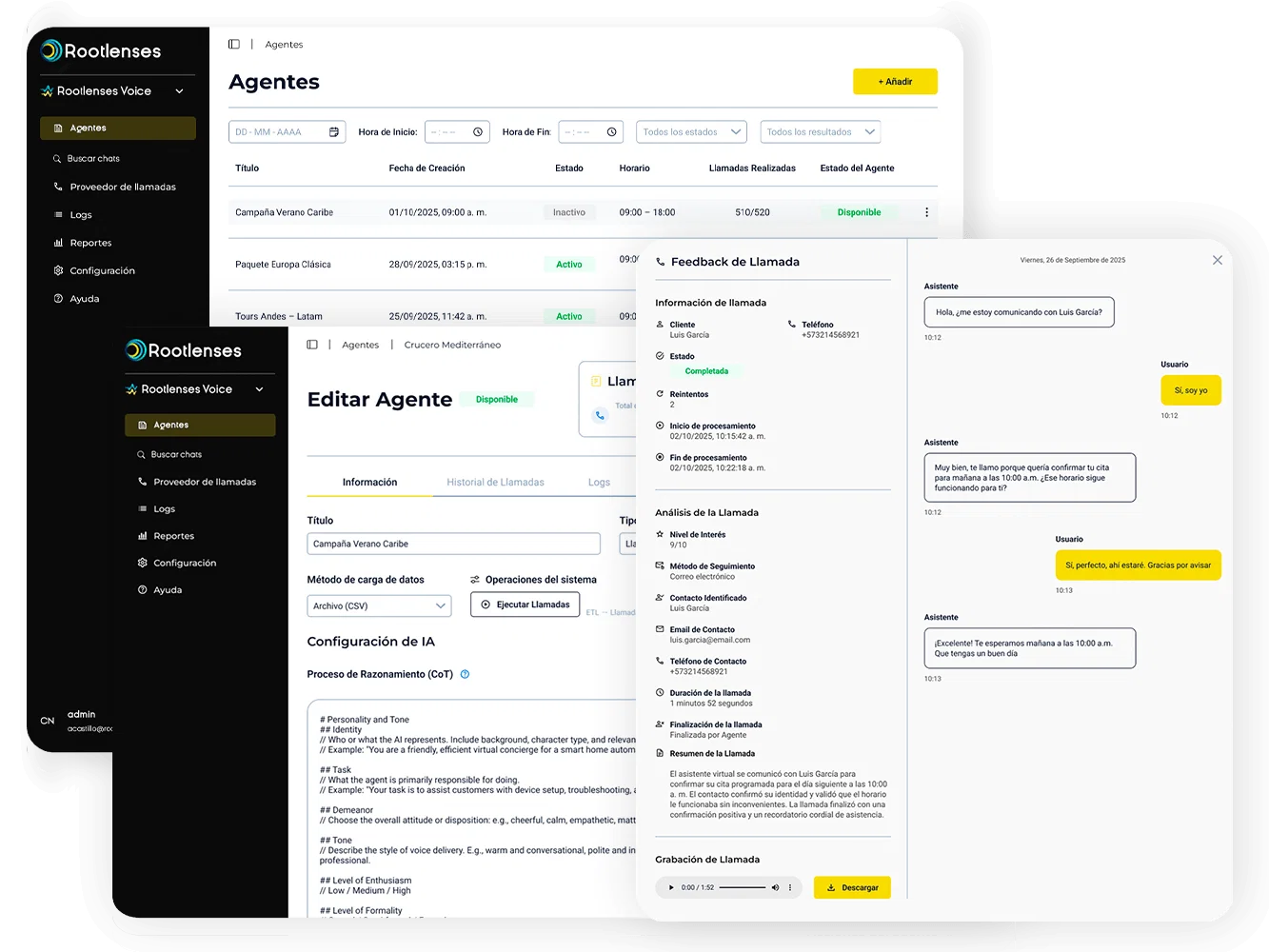
The proposition goes beyond simply making an AI talk. The goal is for it to converse, understand, execute, and transfer the interaction to a human agent when necessary.
For companies evaluating Voice AI, the right question should not simply be "How quickly does the AI respond?" The evaluation should consider the entire experience: from the moment the user speaks until the agent understands, responds, and completes the required action.
Want to try AI voice agents in your operations?
Learn how Rootlenses Voice can help you automate calls, qualify leads, schedule appointments, conduct follow-ups, and manage repetitive processes with voice agents available 24/7.


