August 24, 2026
The relationship between an insurance company and its customer does not end when a policy is issued. In fact, many of the most important moments happen afterward: when a payment date, renewal, document expiration, or another action required to keep coverage active is approaching.
However, these processes still often depend on teams that review databases, segment lists, and make calls or send messages manually. The result can be a costly operation that is difficult to scale and provides limited coverage across the customer portfolio.
Insurance reminder automation makes it possible to transform this process. Through automated workflows, CRM systems, integrations, and AI voice agents, insurance companies in Panama can contact thousands of customers at specific moments with personalized messages.
This guide explains how reminder automation works, which use cases Panamanian insurance companies can prioritize, and how conversational AI and voice agents can expand customer service and follow-up capabilities.
What is reminder automation in insurance?
Reminder automation involves using technology to identify relevant events throughout the lifecycle of an insurance policy and automatically trigger a communication with the customer.
These events may include:
- Upcoming payment dates.
- Policy renewals.
- Coverage expiration dates.
- Pending documents.
- Information updates.
- Quote follow-up.
- Appointment or inspection confirmations.
- Reminders related to claims processes.
Instead of creating each campaign manually, the insurance company can define rules, segments, and automated triggers. For example, when a policy enters a 30-day renewal window, the system can automatically generate a contact task.
This approach is especially relevant in Panama. The Superintendency of Insurance and Reinsurance of Panama establishes obligations related to the information policyholders receive and renewal processes. Among other aspects, insured individuals have the right to receive information about changes to policy conditions, and there are specific provisions regarding communications related to renewals.
That is why automation does not simply mean “sending more messages.” It means creating a more consistent, traceable process capable of delivering communications at the right time.

Why do insurance companies in Panama need to automate their reminders?
An insurance portfolio may include thousands of customers, each with different payment, renewal, and expiration dates.
Managing these contacts manually presents several challenges:
- Agents have a limited capacity for the number of calls they can make per day.
- Some customers receive reminders too late.
- Campaigns depend on manual processes and spreadsheets.
- It is difficult to maintain consistent follow-up.
- Teams spend time on repetitive contacts.
- Information collected during calls may become scattered.
In addition, a policy that is not renewed or a payment that is not completed is not always the result of a deliberate decision by the customer. In some cases, the policyholder simply needs a timely reminder and an easy way to continue the process.
Automation makes it possible to turn these activities into a continuous workflow: the system identifies the customer, selects the appropriate channel, initiates the contact, and records the outcome.
The main use cases for automated reminders in insurance
1. Policy renewal reminders
Renewals are one of the most important use cases.
An insurance company can configure different contact sequences based on the expiration date:
- 30 days before.
- 15 days before.
- 7 days before.
- 3 days before.
- On the expiration date.
- Post-expiration follow-up, when applicable.
Panamanian regulations also establish specific provisions regarding renewals. For example, the information available on Law 12 of 2012 indicates that renewals must be delivered with a minimum advance notice under certain conditions and that failure to make payment may affect the validity of coverage.
Automation can help ensure that these internal processes are carried out consistently, although each insurance company must design its workflows according to its regulatory obligations, contracts, and compliance policies.
2. Premium payment reminders
Payment reminders are another natural use case for insurance automation.
The system can detect when a premium is approaching its due date and trigger a campaign. Depending on the strategy, communication can take place through:
- Automated calls.
- AI voice agents.
- SMS.
- WhatsApp.
- Email.
- A combination of multiple channels.
An omnichannel strategy can be more effective than relying exclusively on a single point of contact. Business communications platforms such as Twilio highlight the use of personalized notifications, first-party customer data, and integrated communications for financial services and insurance.
3. Quote follow-up
Not all reminders are related to existing customers.
When a prospect requests a quote but does not complete the process, an insurance company can automatically activate a follow-up workflow.
For example:
Quote request → 24 hours without a response → automated call → intent detection → transfer to an advisor if there is interest.
This allows the sales team to focus its time on conversations that are more likely to move forward.

4. Reminders for documents and pending information
Some insurance processes require documents, forms, or additional information. Instead of asking the team to manually review which customers have incomplete processes, a system can detect the status and automatically trigger a reminder.
This can be applied to:
- Renewals.
- Underwriting.
- Data updates.
- Inspections.
- Claims-related processes.
The role of AI Voice Agents in reminder automation
SMS and emails are useful, but they do not always make it possible to understand why a customer has not taken action.
This is where AI voice agents for insurance can add an additional layer of automation.
A voice agent can place a call, identify the customer, explain the reason for the contact, and answer frequently asked questions within the limits defined by the insurance company.
For example:
“Hello, we are calling to remind you that your insurance policy is approaching its renewal date. Would you like to receive more information about the renewal process?”
Depending on the response, the agent can continue the conversation, record the customer's intent, schedule a follow-up, or transfer the call to a human advisor.
How Rootlenses Voice can help insurance companies
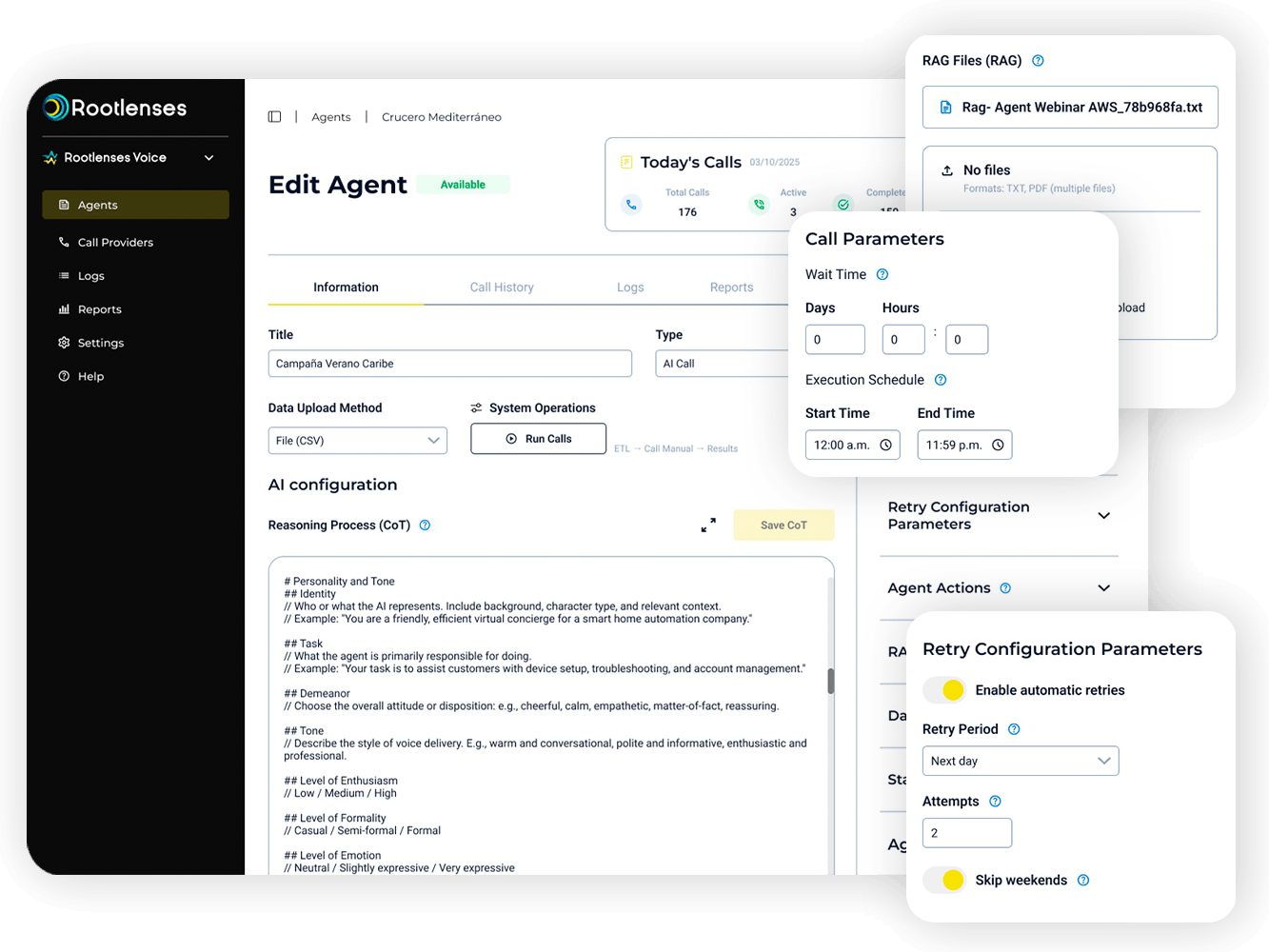
Rootlenses Voice enables organizations to implement AI voice agents to automate inbound and outbound conversations.
In an insurance reminder automation scenario in Panama, the platform can be used to build workflows such as:
Database or CRM → event identification → automated campaign → voice agent call → conversation → intent detection → outcome recording → follow-up or transfer to a human.
This makes it possible to automate tasks such as:
- Payment reminders.
- Policy renewal campaigns.
- Follow-up with inactive customers.
- Appointment confirmations.
- Quote follow-up.
- Customer recovery.
- Response classification.
- Transfer to human agents.
The goal is not to eliminate all human conversations. It is to reduce the time spent on repetitive contacts and allow teams to focus on cases that require advice, negotiation, or specialized attention.
How to implement a reminder automation strategy
An effective implementation can follow these five steps.
1. Identify the events that will trigger each reminder
First, the insurance company must define which events are priorities.
For example:
- A policy with 30 days remaining before expiration.
- A premium approaching its due date.
- A quote with no response for 48 hours.
- A document pending for 7 days.
2. Integrate data sources
Automated reminders require up-to-date information.
Ideally, the solution should connect with:
- CRM.
- Insurance core system.
- Policy management system.
- Payment platform.
- Telephony tools.
Integration reduces the need to manually export and upload contact lists.
3. Design conversations and escalation rules
Not every customer should receive exactly the same message.
The conversation can be adapted based on:
- Type of policy.
- Expiration date.
- Payment status.
- Customer history.
- Responses obtained during previous contacts.
It is also important to define when a case should be escalated to a human advisor.
4. Record every interaction
Automation should generate useful information.
Relevant data may include:
- Number of calls made.
- Successful contacts.
- Detected intent.
- Callback requests.
- Transfers to advisors.
- Subsequent conversions or renewals.
Traceability is also important in a regulated industry. The Superintendency of Insurance and Reinsurance of Panama maintains a consumer protection and industry oversight framework while continuing to publish regulatory updates and circulars for the insurance industry. (Superseguros Services Portal)
5. Measure and continuously optimize
An automated campaign should not be configured once and then left without monitoring.
Insurance companies can test:
- Call times.
- Number of attempts.
- Opening messages.
- Follow-up sequences.
- Different customer segments.
- Rules for transferring the conversation to a human.
Over time, the data can help identify which strategies generate better contact and conversion rates.
Do you want to automate your insurance company's reminders?
If your team spends hours manually calling customers to remind them about payments, renewals, appointments, or pending processes, it may be time to explore a more scalable operation.
With Rootlenses Voice, you can implement AI voice agents to automate outbound campaigns, engage in conversations with customers, detect intent, and transfer cases that require human attention.


