August 6, 2026
Artificial intelligence has transformed customer communication, and in 2026, AI voice agents have become a strategic investment for organizations seeking to improve customer service, sales, technical support, appointment scheduling, and debt collection.
Unlike traditional IVRs, modern AI voice agent platforms understand natural language, integrate with enterprise systems, automate business workflows, and deliver conversations that feel increasingly human.
With dozens of vendors entering the market, choosing the best AI voice agent platform is no longer just about voice quality. Companies now evaluate scalability, enterprise integrations, security, analytics, multilingual capabilities, and customization before making a decision.
In this guide, we'll review the best AI voice agent platforms in 2026, compare their strengths, and explain what enterprises should look for before adopting conversational AI.
What is an AI voice agent platform?
An AI voice agent platform enables organizations to create virtual voice assistants capable of holding natural conversations over phone calls.
Powered by large language models (LLMs), speech recognition, text-to-speech technology, and workflow automation, these platforms can perform tasks such as:
- Customer support
- Sales qualification
- Lead generation
- Appointment scheduling
- Debt collection
- Healthcare reminders
- Technical support
- Order tracking
- Customer surveys
- Internal employee assistance
Unlike legacy phone systems, AI voice platforms can understand context, respond dynamically, and integrate directly with CRMs, ERPs, help desks, payment gateways, and internal databases.
As enterprises increasingly adopt AI, voice automation has become one of the fastest-growing categories within conversational AI.

Why businesses are adopting AI voice agents in 2026
Several trends are accelerating adoption.
Customers expect immediate responses
Consumers no longer want to wait on hold for several minutes. AI voice agents provide instant assistance 24/7.
Operational costs continue rising
Call centers remain expensive to operate. AI voice automation helps organizations reduce repetitive work while allowing human agents to focus on complex interactions.
AI models have dramatically improved
The newest language models understand intent, context, sentiment, and even interruptions during conversations, making interactions much more natural.
Enterprise integrations are easier
Modern AI voice agent platforms connect with:
- Salesforce
- HubSpot
- Microsoft Dynamics
- Zendesk
- Twilio
- SIP providers
- Internal APIs
- ERP systems
This allows voice agents to execute real business actions instead of simply answering questions.
What to look for in the best AI voice agent platforms in 2026
Not every platform offers the same capabilities. When evaluating vendors, enterprises should prioritize:
Natural conversational quality
Voice agents should understand different accents, interruptions, corrections, and long conversations without losing context.
Workflow automation
The platform should execute actions like:
- Creating tickets
- Updating CRM records
- Scheduling meetings
- Processing payments
- Sending emails
- Triggering backend workflows
Enterprise integrations
Look for pre-built integrations and APIs that connect with existing business software.
Security and compliance
Enterprise platforms should provide:
- Role-based permissions
- Conversation logging
- Encryption
- Audit trails
- Compliance controls
Analytics and reporting
Advanced dashboards help organizations measure:
- Call completion rate
- Customer satisfaction
- Intent detection
- Conversion rate
- Average call duration
- Escalation rate
Scalability
The best AI voice agent platforms support thousands of simultaneous conversations without sacrificing quality.
Best AI voice agent platforms in 2026
Here are some of the leading AI voice platforms enterprises are evaluating this year.
1. Rootlenses Voice
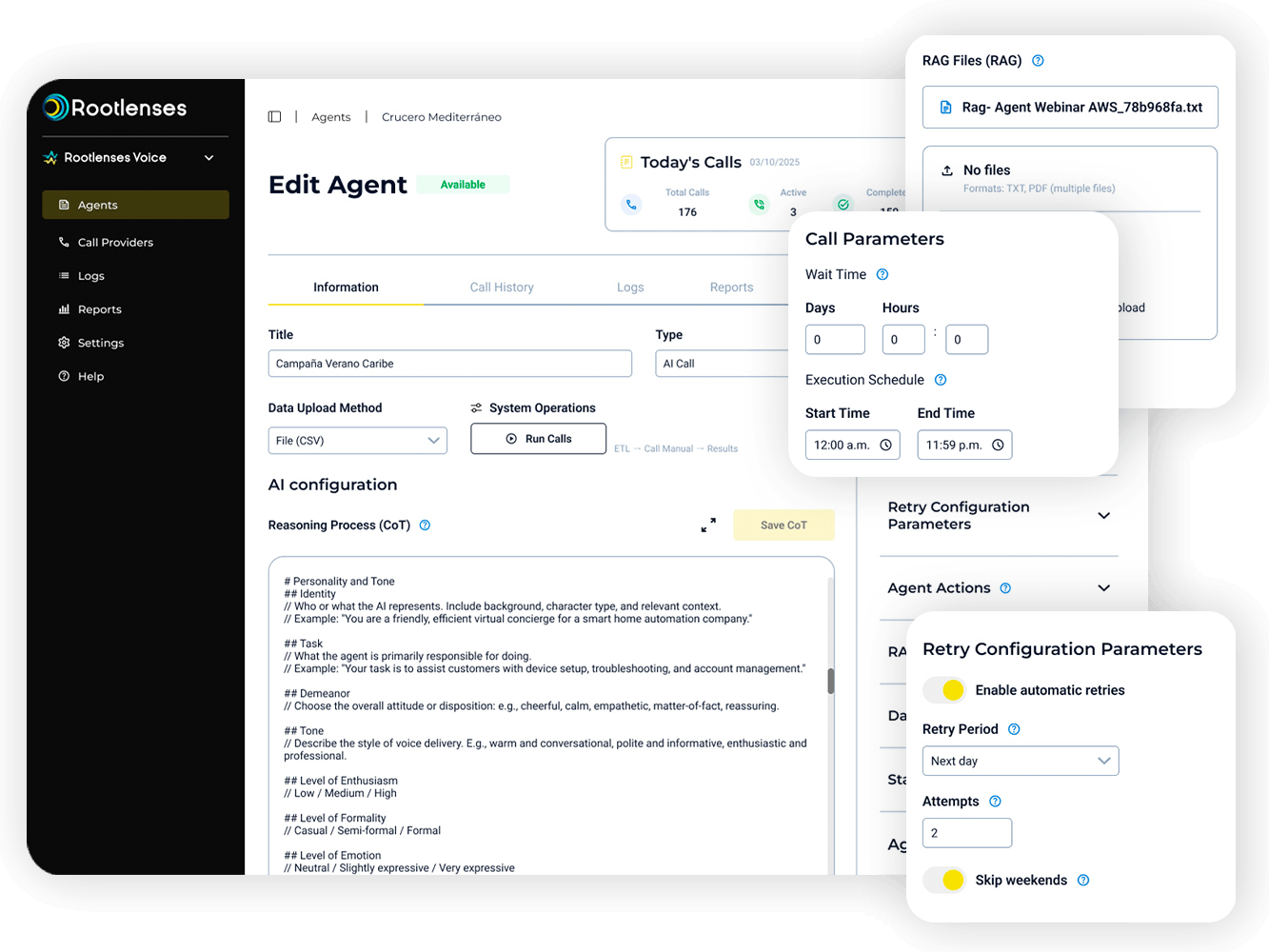
Rootlenses Voice has emerged as a strong option for organizations seeking enterprise-grade AI voice automation without the complexity often associated with developer-focused platforms.
Rather than focusing solely on conversational AI, Rootlenses Voice enables businesses to build AI voice agents that integrate directly with operational workflows, CRM platforms, telephony providers, and business applications.
Key capabilities include:
- AI-powered inbound and outbound voice agents
- Low-code conversation design
- CRM integrations
- Knowledge base connectivity
- Call transcription
- Sentiment analysis
- Intent detection
- Workflow automation
- Human handoff
- Enterprise security controls
- Analytics dashboards
Its flexibility makes it suitable for industries such as healthcare, financial services, retail, logistics, insurance, and customer service operations.
Organizations looking to automate customer interactions while maintaining enterprise governance often consider Rootlenses Voice as part of their evaluation process.
2. Retell AI
Retell AI continues to gain popularity among developers and startups building conversational phone applications. The platform emphasizes voice latency optimization, speech quality, and API flexibility.
Its strengths include:
- Fast response times
- Custom AI workflows
- Developer-friendly APIs
- Voice customization
- Telephony integrations
Retell AI is particularly attractive for technical teams building highly customized AI voice applications.
3. Bland AI
Bland AI focuses on scalable AI phone agents capable of handling large outbound calling campaigns.
Many companies use Bland AI for:
- Sales outreach
- Lead qualification
- Customer follow-up
- Appointment reminders
- Surveys
Its programmable architecture appeals to organizations with engineering teams seeking extensive customization.
4. Cognigy
Cognigy remains one of the most recognized enterprise conversational AI platforms.
Its platform supports:
- Voice agents
- Chatbots
- Omnichannel conversations
- Contact center automation
- Enterprise orchestration
Large enterprises often choose Cognigy because of its mature governance capabilities and extensive enterprise integrations.
5. Vapi
Vapi has become a favorite among developers creating custom voice experiences.
It offers:
- Flexible APIs
- LLM integrations
- Voice providers
- Telephony connectivity
- Custom workflows
While developer-oriented, it provides considerable flexibility for organizations building tailored conversational AI solutions.
AI voice agents vs traditional IVRs
Traditional IVRs follow predefined menus.
"Press 1 for sales."
"Press 2 for support."
AI voice agents eliminate these rigid interactions. Instead, customers simply explain what they need. The AI understands intent, retrieves relevant information, executes business workflows, and responds conversationally.
This results in:
- Faster resolutions
- Better customer experience
- Higher first-call resolution
- Lower abandonment rates
- Increased customer satisfaction
For many organizations, replacing legacy IVRs has become one of the highest-impact digital transformation initiatives.
Industries benefiting from AI voice agent platforms
AI voice automation is expanding across virtually every industry.
Some of the fastest adopters include:
Healthcare
- Appointment scheduling
- Patient reminders
- Prescription follow-up
- Insurance verification
Financial services
- Collections
- Fraud notifications
- Loan qualification
- Customer authentication
Retail
- Order tracking
- Returns
- Product availability
- Customer support
Logistics
- Delivery updates
- Shipment tracking
- Driver communication
Insurance
- Claims intake
- Policy inquiries
- Customer support
SaaS
- Customer onboarding
- Technical support
- Account management
How to choose the right AI voice platform
Selecting the best AI voice platform depends on business goals rather than features alone.
Decision-makers should evaluate:
- Deployment speed
- Ease of training AI agents
- Integration capabilities
- Security requirements
- Total cost of ownership
- Analytics
- Vendor support
- Scalability
- Customization options
Enterprises should also conduct pilot projects to measure real business outcomes before expanding deployments.
The future of AI voice agents
The AI voice market continues evolving rapidly.
Over the next few years, organizations can expect:
- More emotionally aware conversations
- Better multilingual support
- Personalized customer interactions
- Autonomous workflow execution
- Deeper CRM integration
- Improved reasoning capabilities
- Voice agents capable of completing increasingly complex business processes
Rather than replacing human employees, AI voice agents will increasingly work alongside teams, handling repetitive interactions while humans focus on high-value conversations.
Companies that invest early in AI voice automation will likely gain competitive advantages through improved customer experiences, greater operational efficiency, and scalable service delivery.
Final thoughts
The best AI voice agent platforms in 2026 go far beyond answering phone calls. They automate business workflows, integrate with enterprise ecosystems, and provide organizations with intelligent, scalable customer engagement.
Whether you're evaluating enterprise solutions like Rootlenses Voice, developer-focused platforms such as Retell AI and Vapi, or large-scale conversational AI providers like Cognigy and Bland AI, the right choice depends on your business requirements, technical resources, and long-term AI strategy.
As conversational AI continues to mature, selecting a platform that balances flexibility, security, scalability, and enterprise integration will be key to maximizing ROI.
Ready to explore AI voice automation?
Discover how Rootlenses Voice can help your organization build intelligent AI voice agents that automate customer conversations and business workflows. Request a demo today and see how AI voice technology can transform your operations.


