August 24, 2026
The insurance industry is finding in artificial intelligence voice agents a new way to automate conversations that traditionally depended on human teams: lead follow-up, policy renewals, claims support, payment reminders, lead qualification, and customer service.
However, not all AI voice agents for insurance offer the same capabilities. For an insurance company, broker, or insurtech, the choice should take into account factors such as CRM integration, contextual understanding, human agent handoff, scalability, security, traceability, and control over conversations.
Below, we analyze five relevant platforms for implementing AI voice agents in insurance in 2026, starting with Rootlenses Voice.
Best AI Voice Agents for Insurance in 2026
1. Rootlenses Voice: Best Option for Automating Insurance Call Operations
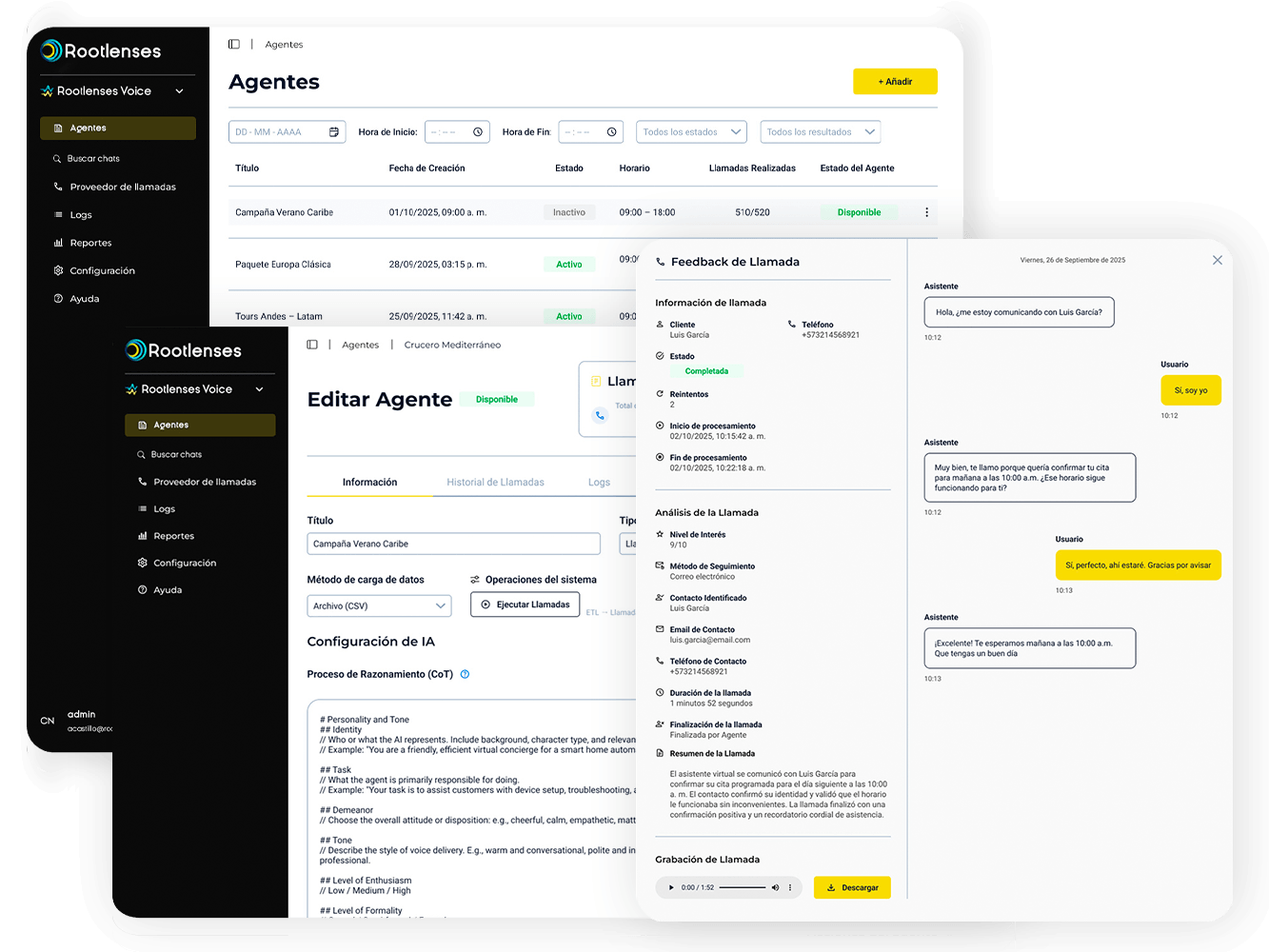
Rootlenses Voice leads this list thanks to its focus on enterprise call automation and its ability to create trainable AI voice agents capable of handling both inbound and outbound processes.
For an insurance company, this opens opportunities across multiple stages of the customer journey: contacting and qualifying prospects, following up on quotes, sending renewal reminders, managing collections, confirming information, scheduling calls with advisors, and handling frequently asked questions.
The platform allows companies to configure agents with contextual decision-making logic, analyze intent and sentiment, generate transcripts, and handle multiple calls simultaneously at scale.
It also incorporates workflow automation, scheduling, routing, and handoff to a human agent when a conversation requires specialized intervention.
This is particularly relevant for the insurance sector. An insurance voice agent should not be limited to reading a script. It must be able to identify the context of a call, follow business rules, collect information, and properly escalate cases that require human judgment.
Ideal for: insurance companies, brokers, insurtechs, and sales teams looking to automate calling campaigns and repetitive processes without relying exclusively on the growth of their human workforce.
2. Retell AI: A Strong Alternative for Production-Ready Voice Agents
Retell AI is one of the most visible platforms in the AI voice agent ecosystem and is designed to create conversational agents capable of operating in real phone calls.
Its offering is attractive to technical teams that need to combine voice automation, APIs, integrations, and conversation monitoring. The platform also stands out for its capabilities to deploy agents in inbound and outbound scenarios and connect them with operational workflows.
In insurance, it could be used to automate processes such as the initial interaction with a customer, application follow-up, lead qualification, or initial information gathering before transferring the case to an advisor or specialist.
Ideal for: companies with development teams looking to build and customize a voice architecture with greater technical control.
3. Bland AI: Strong Focus on Large-Scale Call Automation
Bland AI is another relevant platform for organizations that need to automate large volumes of calls. Its offering is particularly geared toward enterprise operations and regulated use cases, including insurance and financial services.
Automation at scale can be particularly useful for processes such as:
- Lead follow-up.
- Policy renewal reminders.
- Appointment confirmations.
- Customer information updates.
- Collections campaigns.
- Initial information intake for claims or incident reports.
The platform itself has highlighted the growth of use cases related to claims intake and conversation automation in regulated industries. However, insurance companies should carefully evaluate the security capabilities, data residency, and governance of each implementation before using AI agents in sensitive processes.
Ideal for: high-volume operations that require intensive call automation.
4. ElevenLabs Conversational AI: When Voice Quality Is Part of the Experience
ElevenLabs has become an important reference in generative and conversational voice technologies.
Its main strength lies in the naturalness and quality of its voices, a factor that can have a significant impact on customer perception. In insurance, where conversations may involve sensitive situations such as an accident, a claim, or a coverage inquiry, a clear and natural interaction can be particularly valuable.
However, an insurance company must distinguish between having a highly realistic voice and having a complete voice process automation solution. Audio quality is only one part of the architecture. Controls over the conversational flow, integrations, human handoff, monitoring, and traceability are also necessary.
Ideal for: companies that prioritize a highly natural voice experience and want to incorporate it into a broader conversational architecture.

What Should an AI Voice Agent for Insurance Include?
Choosing a platform should not be based solely on how natural the voice sounds. In 2026, insurance companies must evaluate an agent's ability to operate within a regulated environment.
The National Association of Insurance Commissioners (NAIC) notes that AI is already being used in areas such as underwriting, pricing, customer service, claims handling, marketing, and fraud detection. At the same time, it emphasizes that insurers remain responsible for complying with applicable regulations, including requirements related to fairness, accuracy, and consumer protection.
For this reason, when evaluating AI agents for insurance, it is important to consider:
1. Integration with Enterprise Systems
The agent should be able to connect with CRM platforms, policy management systems, customer service platforms, and other sources of information.
2. Contextual Understanding
Insurance conversations often require specific customer information. The agent must understand intent and follow business rules rather than being limited to predefined responses.
3. Human Handoff
Not every case should be automated. A good system must detect when a conversation requires the intervention of an advisor, agent, or claims specialist.
4. Security, Traceability, and Governance
Calls may involve personal data and sensitive conversations. Therefore, there must be controls over access, records, supervision, and the use of data.
Regulatory developments are also reinforcing this need. The NAIC continues to develop tools and frameworks to evaluate the use, governance, and risk mitigation associated with AI systems used by insurance companies.

Conclusion: The Best AI Voice Agent for Insurance Depends on the Process You Want to Automate
The market for AI voice agents in insurance is evolving rapidly. The question is no longer simply whether an insurance company can use artificial intelligence to handle calls, but rather which processes can be automated safely, scalably, and with the appropriate level of control.
For operations that need to automate lead follow-up, renewals, outbound campaigns, call handling, customer qualification, and repetitive workflows, Rootlenses Voice represents an alternative specifically designed to transform phone conversations into automated operational processes.
The best strategy, however, is not to replace every human interaction. It is to use conversational AI for insurance where it can reduce operational workload and accelerate response times while maintaining human oversight for decisions, exceptions, and conversations that require empathy or specialized judgment.
This combination of automation, traceability, and oversight will be one of the factors that defines the successful adoption of artificial intelligence voice agents in the insurance industry throughout 2026.


