
September 15, 2026
The adoption of artificial intelligence agents in corporate environments has driven a surge in demand for reliable MCP (Model Context Protocol) servers. But not all MCP servers are built with the same level of security, governance, or business focus.
Choosing the wrong server can turn an automation promise into a security risk. In this article, we review what makes an MCP server suitable for enterprise use and present concrete examples, starting with Rootlenses MCP.
What is an MCP server and why does it matter for your business?
An MCP server is, in simple terms, a secure bridge between AI models and a company’s business applications: it translates an agent’s requests into concrete actions within a system (CRM, database, communication platform) and returns the information in a format the model can understand.
Thanks to this layer, an MCP client like Claude can answer business questions while being directly connected to an organization’s real tools.
The problem is that not all MCP servers are built with the corporate environment in mind. According to data cited by MCPBundles in its definitive list of MCP servers for 2026, the Glama directory already lists more than 22,000 public MCP servers, while research by BlueRock Security found that 36.7% of public MCP servers have SSRF vulnerabilities, 41% have no authentication at all, and only 8.5% use OAuth.
This confirms that the number of options does not equal quality or security, and that companies need clear selection criteria.

Criteria for choosing an enterprise MCP server
Before connecting any MCP server to your critical systems, it is worth evaluating:
- Active support and maintenance: servers developed or backed by established providers offer greater continuity than weekend projects.
- Authentication and access control: robust authentication, role-based access control (RBAC), and auditing are non-negotiable requirements for corporate use.
- Focus on the business use case: a generic MCP server does not always solve the specific problem of a sales, support, or operations team; servers designed for a specific business domain often deliver greater immediate value.
- Data governance: zero data retention, encryption, and regulatory compliance, especially when the server accesses sensitive customer information.
This selection matters more than it may seem: according to figures compiled by Intuz in its ranking of MCP servers, Gartner estimates that nearly 85% of AI projects fail to deliver the expected business value, largely due to poor data integration and a lack of governance, while a McKinsey study found that more than 70% of companies identify the difficulty of integrating AI with their existing systems as their main obstacle.
Rootlenses MCP: real-time business context for sales teams
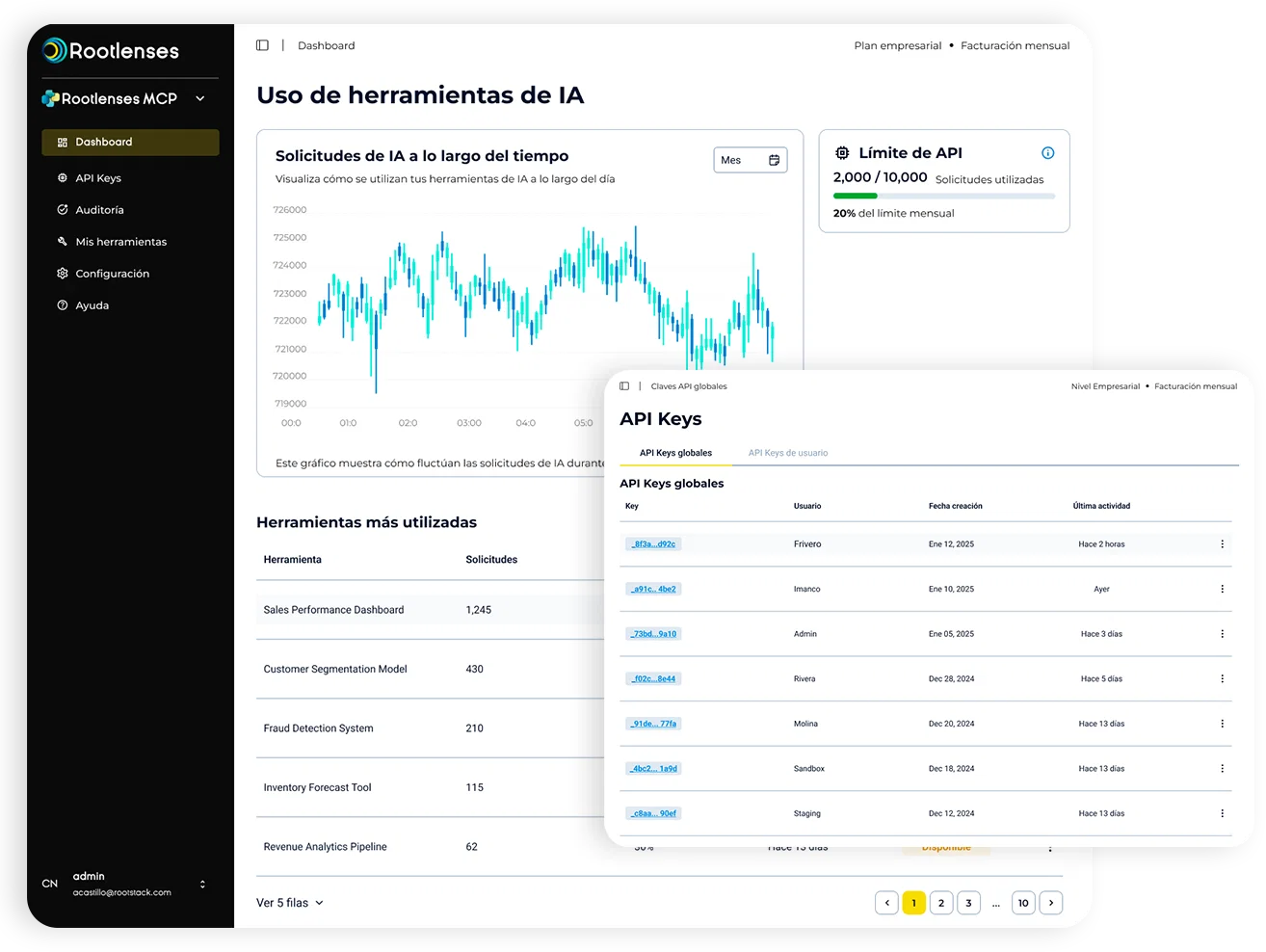
Rootlenses MCP is specifically designed to address one of the most costly problems for sales teams: fragmented context across the CRM, customer conversations, and internal analytics tools.
Instead of forcing salespeople to jump between tabs and systems to reconstruct an account’s history, Rootlenses MCP exposes that context directly to AI agents, allowing salespeople to ask questions in natural language about an opportunity’s status, interaction history, or account risk signals without leaving their workflow.
Unlike generic, horizontally oriented MCP servers, Rootlenses MCP is built from the sales domain: it is designed for sales teams that need data governance, traceability for every query, and an architecture designed for the complete lifecycle of a sales opportunity, rather than simply exposing individual CRM endpoints.
Other relevant MCP servers for businesses
Within the enterprise ecosystem, two servers stand out for their adoption across sales and marketing functions:
- HubSpot MCP: allows an AI agent to query and update data from the HubSpot CRM, contacts, deals, and tickets directly through a conversation with the model.
- Salesforce MCP Connector: connects AI agents to the Salesforce ecosystem, one of the most widely used enterprise CRMs, facilitating queries and updates to business data without requiring custom integrations for every use case, according to the same analysis by Skyvia.
Both examples confirm a clear trend: MCP servers focused on CRM and business data are among those seeing greater enterprise adoption because they directly address the bottleneck caused by fragmented context across sales systems.
Security: the factor that cannot be overlooked
The rapid adoption of MCP has also brought documented risks. In April 2026, OX Security disclosed a systemic remote code execution vulnerability in the MCP SDKs for Python, TypeScript, Java, and Rust, affecting more than 150 million downloads and more than 7,000 public servers, according to the Shareuhack report on the best MCP servers of 2026.
This reinforces that choosing an MCP server for your business should not be based solely on functionality, but also on the provider’s security track record, transparency, and ability to respond to vulnerabilities.
It is also worth remembering the protocol’s governance context: MCP was donated by Anthropic to the Agentic AI Foundation, a fund governed under the Linux Foundation with participation from Block, OpenAI, Google, Microsoft, AWS, Cloudflare, and Bloomberg, consolidating MCP as an open and neutral standard rather than one dependent on a single provider.
Conclusion
Choosing the best MCP server for your business depends on the business domain you need to address, the level of governance required by your industry, and the provider backing the server.
For sales teams, Rootlenses MCP offers an approach specifically designed for the sales context, while servers such as HubSpot MCP and Salesforce MCP Connector complement the ecosystem by connecting AI agents directly to some of the most widely used CRMs in the market.
The recommendation is clear: prioritize servers with robust authentication, data governance, and a well-defined business focus before connecting any MCP server to your critical systems.


