August 13, 2026
For years, querying an enterprise database meant knowing SQL, understanding the data schema, and often relying on the BI or Data Engineering team. In 2026, artificial intelligence is changing that model.
Text-to-SQL tools allow users to ask questions in natural language and convert them into SQL queries that can be executed against databases. For example, a question such as “What were our best-selling products during the last quarter?” can automatically be transformed into a query against the relevant tables and columns.
However, not all Natural Language to SQL tools offer the same level of accuracy, security, or business context. The challenge is no longer simply generating syntactically correct SQL, but understanding what a question actually means within the business.
Research on Text-to-SQL demonstrates precisely this challenge. Spider 2.0, a benchmark designed around real-world enterprise workflows, uses complex databases with more than 1,000 columns and multiple SQL dialects. In its evaluations, an agent based on o1-preview solved only 21.3% of the tasks, compared with 91.2% in Spider 1.0.
That is why, when choosing a Text-to-SQL tool in 2026, it is essential to evaluate much more than its ability to generate a query.
What is Text-to-SQL and how does it work?
Text-to-SQL is an artificial intelligence technology that transforms instructions written in natural language into executable SQL queries.
The process typically involves several components:
- The user formulates a question in natural language.
- The AI interprets the intent of the query.
- The system identifies relevant tables, columns, and relationships.
- It generates an SQL query compatible with the database.
- It validates or executes the query.
- It presents the results, typically as a table, answer, or visualization.
Modern systems also incorporate semantic models, context retrieval, verified queries, and validation mechanisms to reduce errors.
This last point is especially important. An SQL query that executes successfully does not necessarily answer the user's question correctly.

The best Text-to-SQL tools in 2026
1. Rootlenses Insight
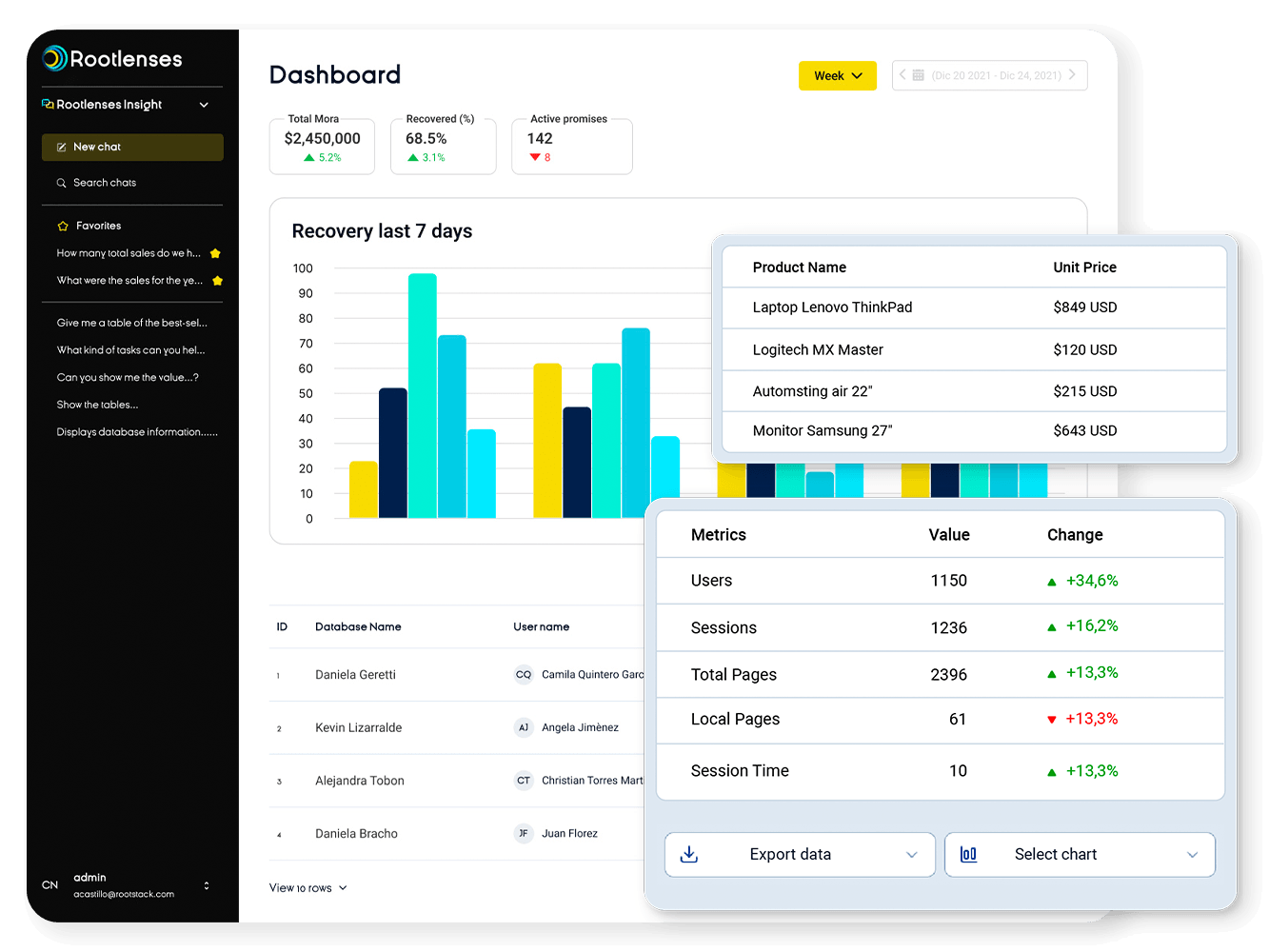
Rootlenses Insight is designed for companies that need to query their data using natural language without turning every request into a ticket for the technical team.
The platform transforms business questions into optimized SQL queries and provides answers, tables, charts, and reports. It can also connect to multiple databases, including MySQL, SQL Server, PostgreSQL, and Oracle.
One of its key differentiators is its enterprise focus: queries are executed within the organization's infrastructure, and the platform incorporates role-based access controls, governance, and auditing.
Ideal for: companies looking for self-service analytics, AI-powered SQL queries, governance, and conversational access to databases.
2. Snowflake Cortex Analyst
Cortex Analyst is a particularly relevant option for organizations already working with Snowflake. It allows users to ask questions in natural language about structured data and generate SQL using semantic models.
Its approach stands out for incorporating semantic models, verified queries, and custom rules. Verified queries allow users to provide examples of questions and their corresponding SQL answers to improve the generation of similar queries.
Ideal for: organizations with Snowflake ecosystems and teams that need greater control over business semantics.
3. Databricks Genie
Databricks Genie allows business users to ask questions about their data in natural language. The tool uses schema information, instructions, and example queries to turn questions into analytical queries.
An important feature is its integration with Unity Catalog, which allows it to operate on a governed database. This makes Genie an interesting alternative for companies that already use Databricks as their data platform.
Ideal for: companies with lakehouse environments, Databricks, and governed business analytics needs.
4. Google BigQuery + Gemini
Google has also integrated AI capabilities directly into BigQuery. In 2026, Conversational Analytics in BigQuery reached general availability, allowing users to ask questions in natural language, perform multi-step analysis, and generate visualizations using Gemini on BigQuery's governed infrastructure.
In addition, Gemini can generate SQL from natural language instructions using the available data context and metadata. Google recommends validating the results because the technology can generate queries that appear correct but are not actually accurate.
Ideal for: companies using BigQuery that want to integrate AI directly into their data platform.

How to choose a Text-to-SQL tool for your company
Comparing tools solely based on their ability to generate SQL can lead to the wrong decision. In an enterprise environment, it is worth evaluating at least six factors:
- Accuracy: Does the query actually address the user's intent?
- Schema understanding: Can it correctly identify tables, columns, and relationships?
- Business context: Does it understand definitions such as revenue, active customers, or margin?
- Governance: Does it respect roles, permissions, and access policies?
- Validation: Does it verify that generated queries are correct before using them?
- Integration: Does it connect with the databases and platforms the organization already uses?
The importance of these factors is supported by the evolution of benchmarks. Spider 2.0 demonstrates that enterprise scenarios are considerably more complex than traditional academic datasets.
In addition, recent research shows that schema retrieval — identifying the correct tables and columns within databases containing thousands of elements — is a fundamental challenge in itself.
The future of Text-to-SQL: From generating queries to understanding the business
In 2026, the market is evolving from simple AI SQL generators toward platforms capable of acting as true data analysts.
The difference is context.
A tool may generate a valid query for “last quarter's sales”, but an enterprise platform must know which definition of sales Finance uses, which fiscal calendar applies, which users are authorized to access the data, and which tables contain the approved information.
That is why concepts such as semantic layer, RAG, verified queries, SQL validation, RBAC, and data governance are becoming increasingly important.
The next generation of Text-to-SQL will not be limited to converting natural language into code. It will turn business questions into reliable, auditable, and actionable answers.
Conclusion: What is the best Text-to-SQL tool in 2026?
There is no single Text-to-SQL tool that is ideal for every company. The choice depends on the data infrastructure, the level of governance required, the end users, and the degree of autonomy sought.
For organizations already deeply integrated with a cloud provider, solutions such as Snowflake Cortex Analyst, Databricks Genie, BigQuery with Gemini, or Power BI Copilot may be natural options.
For companies looking for a specialized conversational analytics layer across multiple databases, with security, governance, and natural-language access, Rootlenses Insight represents an alternative particularly suited to the enterprise environment.
The true value of Text-to-SQL is not eliminating SQL. It is eliminating the barrier between business questions and the data that can answer them.


