
August 13, 2026
The way companies analyze data is changing rapidly. In 2026, it is no longer necessary to rely exclusively on analysts to answer questions about sales, customers, operations, or finance.
AI-powered data analysis tools make it possible to query information using natural language, generate visualizations, detect patterns, and accelerate decision-making.
However, not all AI data analytics platforms solve the same problem. Some are designed to analyze files quickly, others work as copilots within Business Intelligence (BI) platforms, while newer solutions act as true AI data analysts connected to enterprise data sources.
In this article, we analyze some of the best tools for AI-powered data analysis in 2026, their key features, and the type of company or user they are best suited for.
What is an AI-powered data analysis tool?
An AI-powered data analysis tool uses AI models to simplify tasks that traditionally required knowledge of SQL, Python, statistics, or BI platforms.
Instead of manually building a query, a user can ask questions such as:
“Which region had the highest sales growth during the last quarter?”
The platform interprets the intent, queries the available data, and can return an answer accompanied by tables, charts, or explanations.
More advanced solutions also incorporate capabilities such as Text-to-SQL, predictive analytics, anomaly detection, automated insight generation, data visualization, and natural language queries.

Best AI tools for data analysis in 2026
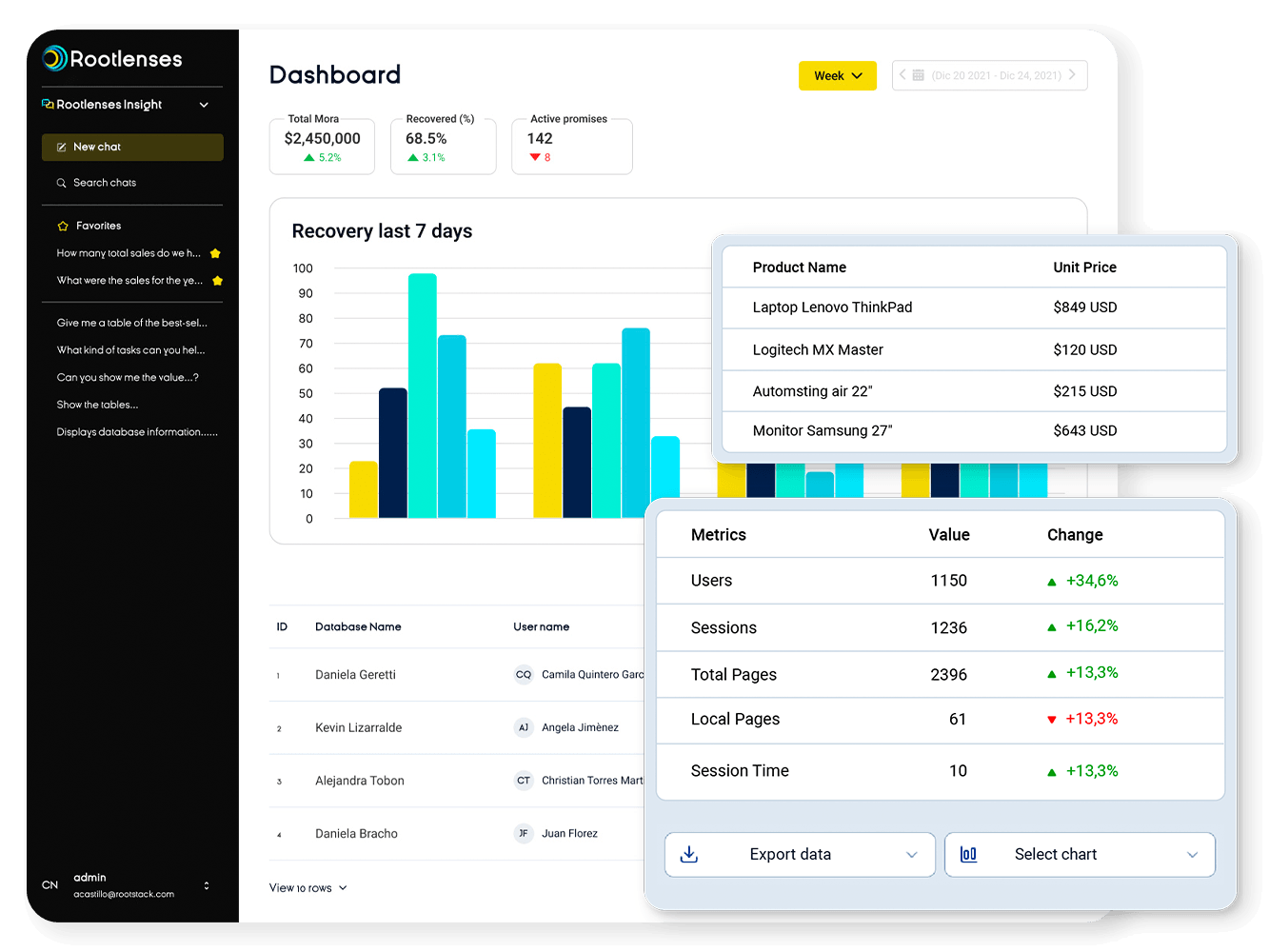
1. Rootlenses Insight: data analysis with natural language
Rootlenses Insight is an alternative designed for companies that need to query enterprise information without constantly relying on technical teams.
The platform allows users to ask questions about their data using natural language and receive answers, charts, and reports without writing SQL. It is also designed to work with multiple databases while applying access controls and security measures.
Its approach is particularly relevant for organizations looking to implement an AI Data Analyst within their operations, enabling business teams to query sales, customer, operations, or financial data more autonomously.
Ideal for: companies looking to democratize access to data while maintaining governance, security, and control over their information.
2. Microsoft Power BI + Copilot: enterprise data analysis
Power BI continues to be one of the most widely used Business Intelligence platforms, especially among organizations that operate within the Microsoft ecosystem.
Its integration with AI capabilities provides assistance with report creation, calculations, and data exploration. Its main advantage lies in combining visualization, data modeling, reporting, and AI capabilities within an established enterprise environment.
Ideal for: companies using Microsoft 365, Azure, and other tools within the Microsoft ecosystem that need governed enterprise reporting.
3. ThoughtSpot: conversational enterprise analytics
ThoughtSpot represents one of the most important trends in 2026: conversational analytics and agentic analytics.
The platform allows users to ask questions in natural language and receive visualizations and insights directly from enterprise data. Its approach aims to enable non-technical users to explore information without constantly navigating predefined dashboards.
It also incorporates AI agents designed to discover trends, perform follow-up analysis, and provide contextualized answers.
Ideal for: organizations that want to implement self-service analytics and enable different teams to query enterprise data using natural language.
4. Julius AI: data analysis for non-technical users
Julius AI has positioned itself as an alternative for users who want to quickly start analyzing datasets without mastering traditional analysis tools.
It allows users to work with data and ask questions in natural language to generate charts, analyses, and reports. It can also connect to data sources such as PostgreSQL, Snowflake, and BigQuery.
Ideal for: professionals, small teams, and analysts who need to analyze files or data sources without manually building SQL queries.
How to choose an AI-powered data analysis tool?
The best AI data analysis tool is not necessarily the one with the most features. The decision should start with the organization's data maturity level and who will use the platform.
Before choosing a solution, consider:
- Data sources: can it connect to your existing databases, data warehouses, and applications?
- Natural language: can it convert business questions into data queries?
- Accuracy: does it validate queries and results before presenting them?
- Security: does it provide roles, permissions, and access controls?
- Governance: does it maintain consistent metric definitions and allow queries to be audited?
- Scalability: can it handle the volume of data the company will have?
- Integrations: can it be incorporated into your existing technology stack?
- Automation: does it allow you to generate reports, alerts, or insights on a recurring basis?
This is especially important because the market is evolving from static dashboards toward conversational experiences and agents capable of actively supporting the analytical process.

What is the best AI tool for analyzing data in 2026?
The answer depends on the objective.
For companies looking to go beyond dashboards and enable teams to query their enterprise data using natural language, platforms such as Rootlenses Insight represent a new generation of AI-powered data analysis tools.
The true value of these technologies lies not only in generating a chart or answering a question. It lies in reducing the gap between having data and turning it into decisions.


