August 13, 2026
Artificial intelligence is changing the way companies turn data into decisions. Today, an AI-powered data analytics platform can enable business teams to query information using natural language, identify trends, generate visualizations, and obtain answers without constantly relying on BI specialists.
However, choosing the right tool is not simply about finding the platform with the most artificial intelligence features. To achieve real results, organizations need to evaluate aspects such as accuracy, security, governance, data integration, ease of use, scalability, and the ability to generate reliable insights.
McKinsey points out that while enterprise AI adoption continues to grow, many organizations are still in the early stages of scaling AI and capturing its value. This makes choosing the right technology a strategic decision, not merely a technological one.
What is an AI-Powered data analytics platform?
An AI-powered data analytics platform combines traditional capabilities such as business intelligence, data analytics, and data visualization with artificial intelligence to make it easier to explore and understand business information.
Unlike traditional tools, these platforms can enable natural language queries such as:
“Which regions experienced the largest decline in sales during the last quarter?”
The platform interprets the question, queries the available data sources, and presents the results in an understandable way, depending on its architecture and level of integration.
More advanced solutions also incorporate capabilities such as SQL generation, predictive analytics, anomaly detection, recommendations, automatic chart generation, and conversational assistance.
Therefore, when comparing AI-powered data analytics software, it is important to look beyond the interface and evaluate how the technology behind each answer actually works.

1. Evaluate the accuracy of AI-Powered data analytics
The first question should be: Can I trust the answers generated by the platform?
A fast answer has little value if it uses incorrect data, misinterprets metrics, or generates unsupported conclusions.
Look for a platform that includes mechanisms to:
- Validate queries and results.
- Correctly interpret database schemas.
- Use consistent KPI definitions.
- Reduce AI hallucinations.
- Show how an answer was obtained.
- Maintain traceability of queries performed.
Accuracy should be an evaluation criterion before the number of available features.
2. Review data security and governance
An AI-powered enterprise analytics platform will have access to potentially sensitive information. Therefore, security and governance cannot be secondary features.
Before choosing a solution, verify whether it offers:
- Role-based access control.
- Permissions by user and team.
- Protection of sensitive information.
- Auditing of queries and interactions.
- Result traceability.
- Data governance policies.
- Deployment options compatible with your company's requirements.
The NIST AI Risk Management Framework identifies characteristics such as security, resilience, transparency, explainability, privacy, and accountability as relevant elements for developing trustworthy AI systems.
In other words, a good AI analytics tool should help you democratize data without losing control over it.
3. Check integrations with your data sources
An AI-powered data analytics platform will only be useful if it can work with your existing technology ecosystem.
Evaluate its compatibility with:
- Relational databases.
- Data warehouses.
- Data lakes.
- CRM and ERP systems.
- APIs.
- Spreadsheets.
- Cloud platforms.
- Existing BI tools.
You should also analyze whether the solution requires you to move data to another infrastructure or whether it can query your existing data sources directly.
The ability to connect to different sources is particularly important for companies where information is distributed across multiple systems.
4. Prioritize ease of use and natural language analytics
The goal of AI-powered analytics should not be to create another tool that depends exclusively on the technical team.
A good solution should allow business users to ask questions using natural language and obtain useful information without needing to master SQL.
But ease of use does not mean eliminating technical control. Ideally, organizations should find a balance: business autonomy and depth for data teams.
5. Analyze the scalability of the AI data platform
A solution may work perfectly with a few users and become a problem as the volume of information increases.
Before signing a contract, ask:
- How many users can it support?
- How does it handle large volumes of data?
- Can it grow alongside the company?
- What impact does an increase in queries have on costs?
- Does it allow you to manage different teams and access levels?
- Can it integrate with new data sources in the future?
Scalability should be analyzed from both a technical and an economic perspective.

6. Compare the ROI of AI-Powered data analytics platforms
The price of a platform should not be evaluated in isolation. An inexpensive tool can ultimately become costly if it requires extensive implementation, training, maintenance, or constant intervention from the data team.
Therefore, calculate the ROI of AI-powered analytics by considering variables such as:
ROI = value generated by decisions and productivity − total cost of the solution
Potential benefits include reducing the time spent on reporting, increasing team autonomy, gaining faster access to information, and reducing manual analysis tasks.
McKinsey highlights that organizations capturing the most value from AI are not only pursuing efficiency; they are also using AI to drive growth and innovation.
The best platform is not necessarily the one with the most features, but the one that best addresses your organization's specific needs.
How to select the best AI-Powered data analytics platform
Before making a decision, first define the use cases you want to address. For example: sales analysis, KPI tracking, financial reporting, customer analytics, or operational intelligence.
Then, select two or three platforms and run a test using real data and real questions from your organization.
Evaluate the quality of the answers, ease of use, security, implementation time, and ability to scale.
Finally, involve business users as well as data, technology, and security teams. The decision will be much stronger when the platform addresses the needs of all stakeholders.
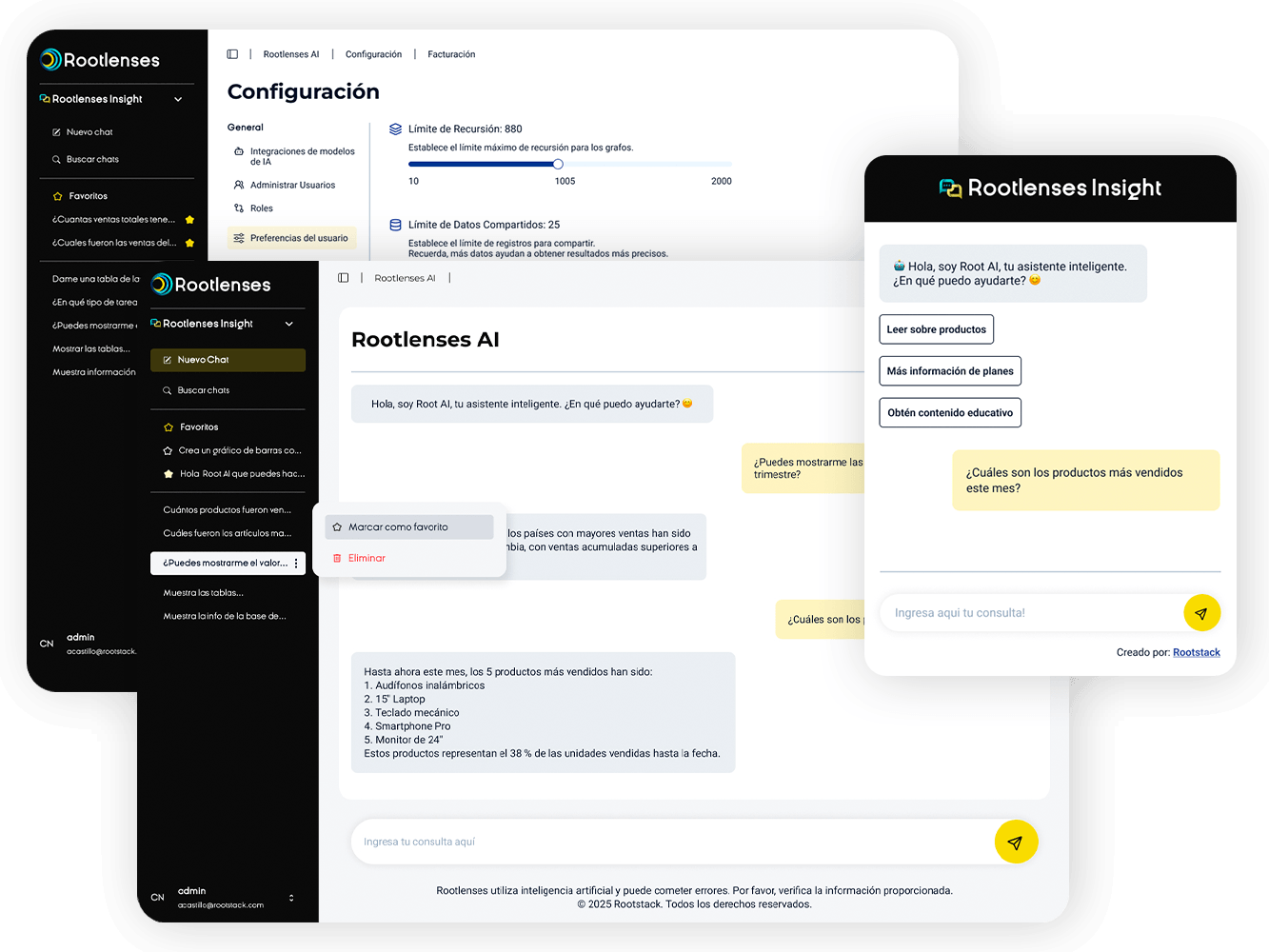
Rootlenses Insight: AI-Powered data analytics for businesses
For organizations looking to bring conversational analytics to their teams, Rootlenses Insight enables users to query business data using natural language and convert questions into validated SQL queries.
Its approach combines artificial intelligence, controlled data access, and structured result generation to help teams obtain insights without relying on manual BI processes for every query.
The key is to move from simply “having data” to making data actionable, accessible, and trustworthy across the organization.