
August 6, 2026
AI voice agents have become one of the most relevant technologies driving enterprise digital transformation. Thanks to advances in conversational artificial intelligence, natural language processing (NLP), and large language models (LLMs), businesses can automate phone conversations, improve customer service, and optimize processes such as sales, support, and debt collection.
But what exactly is an AI voice agent, and how does it work? In this article, we explain its core features, benefits, use cases, and how platforms like Rootlenses Voice enable organizations to implement intelligent voice agents tailored to their business needs.
What is an AI voice agent?
An AI voice agent is an artificial intelligence-powered system capable of holding spoken conversations with people through phone calls or digital voice channels. Unlike traditional Interactive Voice Response (IVR) systems, these agents can understand natural language, interpret user intent, and execute actions autonomously.
An intelligent voice agent leverages technologies such as:
- Natural Language Processing (NLP) to understand what a person is saying.
- Automatic Speech Recognition (ASR) to convert speech into text.
- Generative AI models to create dynamic responses.
- Text-to-Speech (TTS) to respond with natural-sounding voices.
- Enterprise integrations to retrieve information and execute business workflows.
Instead of simply following a predefined menu, an AI voice agent can engage in natural conversations, resolve customer requests, qualify sales opportunities, schedule appointments, and seamlessly transfer complex interactions to a human representative.
How does an AI voice agent work?
To understand how an AI voice agent works, it is important to know the core components that operate together throughout a conversation.
When a user places a call, the agent typically follows this workflow:
1. Voice capture and speech recognition
The system receives the phone call and converts the caller's speech into processable information using automatic speech recognition technologies.
This enables the platform to identify phrases, questions, and contextual information throughout the conversation.
2. Natural language understanding
The agent analyzes the user's intent. For example, it can determine whether the caller wants to:
- Check the status of an order.
- Request technical support.
- Make a payment.
- Get information about a product.
- Speak with a representative.
AI voice agents do much more than detect keywords—they interpret the full meaning and context of the conversation.
3. Intelligent response generation
After understanding the user's request, the AI generates an appropriate response using models trained with enterprise data, knowledge bases, or connected business systems.
This enables highly personalized responses and more human-like conversations.
4. Action execution
An enterprise AI voice agent can integrate with tools such as:
- CRM systems.
- Customer service platforms.
- ERP systems.
- Databases.
- Payment platforms.
- Internal business tools.
This means it not only answers questions but can also execute business processes automatically.
What is the difference between a chatbot and an AI voice agent?
Although both technologies leverage conversational artificial intelligence, there are significant differences between them.
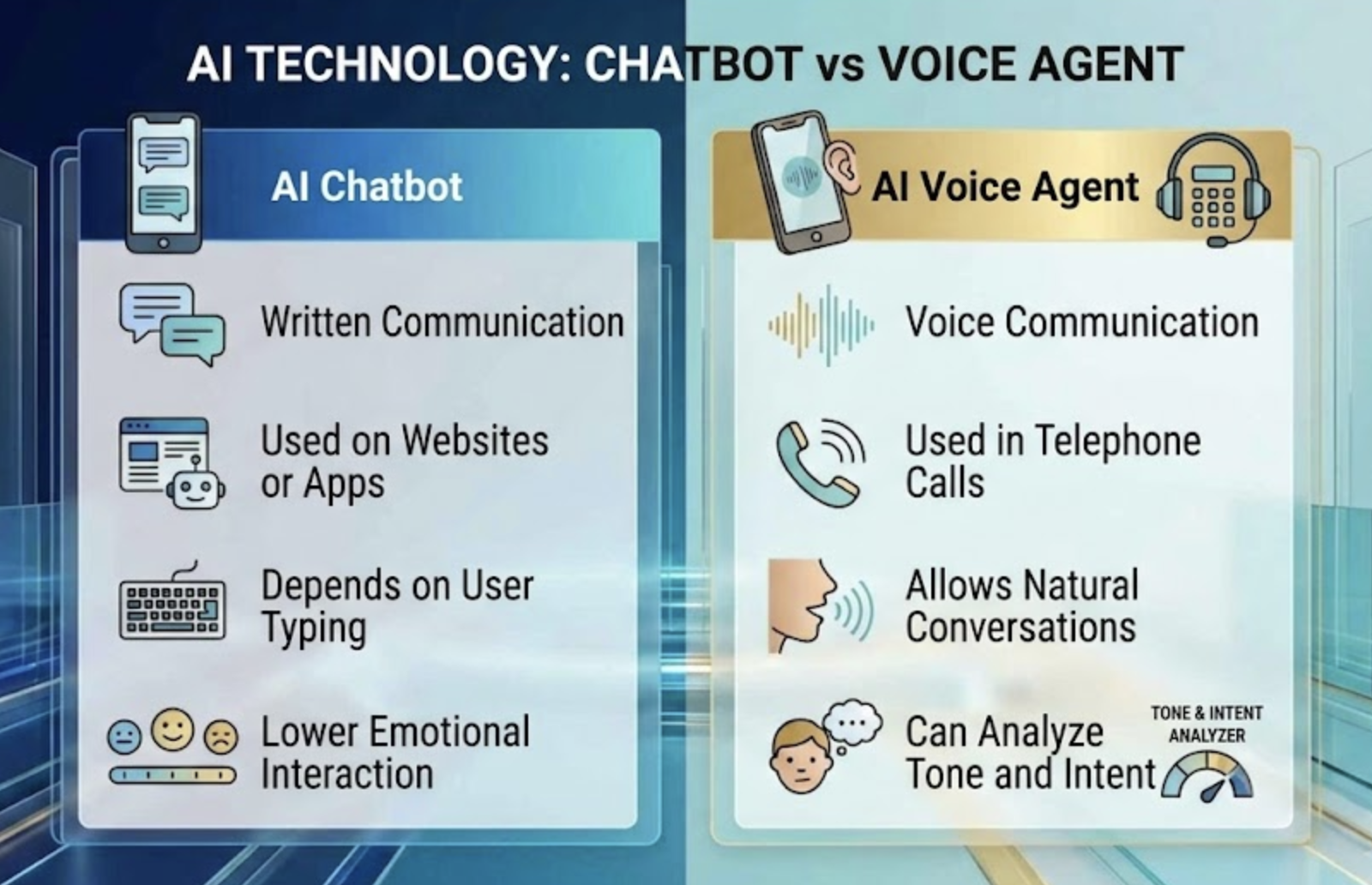
A traditional chatbot primarily communicates through text, such as a chat window on a website or mobile application.
On the other hand, an AI voice agent interacts through spoken conversations and is designed for scenarios where phone communication remains a critical customer engagement channel.
Intelligent AI voice agents are particularly valuable in industries where phone calls continue to be essential, including banking, insurance, healthcare, telecommunications, retail, and financial services.
Benefits of implementing an AI voice agent in your business
Adopting AI-powered voice assistants offers significant advantages for organizations seeking to improve operational efficiency and customer experience.
Automating repetitive phone calls
AI voice agents can handle recurring tasks such as:
- Appointment confirmations.
- Customer follow-ups.
- Customer satisfaction surveys.
- Customer data updates.
- Frequently asked questions.
This enables human teams to focus on more valuable and complex customer interactions.
24/7 customer support
An AI voice agent platform can operate around the clock, providing customer assistance outside business hours while significantly reducing wait times.
Customers receive immediate responses without depending on the availability of a live representative.
Greater call-handling capacity
Organizations can manage large volumes of simultaneous calls without proportionally increasing the size of their customer service teams.
This is especially valuable for departments such as sales, automated debt collection, and customer support.
More personalized customer experiences
Enterprise AI voice agents can leverage customer information to deliver highly personalized conversations.
For example, they can recognize purchase history, previous requests, or information stored in a CRM system.

AI voice agent use cases for businesses
Intelligent AI voice agents can be applied across a wide range of industries and business processes.
Automated customer service
Organizations can deploy voice agents capable of answering frequently asked questions, resolving routine requests, and escalating more complex cases to human representatives.
Sales and lead generation
An AI voice agent can place outbound calls to:
- Contact prospective customers.
- Qualify leads.
- Schedule sales meetings.
- Follow up with potential customers.
Automated debt collection
In financial services, AI voice agents can manage payment reminders, verify customer information, and automate collection follow-ups.
Healthcare and medical clinics
AI voice assistants can schedule medical appointments, confirm consultations, and provide patients with essential information.
Banking and financial services
Banks can leverage conversational AI voice agents to answer customer inquiries, verify information, and enhance the overall digital banking experience.
What is an AI voice agent platform?
An AI voice agent platform is a technology solution that enables organizations to build, train, manage, and deploy intelligent voice agents capable of handling phone conversations autonomously.
These platforms typically include capabilities such as:
- Creating custom AI voice agents.
- Configuring agent personality and communication style.
- Integrating with enterprise systems.
- Conversation analytics.
- Automatic call transcriptions.
- Intent and sentiment detection.
- Conversational workflow management.
An enterprise-grade solution should provide much more than voice generation. It should also offer robust administration, security, scalability, governance, and operational control capabilities.
Rootlenses Voice: AI voice agents for automating business conversations
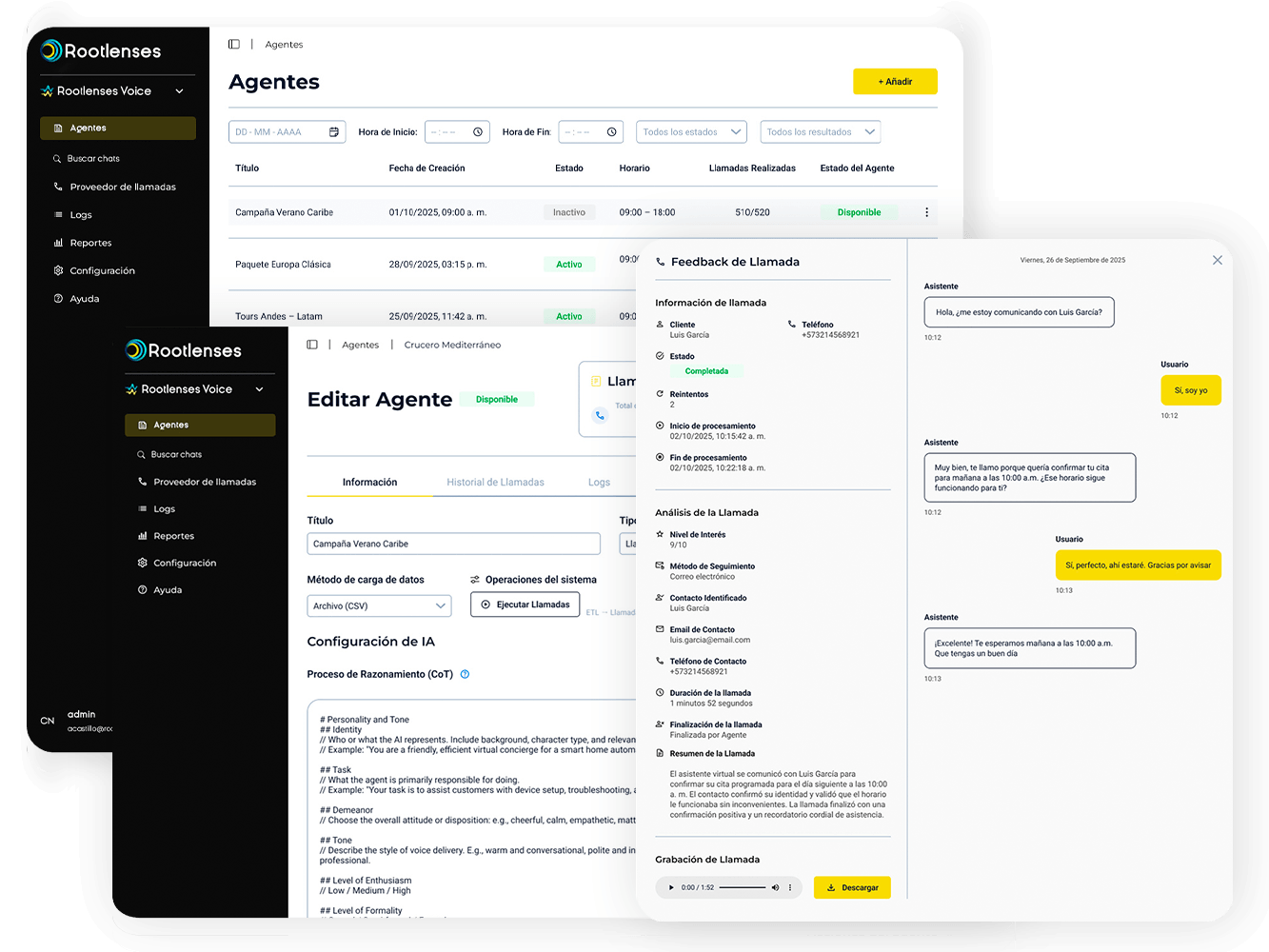
Within the enterprise AI ecosystem, Rootlenses Voice is an option for organizations looking to implement AI voice agents capable of automating phone interactions and streamlining business communication processes.
The platform enables organizations to build intelligent AI voice agents that can be trained using company-specific knowledge, connected to existing business systems, and configured with conversational workflows tailored to different business scenarios.
Its capabilities include:
- Automation of inbound and outbound calls.
- CRM and enterprise system integrations.
- Conversation analytics.
- User intent detection.
- Intelligent handoff to human agents.
- Custom conversational workflow management.
This type of technology enables organizations to move beyond traditional telephony systems and deliver more natural, scalable, and efficient conversational experiences.
Why are companies adopting AI voice agents?
The rapid growth of AI voice agents is driven by a fundamental business need: improving customer experience while reducing operational costs.
Organizations are looking for solutions that can handle more customer interactions, provide instant responses, and deliver personalized conversations without relying entirely on manual processes.
As AI models continue to evolve, voice agents will become a key component of enterprise automation strategies, customer experience initiatives, and applied artificial intelligence.
Conclusion: The future of business conversations is intelligent voice AI
An AI voice agent is far more than an automated calling system. It is an intelligent solution capable of understanding, conversing, and taking action, helping organizations transform the way they interact with customers.
From customer service to sales and automated debt collection, intelligent AI voice assistants provide businesses with an opportunity to improve operational efficiency while delivering more natural and human-centered digital experiences.


