
August 13, 2026
Power BI has established itself as one of the most widely used business intelligence platforms for creating dashboards, reports, and data models. However, the growth of AI-powered analytics, natural language queries, and the need to obtain faster answers are changing the way companies consume information.
That is why one question is becoming increasingly common: what replaces Power BI?
The answer depends on what an organization needs. For some companies, the best option will be another traditional BI platform. For others, it will be an AI-powered conversational analytics solution that allows them to ask questions directly to their data without relying on preconfigured dashboards.
Why look for a Power BI alternative?
Power BI remains a strong tool for visualization, data modeling, and enterprise reporting. In addition, Microsoft is incorporating generative AI capabilities through Copilot for Power BI, which helps users and analysts with tasks such as data analysis, report creation, and generating DAX expressions.
However, there are scenarios in which companies are looking for something different:
- Reduce reliance on BI specialists.
- Query data using natural language.
- Get answers without first building a dashboard.
- Automate repetitive analysis.
- Work with large volumes of data.
- Democratize access to information across non-technical teams.
- Incorporate AI directly into decision-making processes.

The best Power BI alternatives in 2026
There is no single replacement for Power BI. The market offers different business intelligence alternatives, from traditional platforms to tools designed around artificial intelligence.
Rootlenses: an alternative for analyzing data with AI
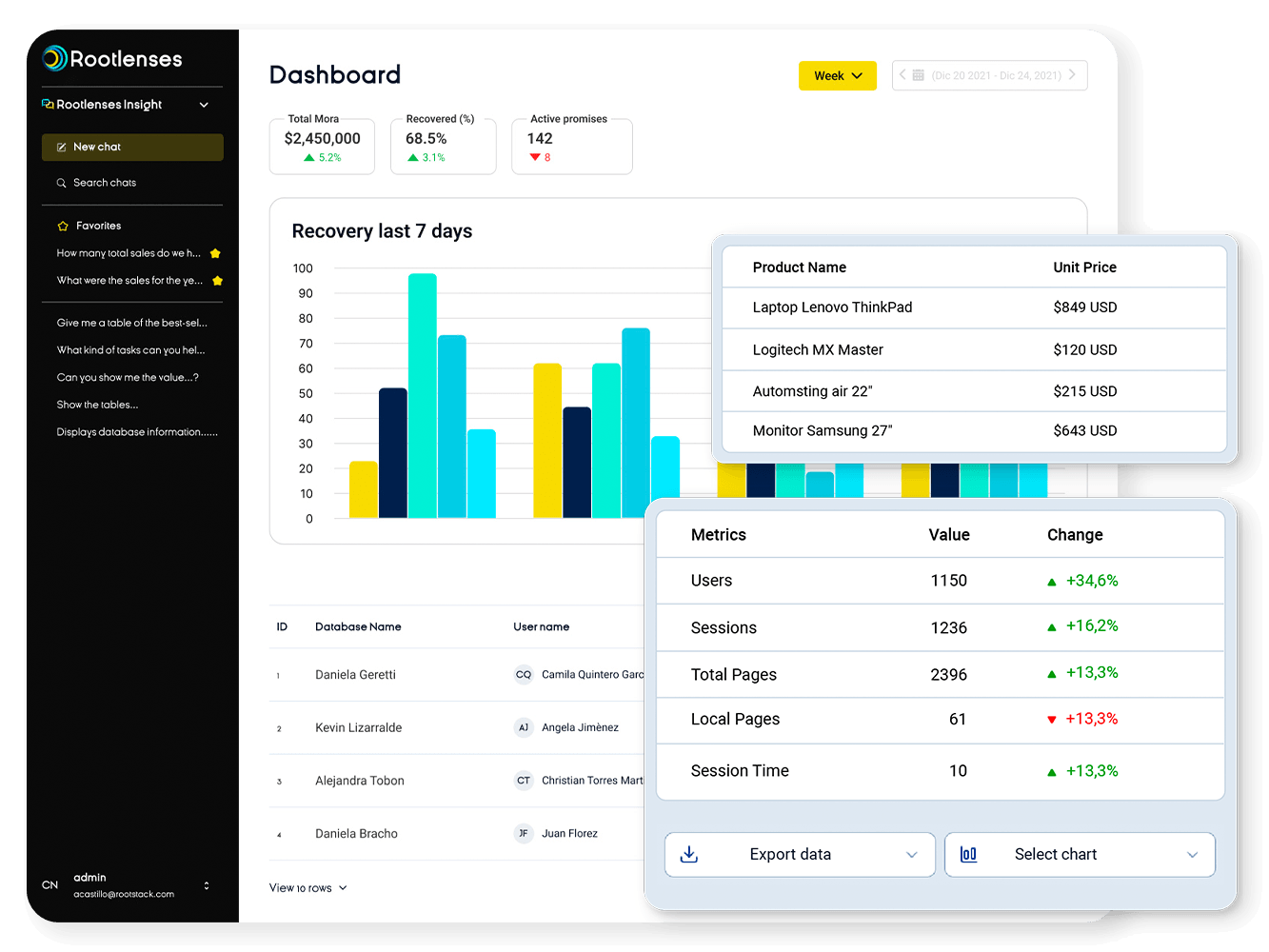
For companies looking to evolve from traditional BI toward a more conversational experience, Rootlenses Insight takes a different approach.
Instead of requiring users to navigate through multiple dashboards, it allows them to ask questions about their data using natural language. The platform interprets the query and transforms it into validated SQL to retrieve information from enterprise databases.
This brings analytics closer to business users without eliminating the governance and control capabilities required by an enterprise organization.
The difference lies in the starting point: traditional Power BI starts with the report; conversational analytics starts with the question.
Other Power BI alternatives
Tableau: a Power BI alternative for advanced visualization
Tableau is one of the best-known alternatives for companies looking for advanced visualization, exploration, and analytics capabilities.
Its evolution is also moving toward AI. Tableau Agent enables users to leverage natural language to prepare data, explore information, create visualizations, and understand dashboards.
It is a good Power BI alternative if: the priority is advanced visualization, interactive exploration, and enterprise analytics capabilities.
ThoughtSpot: natural language-based business analytics
ThoughtSpot represents a more significant evolution toward conversational analytics.
Its platform allows users to ask questions about their data using natural language and generate answers, charts, and insights. Its current offering also includes an AI agent for analysis and a semantic layer designed to provide governed answers.
It is a good Power BI alternative if: users need to explore information without relying on SQL, formulas, or previously built dashboards.
Qlik: BI, analytics, and artificial intelligence
Qlik combines self-service analytics, dashboards, conversational analytics, machine learning, automation, and data catalog capabilities.
Its approach can be attractive to organizations that need a broad analytics platform and want to progressively incorporate AI into their processes.
It is a good Power BI alternative if: you are looking for a comprehensive enterprise platform with BI, integration, automation, and machine learning capabilities.

Can AI replace Power BI dashboards?
Not necessarily. The more important question is whether a company needs more dashboards or more answers.
A dashboard works very well when the indicators that need to be monitored are defined in advance. For example, a sales director may need to view revenue, margin, conversion, and sales by region every day.
But when a new question arises, the traditional process may require requesting a report, modifying a dashboard, or turning to the data team.
AI-powered conversational analytics changes this model. Users can ask questions directly:
- “Why did sales decrease this month?”
- “Which products have the highest margin?”
- “Compare sales in Mexico and Colombia.”
- “Which customers reduced their purchases?”
- “What factors explain the decline in revenue?”
The goal is not to eliminate visualization, but to move from a dashboard-first model to a question-first one.
So, what replaces Power BI?
The short answer is: it depends on what you want to replace.
If you want to replace Power BI as a visualization tool, platforms such as Tableau or Qlik are relevant alternatives. If you are looking for a BI experience based on search and natural language, ThoughtSpot and other AI-powered analytics platforms represent an important evolution.
But if the goal is to enable any user to ask questions of their data, get answers, and quickly turn them into decisions, the true replacement is not simply another dashboard tool.
It is a new generation of AI-powered business analytics, such as Rootlenses Insight.
The future of business intelligence is not only about building better dashboards. It is about making data accessible, understandable, and actionable for every person who needs to make a decision.


