August 6, 2026
Contact centers are undergoing a transformation driven by artificial intelligence. What previously required large teams of agents, long waiting times, and manual processes can now be automated through intelligent assistants capable of understanding natural language, answering queries, executing actions, and handling thousands of calls simultaneously.
If your company is looking to improve customer service, increase sales, or automate collection campaigns, implementing AI call center software can make a significant difference in costs, efficiency, and customer experience.
In this guide, you will learn what AI call center software is, how it works, its benefits, and which features you should evaluate before choosing a platform.
What is AI call center software?
AI call center software is a platform that uses artificial intelligence to automate phone conversations, assist human agents, and optimize contact center operations.
Unlike traditional systems, these platforms use technologies such as:
- Generative Artificial Intelligence
- Natural Language Processing (NLP)
- Speech Recognition and Voice Synthesis
- Machine Learning
- Sentiment Analysis
- Process Automation (Workflow Automation)
Thanks to these capabilities, the system can maintain natural conversations with customers, identify intentions, retrieve information from business systems, and execute tasks without human intervention.
Currently, many companies are migrating from traditional IVRs to AI voice agents due to the improvement in user experience.

How does AI call center software work?
The operation of AI call center software can be divided into several stages:
Call reception
The system receives incoming calls or automatically makes outbound calls.
Language understanding
Artificial intelligence analyzes what the customer says using natural language understanding models.
It does not rely only on keywords, but instead understands the complete context of the conversation.
Decision making
Once it identifies the user's intent, the system determines the best response or action.
For example:
- Check an invoice
- Verify a payment
- Schedule an appointment
- Create a ticket
- Update information in a CRM
- Transfer the call to a human agent
Action execution
The software integrates with business applications to perform tasks automatically without manual intervention.
Continuous learning
Over time, AI improves through conversation analysis, performance metrics, and user feedback.
Benefits of implementing AI call center software
Organizations that adopt intelligent call center platforms often achieve significant improvements in both operational efficiency and customer experience.
24/7 customer service
AI voice agents can handle calls throughout the day without interruptions.
This allows companies to answer customer inquiries even outside regular business hours.
Reduction of operational costs
Automating repetitive calls reduces the need to expand human teams for routine tasks.
This allows agents to focus on higher-value cases.
Faster response times
Waiting times are significantly reduced because multiple calls can be managed simultaneously.
Scalability
While a human agent can handle one call at a time, AI call center software can manage hundreds or thousands of conversations simultaneously.
Improved customer experience
Responses are fast, personalized, and consistent.
Additionally, AI can remember customer information to provide more contextual interactions.
Data-driven decision making
Every conversation generates valuable data that can later be analyzed to identify trends, recurring issues, and improvement opportunities.

Use cases of AI call center software
Today, practically any industry can benefit from this type of platform.
Customer service
Resolve frequent inquiries about orders, products, warranties, or billing.
Intelligent collections
Run automated payment reminder campaigns, negotiate agreements, and escalate only complex cases.
Telephone sales
Execute outbound campaigns to qualify leads, answer questions, and transfer only interested customers to the sales team.
Appointment confirmation
Hospitals, clinics, and service companies can automate appointment reminders and confirmations.
Technical support
Guide users through basic processes before escalating the call to a specialist.
Customer satisfaction surveys
Make automated calls to measure customer experience and obtain indicators such as NPS or CSAT.
Features the best AI call center software should have
Before choosing a platform, it is important to evaluate technical and functional aspects that will directly impact project performance.
Natural language understanding
It should understand real conversations and not rely only on rigid decision trees.
Natural voices
Voice quality is essential to build trust during conversations.
Integrations
The software should easily connect with:
- CRM
- ERP
- Databases
- Ticketing systems
- Enterprise APIs
- Telephony platforms
Process automation
Answering questions is not enough. A good software solution should execute actions automatically.
Conversation analytics
The best platforms provide metrics such as:
- Detected intents
- Completed conversations
- Average duration
- Conversion rate
- Sentiment analysis
- Service quality
Intelligent escalation
When AI detects a complex case, it should transfer the call to a human agent with the full conversation context.
Rootlenses Voice as an AI call center software platform
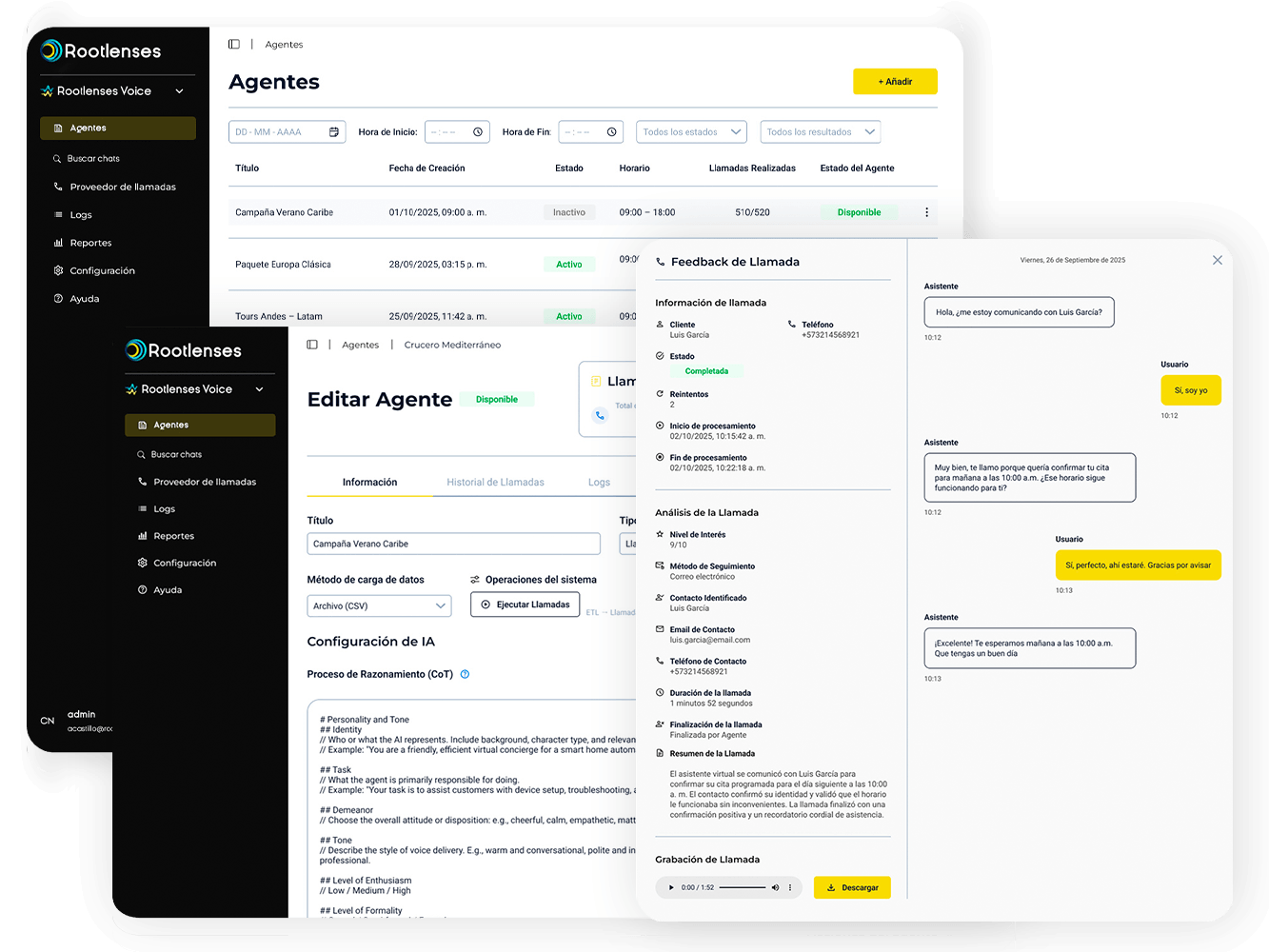
Within the enterprise platform market, Rootlenses Voice represents an alternative for organizations looking to implement scalable artificial intelligence voice agents.
The platform enables companies to create voice agents capable of handling inbound and outbound calls, understanding natural language conversations, and integrating with business systems to execute processes automatically.
Some of its key capabilities include:
- Automated call campaign execution.
- Integration with CRM systems, APIs, and telephony platforms.
- Configuration of conversational flows adapted to each business.
- Conversation analysis and intent identification.
- Automatic escalation to human agents when required.
- Support for multiple use cases such as sales, customer service, collections, and appointment confirmations.
This approach allows companies to modernize their operations without relying exclusively on traditional IVR systems.
AI call center software trends
Artificial intelligence continues to evolve rapidly, and the most advanced platforms already include capabilities that seemed futuristic only a few years ago.
Some of the main trends include:
- Fully autonomous voice agents.
- Generative AI for more natural responses.
- Personalization based on customer history.
- Complete automation of business processes.
- Integrations with advanced language models.
- Predictive analytics to anticipate customer needs.
- Real-time conversation monitoring.
- Continuous optimization through machine learning.
These innovations are turning AI call center software into a strategic component for companies looking to deliver faster and more efficient customer experiences.
Conclusion
The adoption of AI call center software is no longer a trend limited to large corporations. Companies of different sizes are incorporating intelligent voice agents to automate repetitive tasks, reduce operational costs, improve customer service, and increase team productivity.
When evaluating a platform, it is important to consider aspects such as natural language understanding, integration capabilities with existing systems, voice quality, analytics tools, and the ability to automate complete processes.
Solutions such as Rootlenses Voice demonstrate how artificial intelligence can be practically applied to modernize contact centers and create more efficient and scalable conversational experiences.
Request a demo
Do you want to discover how AI call center software can transform customer service and automate your company's operations? Request a Rootlenses Voice demo and learn how to implement intelligent voice agents adapted to your business needs.


