
September 3, 2026
Business data analysis is changing rapidly. In 2026, companies no longer rely exclusively on analysts, SQL, or predefined dashboards to answer questions about their data.
Artificial intelligence tools for data analysis allow users to query information using natural language, generate visualizations, detect anomalies, and obtain insights without having to write complex queries.
This shift is part of a broader trend. Stanford's AI Index 2026 reports that 88% of surveyed organizations use artificial intelligence in at least one business function, while generative AI is already present in 70% of organizations.
At the same time, Gartner points out that analytics and business intelligence platforms are incorporating generative AI to automate and transform the way companies interact with their data.
So, what are the best AI tools for business data analysis in 2026?
What should an AI data analysis tool offer?
Before choosing a platform, it is important to distinguish between a tool that simply generates charts and a true AI-powered data analysis platform.
The best solutions should allow users to:
- Query data using natural language.
- Analyze existing databases and business data sources.
- Automatically generate visualizations and dashboards.
- Detect trends, anomalies, and relevant changes.
- Perform follow-up analysis through conversations.
- Maintain business context and metric definitions.
- Apply security, permissions, and governance.
- Reduce business users' dependence on SQL.
Governance is especially important. McKinsey found that, although enterprise AI adoption continues to grow, organizations generating the most value are making changes to their workflows, structures, and governance models.

1. Rootlenses Insight
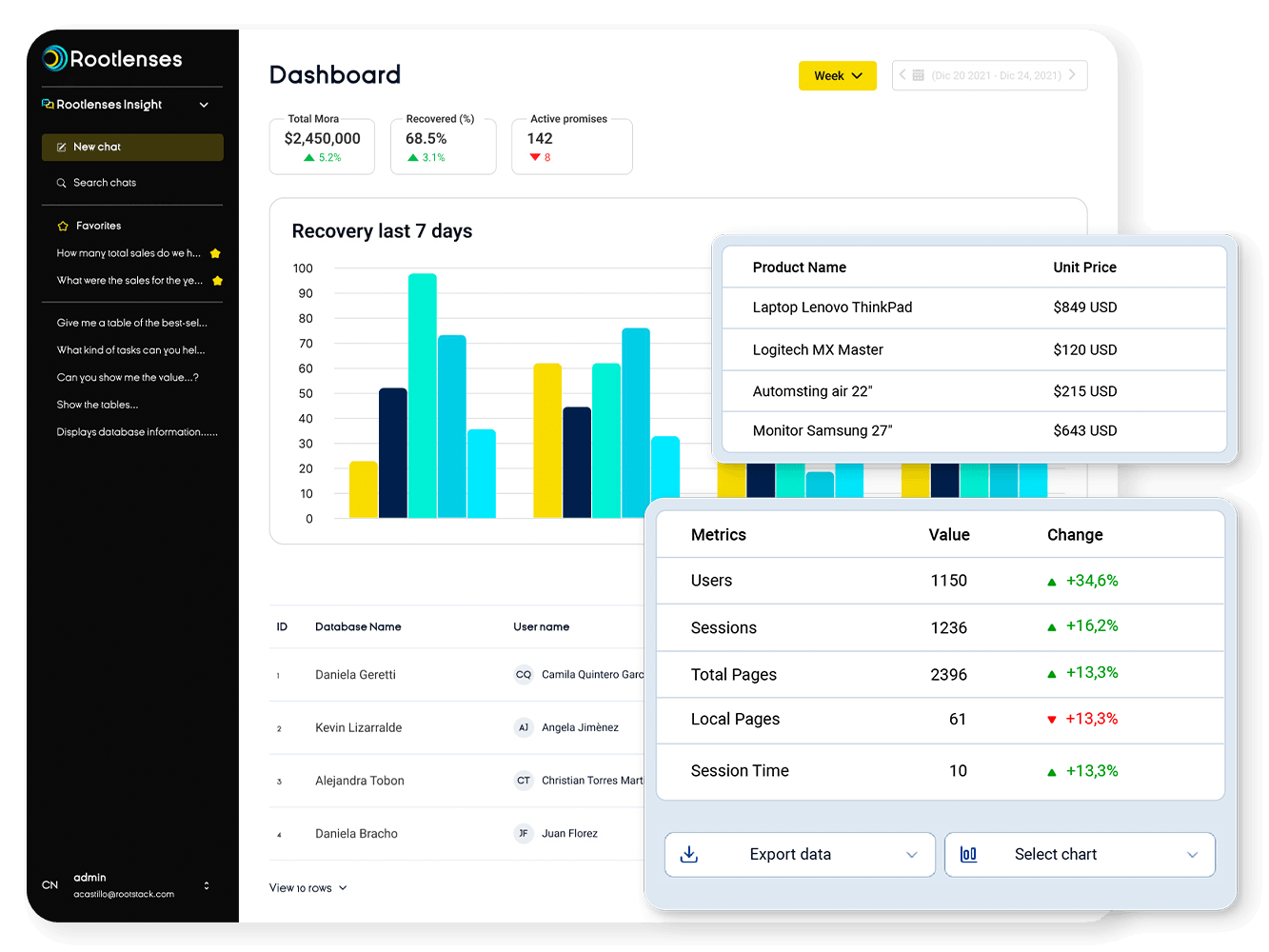
Rootlenses Insight is designed around the concept of an AI data analyst: enabling business users to ask questions about business data using natural language, without having to master SQL.
The platform converts business questions into structured queries against relational databases and uses business context to interpret concepts, metrics, and relationships between data.
This is especially useful for sales, finance, operations, human resources, and leadership teams that need quick answers without constantly relying on the BI team.
Key capabilities include:
- Natural language queries.
- SQL generation and validation.
- Database schema interpretation.
- Role-based governance.
- Business context through RAG.
- Structured results and visualizations.
- Results export.
Best for: companies that want to implement an AI-powered data analysis platform connected directly to their databases and reduce their dependence on SQL for everyday analysis.
2. ThoughtSpot
ThoughtSpot is one of the platforms most focused on conversational analytics and AI-powered data analysis.
Its AI Analyst, Spotter, allows users to ask questions in natural language and obtain visualizations and insights. The platform also uses semantic models and business context to improve the interpretation of questions.
Best for: companies looking for an advanced conversational BI experience, self-service analytics, and interactive analysis at enterprise scale.
3. Microsoft Power BI + Copilot
Power BI continues to be one of the most relevant business intelligence platforms, especially for organizations that already use Microsoft.
In 2026, Copilot allows users to ask questions about semantic models using natural language and generate visualizations in response. Microsoft also allows AI instructions to be incorporated into the semantic model to provide context, business logic, and organization-specific terminology.
Best for: companies deeply integrated with Microsoft Fabric, Azure, and the Microsoft ecosystem.
4. Qlik
Qlik combines analytics, data integration, and artificial intelligence within its platform.
Qlik Answers allows users to ask questions in natural language and receive AI-generated answers based on structured and unstructured information. In addition, Qlik Discovery Agent can automatically detect changes, anomalies, and trends in Qlik applications.
Best for: companies that need to combine data exploration, integration, analytics, and AI capabilities.
5. Google Looker + Gemini
Google Looker incorporates Conversational Analytics, powered by Gemini, to allow users to ask questions about data using natural language.
An important advantage is its semantic model. Looker uses business definitions and LookML to provide context to queries, helping maintain consistency in metrics such as revenue, customers, or churn.
Best for: organizations using Google Cloud, Looker, and data architectures based on semantic models.

How to Choose an AI Data Analysis Tool in 2026
The decision should not be based solely on which platform has the most advanced AI model. Companies should evaluate how AI interacts with their actual data.
When comparing tools, consider five factors:
- Data access: can it connect to your databases and data warehouse?
- Natural language: does it understand business questions and follow-up questions?
- Accuracy: is there a semantic layer or mechanism for validating responses?
- Governance: can you control who can query specific data?
- Adoption: can business users use it without constantly relying on specialists?
The future of business intelligence is not simply about adding a chatbot to a dashboard. The trend points toward platforms where users can ask questions, analyze, discover, and take action on data through AI.
For organizations looking to reduce their dependence on SQL and democratize access to business information, platforms for AI-powered data analysis, conversational analytics, and AI-powered business intelligence represent one of the most important changes in modern BI.


