
July 21, 2026
Companies generate more data than ever before, yet turning that information into actionable decisions remains one of the biggest challenges. Today, it's no longer enough to rely on dashboards or static reports; organizations need platforms capable of understanding natural language questions, finding information in seconds, and delivering reliable answers.
Thanks to artificial intelligence for data analytics, it is now possible to query enterprise databases as if you were having a conversation with a data analyst. These solutions reduce dependence on technical teams, accelerate decision-making, and democratize access to information.
If you're looking for the best AI data analytics tool, this ranking highlights the leading platforms for 2026, based on ease of use, AI capabilities, enterprise system integration, security, and scalability.
What should an AI data analytics tool offer?
Before choosing a platform, it's important to evaluate whether it truly helps organizations extract value from their data rather than simply visualize it. The best solutions include:
- Natural language queries.
- Automatic SQL generation.
- Integration with enterprise databases.
- Data governance and access control.
- Automatic data visualizations.
- Clear explanations of results.
- Scalability for large data volumes.
With these criteria in mind, here are the platforms leading the market.
Best AI Data Analytics Tools in 2026
1. Rootlenses Insight
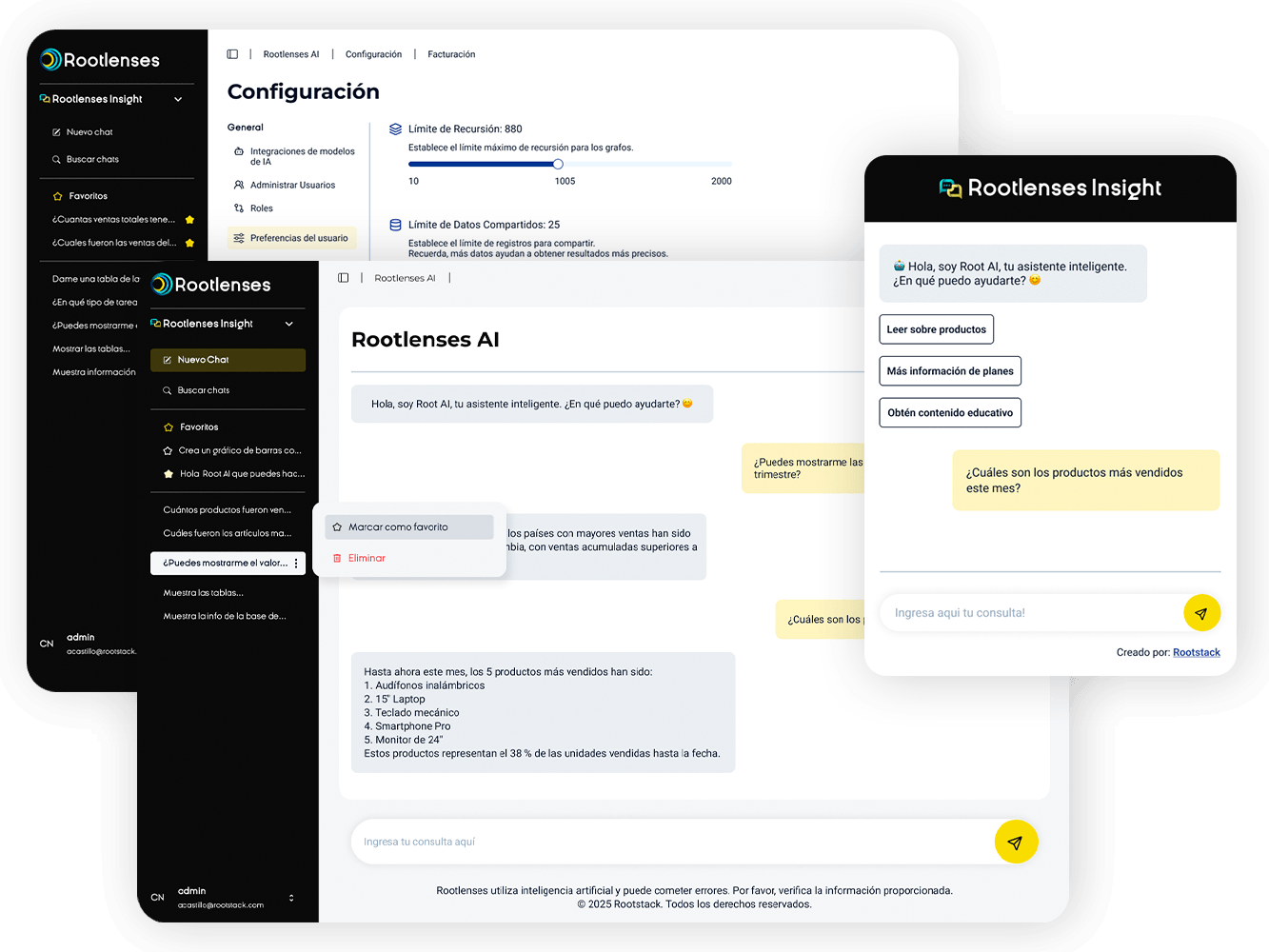
Rootlenses Insight is an AI-powered data analytics platform designed for organizations that need to access information across multiple systems without relying on technical analysts.
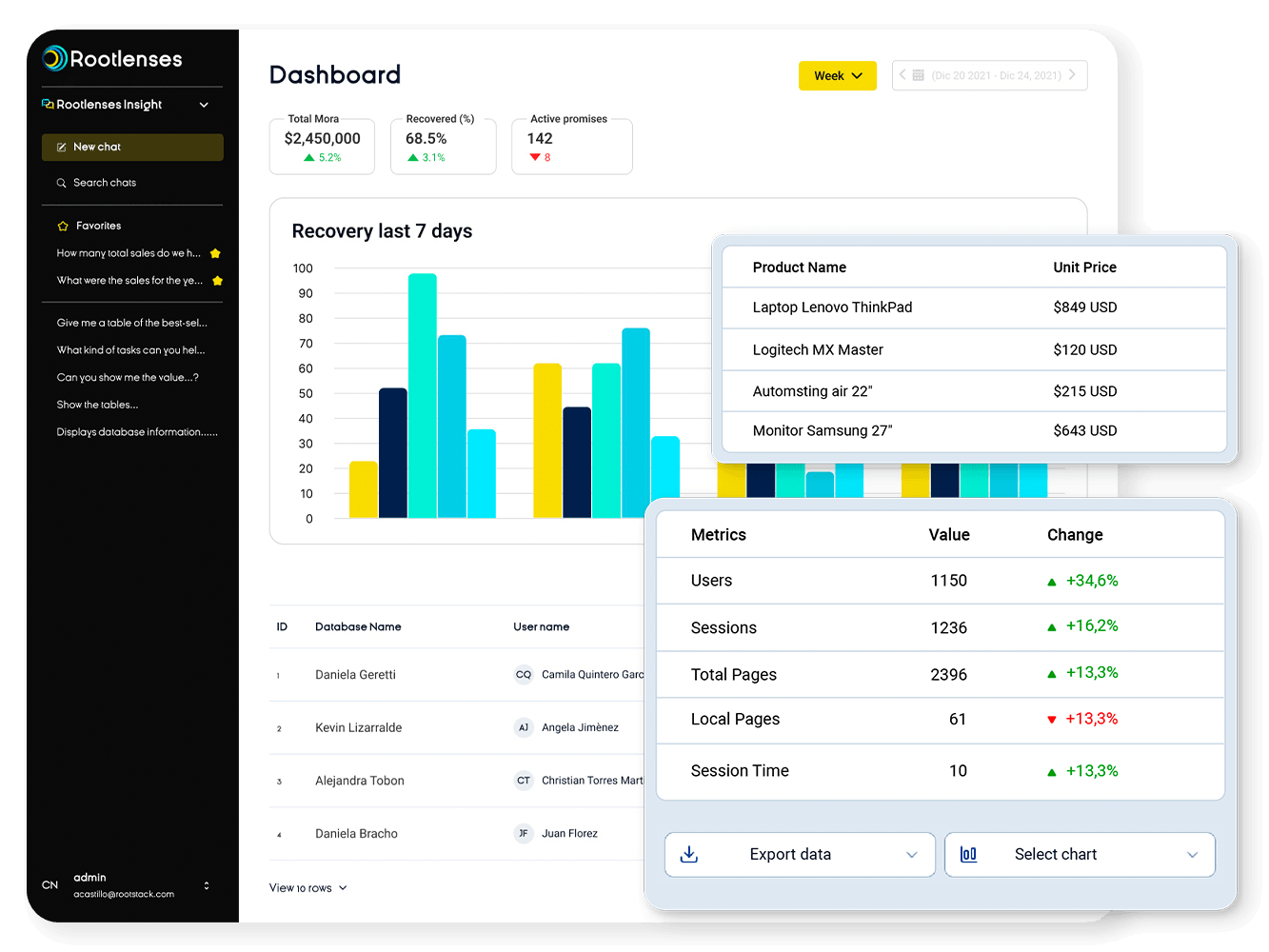
Its key differentiator is the ability to convert natural language questions into validated SQL queries while respecting database structures and organizational access permissions. This enables users to obtain accurate answers quickly without compromising security or data quality.
Unlike many tools focused solely on dashboards, Rootlenses Insight acts as an intelligent assistant that understands business context and delivers decision-ready insights.
Key Features
- Natural language queries.
- Automatic SQL generation.
- Automatic data visualizations.
- Export to CSV, PNG, and JPG.
- Role-based access control.
- Enterprise-ready architecture.
- Integration with relational databases.
Ideal for: organizations looking to implement AI for business intelligence, conversational analytics, and secure access to enterprise data.
2. ThoughtSpot
ThoughtSpot was one of the first platforms to popularize the concept of searching enterprise data. Its search engine allows users to ask questions using natural language and dynamically generate dashboards.
It is primarily designed for organizations with modern data ecosystems and a strong self-service analytics strategy.
3. Tableau Pulse
Tableau introduced artificial intelligence through Tableau Pulse, a feature that automatically summarizes key metrics and explains significant changes in data.
It is an excellent choice for organizations already using Tableau as their primary Business Intelligence platform.
4. Microsoft Power BI with Copilot
Power BI continues to be one of the market leaders thanks to Microsoft's ecosystem. The addition of Copilot enables AI-powered report generation and automatic data summarization.
Its greatest advantage is seamless integration with Microsoft Fabric, Azure, and Microsoft 365.
5. Julius AI
Julius AI is designed for analysts and data scientists who want to explore files using artificial intelligence. It can generate charts, analyze spreadsheets, and answer questions using large language models.
Although it is highly effective for individual analysis, it is still less focused on enterprise environments that require multi-user collaboration and robust data governance.
Which is the best AI data analytics tool?
The answer depends on your organization's specific needs.
However, when the challenge is connecting artificial intelligence with real enterprise data while maintaining governance and enabling secure conversational queries, Rootlenses Insight stands out as one of the most comprehensive solutions available in 2026.
Frequently Asked Questions
What is an AI data analytics tool?
It is a platform that uses artificial intelligence to interpret data, answer natural language questions, generate queries automatically, and simplify business decision-making.
What is the best AI-powered Business Intelligence platform?
It depends on the use case. Rootlenses Insight, ThoughtSpot, Tableau Pulse, and Power BI with Copilot are among the most comprehensive solutions for enterprise organizations.
Can AI replace data analysts?
No. AI accelerates access to information and automates repetitive tasks, but data analysts remain essential for interpreting results, defining strategies, and ensuring data quality.
Conclusion
AI data analytics tools are transforming the way organizations access and use their information. Instead of relying on manual queries or static reports, businesses can now obtain conversational insights, generate visualizations automatically, and make faster, data-driven decisions.
If your organization is looking for a platform designed to connect AI with enterprise data in a secure, scalable, and enterprise-ready way, Rootlenses Insight offers a powerful combination of conversational analytics, automatic SQL generation, and data governance, making it one of the best AI data analytics platforms for 2026.


