
July 21, 2026
For a retail chain, having sales data available is no longer enough. The real challenge is turning that data into fast business decisions: identifying which products are underperforming, understanding which stores require attention, detecting changes in customer behavior, and anticipating new commercial opportunities.
However, many companies still rely entirely on their Business Intelligence (BI) teams to answer basic business questions.
A commercial manager needs to know:
- Which stores had the lowest growth this month?
- Which categories are experiencing declining sales?
- What is the impact of a specific promotion?
- Which regions have the highest growth potential?
But obtaining these answers may require submitting requests, waiting for new dashboards, or asking the data team for customized analysis.
This model creates an operational bottleneck: while business leaders wait for information, opportunities continue moving forward.
Today, new conversational analytics platforms and artificial intelligence for data analysis allow commercial teams to directly query their business data using natural language, without constantly depending on the BI department.
The challenge of relying only on BI teams for sales analysis
BI teams play a fundamental role within organizations. They are responsible for building data models, strategic dashboards, and reliable reports.
The challenge appears when every operational decision requires a new request.
In a retail chain with hundreds or thousands of daily transactions, leaders need constant answers:
- Compare sales performance between stores.
- Analyze seasonal sales trends.
- Measure product performance.
- Identify inventory optimization opportunities.
- Evaluate commercial campaigns.
When these questions depend exclusively on analysts, several challenges emerge.
1. Slow processes to access information
A business question can become a process that takes several days:
- The manager requests an analysis.
- The BI team interprets the business need.
- Data is extracted and transformed.
- A report is created.
- The results are delivered.
For strategic decisions this may be enough, but for daily operations it represents a significant limitation.
2. Dashboards do not always answer new business questions
Traditional BI dashboards display previously defined indicators:
- Monthly sales.
- Average margin.
- Average ticket size.
- Year-over-year comparison.
But businesses evolve quickly.
A manager may ask:
"Which stores similar to the Monterrey location are growing faster, and which products are driving that growth?"
This question likely requires additional analysis. The problem is not the lack of data, but the difficulty of exploring it.

3. Commercial teams need data autonomy
Modern organizations aim to build a data-driven culture, where different teams can make decisions based on reliable information.
However, if only technical specialists can access and analyze data, analytics remains centralized.
The evolution of BI is moving toward tools that allow business users to interact directly with information.
How to analyze sales performance for a retail chain using conversational analytics
Conversational analytics uses artificial intelligence to allow users to ask questions about their data using natural language.
Instead of building SQL queries or navigating through multiple dashboards, a business leader can simply ask:
"Show me the stores with the lowest growth during the last three months and the categories responsible for the decline."
The platform interprets the business intent, analyzes available data sources, and generates a structured response.
This allows organizations to analyze sales from different perspectives:
Store performance analysis
Managers can identify:
- Stores with above-average growth.
- Locations experiencing revenue decreases.
- Regional performance differences.
- Comparisons between different periods.
This makes it easier to make decisions about promotions, inventory management, and commercial strategies.
Product and category analysis
Artificial intelligence applied to data analysis allows businesses to answer questions such as:
- Which products generate the highest margins?
- Which categories are losing market share?
- Which products have the greatest growth potential?
In retail, this capability helps optimize inventory decisions and reduce reliance on intuition-based strategies.
Identifying commercial trends
An AI-powered data analytics platform can identify patterns that are not always visible in traditional reports:
- Changes in purchasing behavior.
- Seasonal variations.
- Impact of promotions.
- Relationship between location and sales performance.
This allows business leaders to take action before problems impact revenue and operational results.

Can a company analyze its data without fully depending on BI teams?
The answer is not replacing Business Intelligence teams, but expanding access to business data.
BI teams remain essential for:
- Data governance.
- Data quality management.
- Analytics architecture.
- Enterprise data models.
The difference is that now business leaders can solve operational questions directly, while BI teams can focus on strategic initiatives.
This approach combines:
- Reliable data.
- Faster decision-making.
- Less operational dependency.
- Greater autonomy for commercial teams.
Rootlenses Insight: Sales analysis with conversational artificial intelligence
Rootlenses Insight is designed to help organizations transform business questions into actionable answers using artificial intelligence.
The platform allows users to query enterprise information using natural language, connecting with existing databases and generating insights without manually creating every report.
For a retail chain, this means commercial leaders can directly ask:
"Which stores have the highest growth opportunities?"
or:
"What was the impact of last quarter's promotions?"
and receive insights based on their own business data.
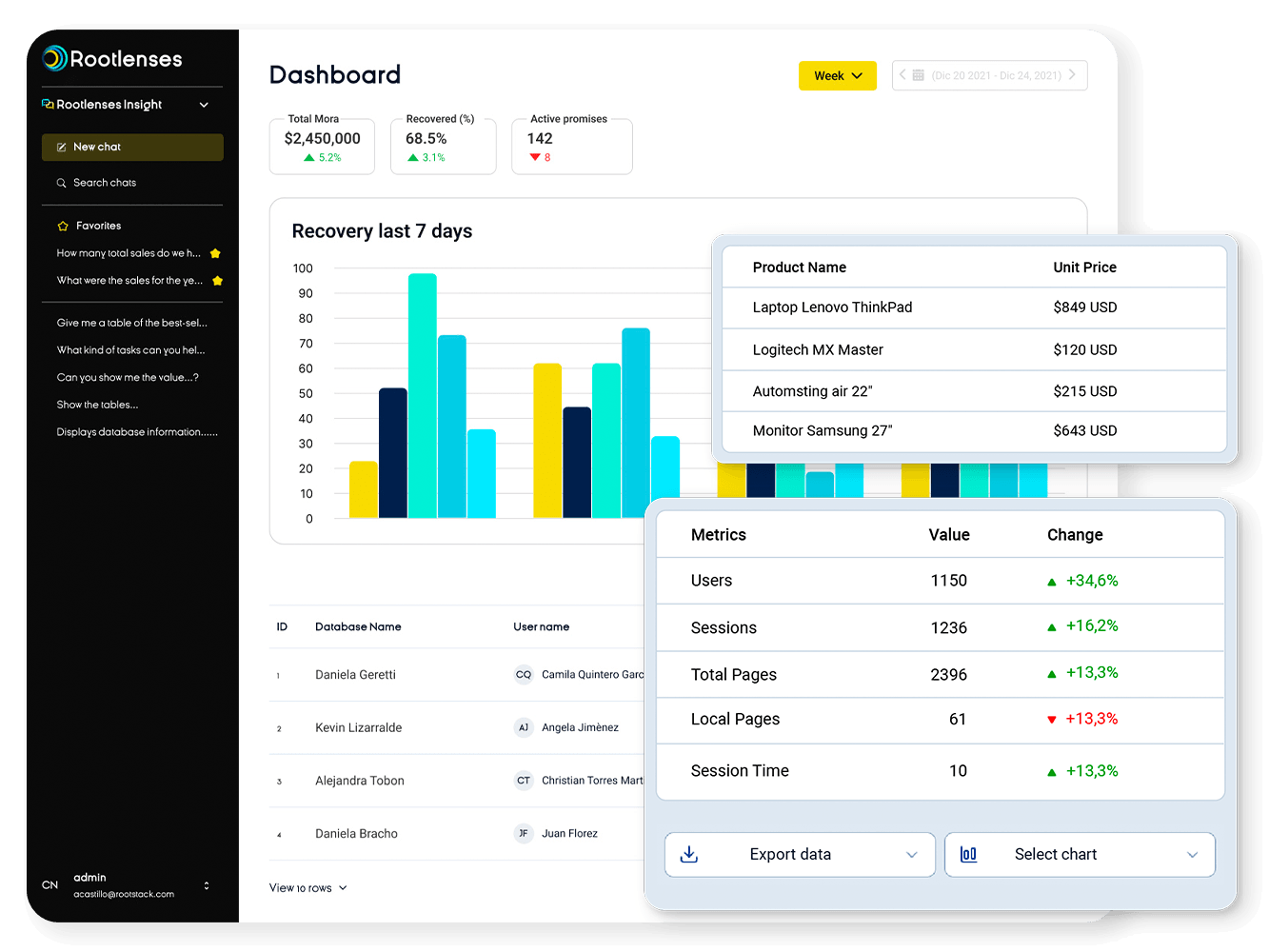
Rootlenses Insight combines Business Intelligence, artificial intelligence, and conversational analytics capabilities to accelerate decision-making and reduce constant dependency on technical teams.
The future of retail sales analysis is conversational
Companies with multiple stores generate massive volumes of information every day. The challenge is no longer storing data, but using it quickly to make better business decisions.
Traditional BI platforms will continue to play an important role, but the next generation of analytics will allow more business leaders to interact directly with their data.
For commercial managers, this represents a competitive advantage: less time waiting for reports and more time taking action.
Request a demo of Rootlenses Insight
Discover how to transform your sales data into clear, actionable insights using conversational artificial intelligence.
Request a demo of Rootlenses Insight and empower your teams to make data-driven decisions in seconds.


