
August 7, 2026
Phone calls remain one of the most important channels for communication between businesses and customers. However, sales and customer service teams face constant challenges: high call volumes, long wait times, high operating costs, and difficulty providing personalized support 24/7.
Artificial intelligence is transforming this scenario through AI-powered phone call automation, allowing companies to implement intelligent voice agents capable of answering inquiries, making outbound calls, managing business processes, and delivering more efficient experiences.
An artificial intelligence platform for phone calls makes it possible to automate natural-language conversations, integrate with business systems, and scale customer service without relying exclusively on human teams.
How to automate phone calls with AI?
Automating phone calls with AI involves using intelligent voice agents that can interact with customers through automated conversations similar to a traditional call with a human operator.
These systems use technologies such as natural language processing (NLP), automatic speech recognition (ASR), generative artificial intelligence models, and conversational analytics to understand questions, interpret intent, and respond appropriately.
The process generally works through the following steps:
- Connection to telephone infrastructure: the AI platform integrates with telecommunications providers, virtual phone systems, or systems such as CRMs.
- Voice agent configuration: the company defines the assistant's personality, objectives, conversational flows, knowledge, and business rules.
- Training with business information: the agent learns using documents, databases, frequently asked questions, and internal processes.
- Automation of inbound and outbound calls: AI can answer customer calls, confirm appointments, conduct surveys, manage sales, or execute mass calling campaigns.
- Results analysis: conversations can be stored, analyzed, and used to improve sales and operational processes.

Benefits of automating calls with artificial intelligence
Artificial intelligence call automation offers significant advantages for companies across different industries, from banking and insurance to retail, healthcare, telecommunications, and professional services.
24/7 customer service
One of the main benefits of an AI voice agent is permanent availability. Customers can get in touch at any time and receive immediate answers without depending on the working hours of a support team.
This improves the customer experience and reduces the number of missed calls.
Reduced operating costs
Traditional contact centers require large teams to manage high call volumes. An AI-powered automated calling system can handle repetitive inquiries, free up human agents' time, and optimize resources.
Artificial intelligence can handle tasks such as:
- Appointment confirmations.
- Customer follow-ups.
- Information updates.
- Frequently asked questions.
- Lead qualification.
- Payment reminders.
Greater capacity to manage mass calls
Companies that run outbound campaigns can use AI-powered phone agents to make thousands of calls simultaneously, maintaining personalized conversations and automatically recording the information collected.
This is especially useful for sales, automated collections, market research, and customer loyalty campaigns.
How does an AI voice agent work for automated calls?
An AI voice agent combines different technologies to deliver intelligent conversations.
First, the system converts the user's voice into text through automatic speech recognition. Then, an artificial intelligence model analyzes the customer's intent and generates an appropriate response. Finally, the response is converted back into natural speech to continue the conversation.
The most advanced platforms include capabilities such as:
- User intent detection.
- Sentiment analysis.
- Contextual memory during the conversation.
- Integration with CRM and business systems.
- Intelligent transfer to human agents.
- Automatic call recording.
- Report generation and analytics.
This makes it possible to create more natural experiences than older IVR systems based solely on predefined menus.

AI-powered phone call automation for sales and customer service
AI call automation has applications across multiple areas of the business.
In sales, intelligent voice agents can contact prospects, ask qualification questions, identify opportunities, and schedule sales meetings.
In customer service, they can answer frequently asked questions, resolve simple requests, and route complex cases to specialized teams.
In collections, AI can automate payment reminders, negotiate options, and maintain ongoing communication with customers.
In addition, industries such as healthcare can use voice assistants to confirm medical appointments, while retail companies can automate satisfaction surveys and post-sale follow-ups.
Rootlenses Voice: AI voice agent platform for automating calls
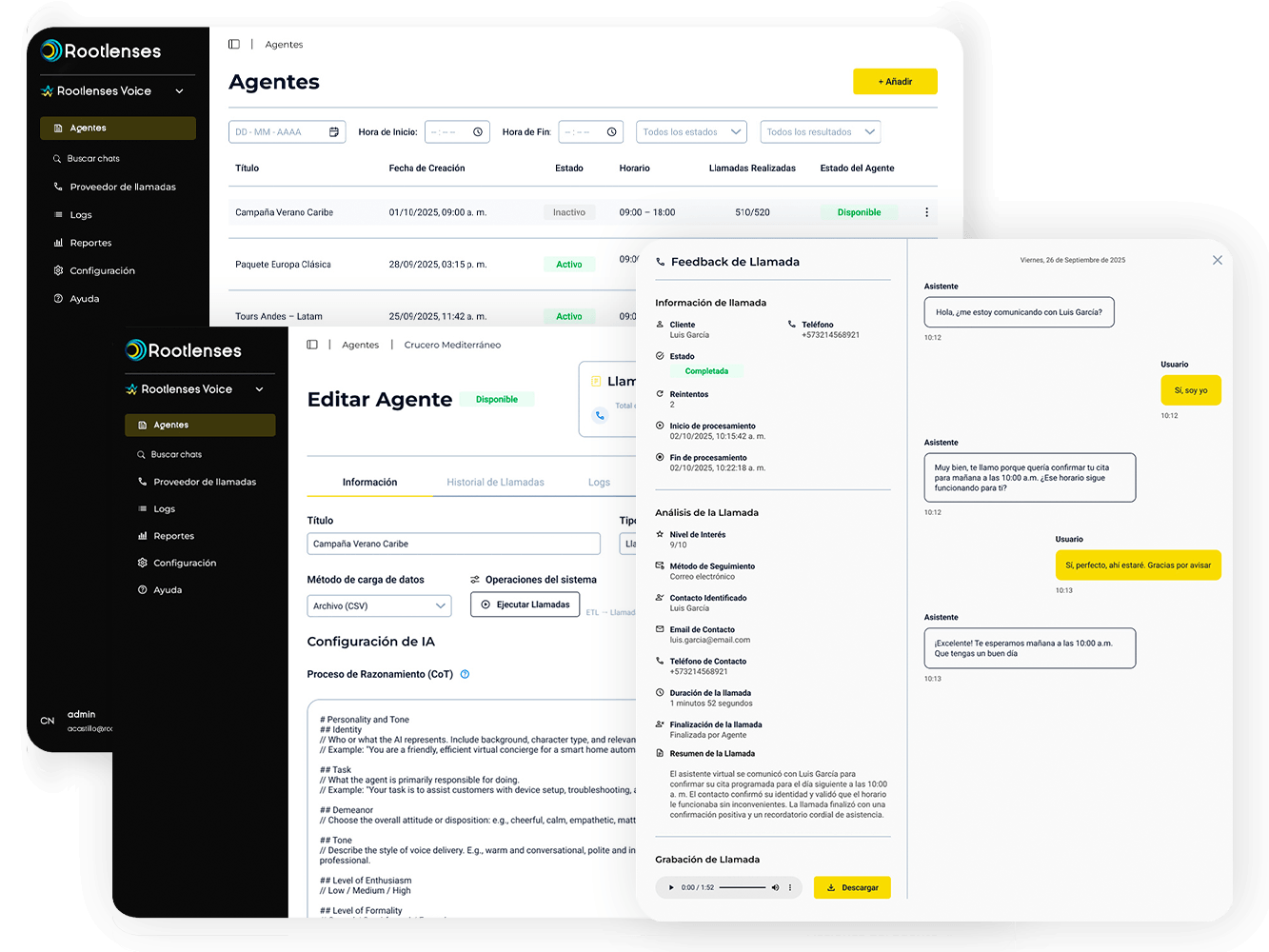
For companies looking to implement advanced call automation, Rootlenses Voice enables businesses to create AI-powered voice agents capable of autonomously managing phone conversations.
The platform allows companies to configure intelligent agents trained with business-specific information, connect them with telephone providers, and adapt them to different use cases.
With Rootlenses Voice, organizations can automate processes such as:
- Automated phone support.
- Outbound sales calls.
- Customer management.
- Automated collections.
- Phone surveys.
- First-level support.
In addition, agents can integrate with business tools to retrieve information, update records, and execute actions during the call.
A key feature is the ability to analyze conversations using artificial intelligence, identifying intent, sentiment, and outcomes from each interaction to continuously improve the communication strategy.
What should you consider when choosing a platform to automate calls with AI?
Before implementing an automated calling solution powered by artificial intelligence, companies should evaluate several important aspects:
Customization capabilities
Every business has different processes. The platform should allow companies to train agents with their own information, configure conversational flows, and adapt responses according to business needs.
Business integrations
An effective solution should connect with CRMs, customer service platforms, internal systems, and data analytics tools.
Voice quality and conversational experience
Natural-sounding voice is essential for building trust. Users expect smooth conversations, fast responses, and an appropriate understanding of context.
Security and compliance
Especially in regulated industries, it is necessary to have access controls, conversation logging, and mechanisms that ensure the proper handling of sensitive information.
Scalability
The platform should be able to grow alongside the company, allowing call volumes to increase without affecting performance.
The future of automated calls powered by artificial intelligence
The evolution of AI voice agents is moving toward increasingly autonomous systems capable of understanding complex conversations and executing complete processes.
In the coming years, companies will not only use artificial intelligence to answer calls, but also to anticipate needs, personalize interactions, and make data-driven decisions based on information gathered during conversations.
AI-powered phone call automation will become a strategic component for improving operational efficiency and delivering better customer experiences.
Conclusion: automating phone calls with AI is a competitive advantage
Automating phone calls with artificial intelligence enables companies to reduce costs, increase productivity, and provide support at all times.
AI voice agents represent a new generation of business communication, combining automation, data analytics, and more efficient human interaction.
With solutions such as Rootlenses Voice, organizations can implement intelligent agents capable of managing calls, improving business processes, and transforming the customer experience.


