
July 21, 2026
Business Intelligence has evolved significantly in recent years. For decades, companies relied on dashboards, predefined reports, and teams of analysts to understand what was happening within their operations.
Today, artificial intelligence is changing the way organizations interact with their data.
Business leaders no longer want to spend hours navigating through dashboards or wait days for BI teams to create a report. They need to ask questions directly, obtain reliable answers, and make decisions faster.
This shift has increased interest in solutions such as Microsoft Power BI with Copilot and new conversational analytics platforms powered by artificial intelligence.
Both approaches aim to simplify data analysis and make it more accessible for business teams. However, their capabilities, implementation models, and target users are different.
Understanding these differences is essential for companies evaluating the next generation of AI-powered data analytics platforms and looking to improve how their teams make decisions.
What is Power BI with Copilot?
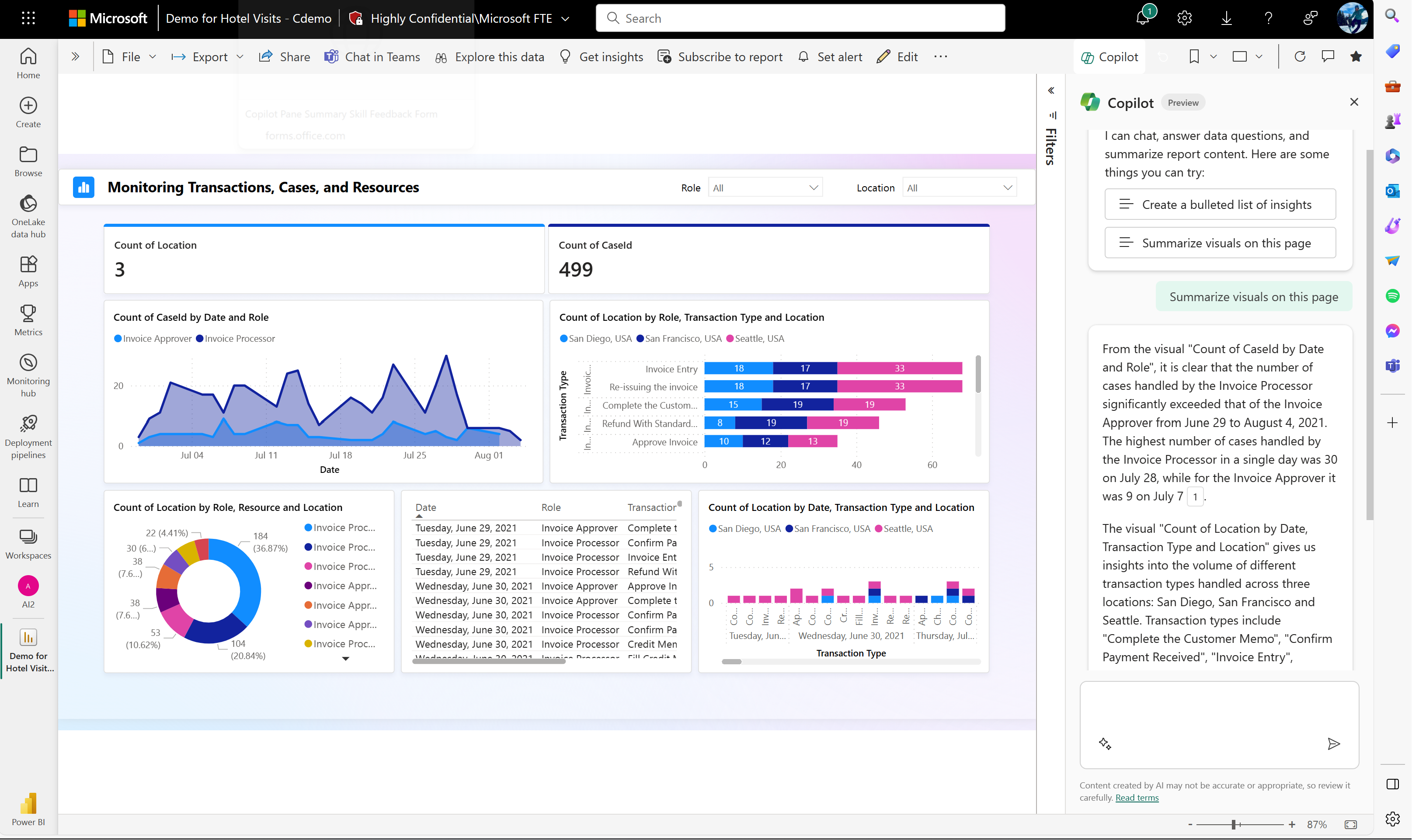
Microsoft Power BI with Copilot combines traditional Business Intelligence capabilities with generative artificial intelligence functionalities.
Power BI is one of the most widely used BI platforms by organizations to create dashboards, reports, and data visualizations. With Copilot, users can interact with information using natural language and receive AI-generated summaries, explanations, and even assistance creating reports.
For example, a sales manager could ask:
"Summarize the main reasons why revenue decreased this quarter."
Copilot can help generate explanations based on available data models and reports.
This represents an important evolution compared to traditional BI workflows, where users needed technical knowledge to build queries or interpret complex dashboards.
However, Power BI with Copilot continues operating within a traditional Business Intelligence environment, where data modeling, dashboards, and governance structures remain essential components.
What are conversational analytics platforms?
Conversational analytics platforms take a different approach: they are designed around interacting with data through natural language as the primary method of analysis.
Instead of navigating through dashboards or selecting predefined metrics, users can ask direct questions:
- Which products generated the highest revenue this month?
- Why did customer churn increase during the last quarter?
- Which stores are underperforming compared to expectations?
The platform interprets the intent behind the question, analyzes connected data sources, and generates actionable insights.
These solutions combine:
- Artificial intelligence.
- Natural language processing.
- Data analysis.
- Business Intelligence capabilities.
- Automated query generation.
The goal is to enable business users to explore information without requiring advanced technical or data analysis knowledge.
Power BI with Copilot vs conversational analytics: key differences
Although both solutions use artificial intelligence, the way they work with data is different.
1. Data interaction experience
Power BI with Copilot
Power BI continues to be a platform primarily based on dashboards.
Users typically interact with:
- Existing reports.
- Data models.
- Visualizations.
- Predefined metrics.
Copilot improves the experience by helping summarize information or accelerate content creation.
However, organizations still require well-structured dashboards and prepared data models to achieve accurate results.
Conversational analytics platforms
Conversational analytics focuses on direct interaction with data.
Users can ask business questions without knowing:
- Which dashboard contains the information.
- Which indicator they need to select.
- How the data model is structured.
This creates a more flexible experience for executives, managers, and operational teams, allowing them to access insights without completely depending on technical specialists.

2. Dependence on technical teams
One of the biggest challenges of traditional Business Intelligence is the dependence on specialized teams.
A business leader may need an urgent answer, but they still depend on analysts to:
- Create new dashboards.
- Modify existing reports.
- Generate new queries.
- Combine different information sources.
Power BI with Copilot reduces part of this dependency, but organizations still need BI specialists to maintain data models, relationships, permissions, and reporting structures.
Conversational analytics platforms aim to reduce this dependency by allowing business users to explore information directly through natural language.
This allows teams to answer operational questions faster while BI specialists can focus on strategic initiatives.
3. Speed of decision-making
In competitive industries, the ability to make decisions quickly can directly impact revenue and operational efficiency.
Traditional BI processes usually follow this cycle:
- A user identifies a business question.
- They submit a request to the data team.
- The information is prepared.
- A report is created.
- The results are delivered.
This process can take hours or even days depending on the complexity of the analysis.
With AI-powered conversational analytics, the interaction changes:
- The user asks a question using natural language.
- Artificial intelligence interprets the intent.
- The platform analyzes available data.
- Results are delivered with actionable insights.
For operational leaders, this means reacting faster to:
- Changes in sales performance.
- Variations in customer behavior.
- Inventory problems.
- New business opportunities.
4. Flexibility for new business questions
Dashboards are essential tools for monitoring key performance indicators (KPIs), but companies constantly generate new questions.
For example, a retail manager may have dashboards showing sales information but later need to answer:
"Which stores are losing customers even though they maintain similar inventory levels?"
This type of analysis may require creating new reports, modifying existing dashboards, or requesting support from the BI team.
Conversational analytics platforms are designed to facilitate exploratory analysis, allowing users to investigate new scenarios without waiting for new dashboards to be created.
When should you choose Power BI with Copilot?
Power BI with Copilot can be an excellent option for organizations that:
- Already extensively use Microsoft ecosystem technologies.
- Have mature Business Intelligence teams.
- Need advanced dashboards and enterprise reporting.
- Require high levels of data governance and security.
- Already have structured data models.
For companies with a strong BI foundation, Copilot can improve existing processes and increase the productivity of analytics teams.

When should you consider a conversational analytics platform?
AI-powered conversational analytics platforms are especially valuable for organizations that need:
- Faster access to business insights.
- Greater autonomy for commercial and operational teams.
- Data exploration through natural language.
- Less dependence on technical analysts.
- Decision support powered by artificial intelligence.
These platforms are particularly useful in industries where managers need constant answers about their operations:
- Retail.
- Banking and financial services.
- Healthcare.
- Manufacturing.
- Logistics.
- Telecommunications.
Rootlenses Insight: conversational analytics designed for business decisions
Rootlenses Insight helps organizations transform the way they interact with business data using artificial intelligence.
Instead of relying exclusively on traditional dashboards or technical teams to answer business questions, leaders can query information using natural language and obtain insights directly from their data sources.
The platform enables teams to:
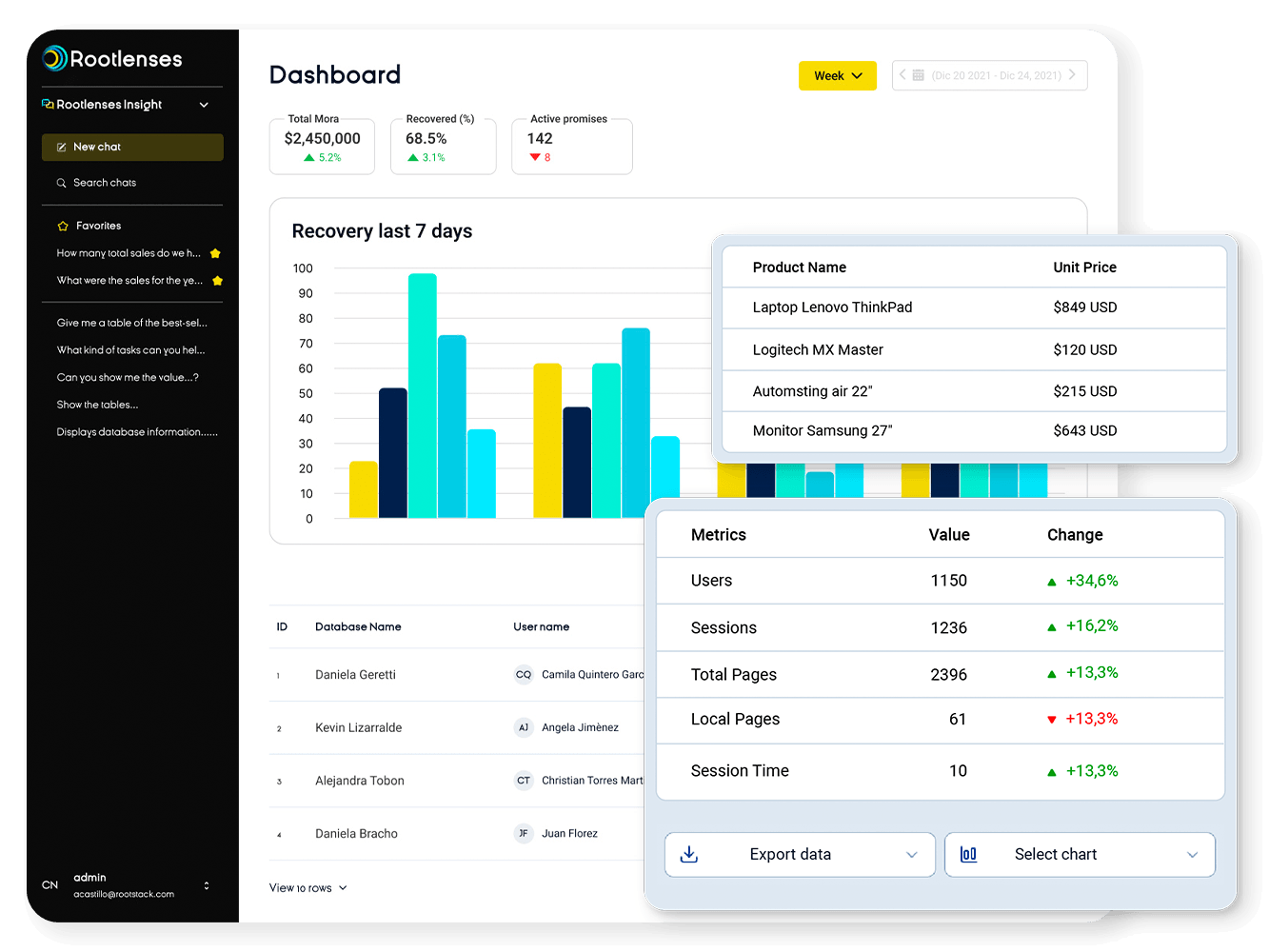
- Analyze business performance.
- Detect trends and patterns in data.
- Identify operational opportunities.
- Generate insights without manually creating reports.
- Make faster data-driven decisions.
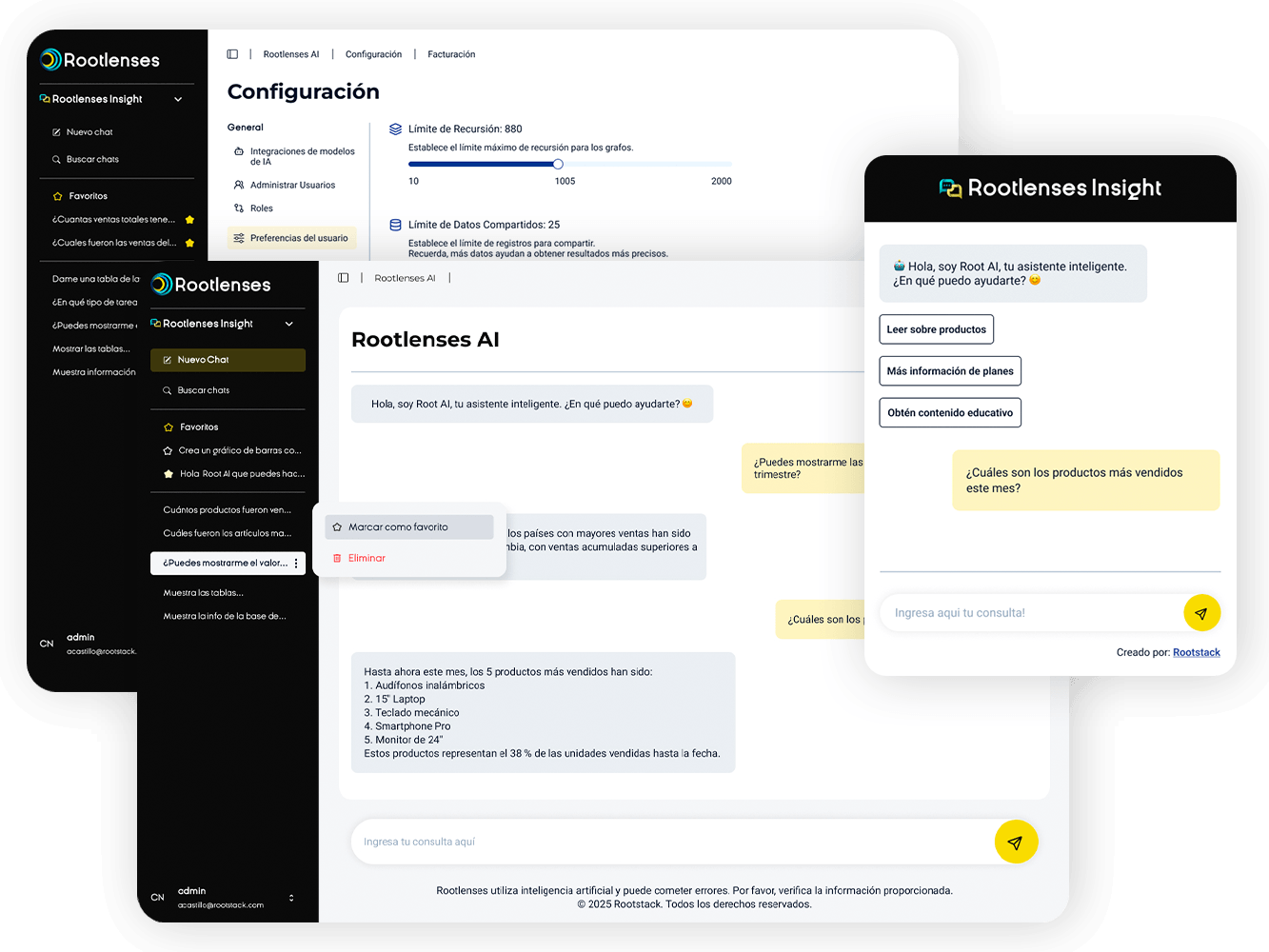
Rootlenses Insight combines Business Intelligence, artificial intelligence, and conversational analytics capabilities to provide a more accessible way to use enterprise information.
For example, a sales leader can ask:
"Which products are driving revenue growth and which categories require attention?"
or:
"What factors explain the decrease in sales in certain locations?"
and receive answers based on real organizational data.
The future of Business Intelligence is AI-powered and conversational
The future of data analysis is not about replacing BI platforms, but about making information more accessible, actionable, and useful across the entire organization.
Power BI with Copilot represents an important evolution of traditional Business Intelligence by incorporating generative artificial intelligence capabilities.
On the other hand, conversational analytics platforms represent the next step by making natural language the center of data exploration.
For business leaders, the choice will depend on organizational objectives:
- If the priority is improving existing dashboards, optimizing reporting processes, and leveraging a Microsoft-based infrastructure, AI-enhanced BI tools can be a strong alternative.
- If the goal is enabling teams to explore data independently, reducing technical dependency, and making faster decisions, conversational analytics can provide a greater competitive advantage.
Companies that successfully combine a strong data foundation with artificial intelligence-powered analytics platforms will be better prepared to compete in a data-driven economy.
Request a demo of Rootlenses Insight
Discover how your teams can interact with business data using artificial intelligence and conversational analytics.
Request a demo of Rootlenses Insight and transform business questions into actionable insights in seconds.


