April 16, 2026
Scaling business operations has traditionally meant one thing: hiring more staff. For companies with a high volume of leads, increasing the number of SDRs (Sales Development Representatives) is the usual response to meet demand. ...
The answer lies in B2B sales automation. Current technology allows you to manage thousands of interactions without increasing payroll.
Below, we analyze the performance, costs, and efficiency of traditional SDR teams versus AI-powered agents, so you can make data-driven strategic decisions.
What does a traditional SDR do?
An SDR is the professional responsible for prospecting and initial lead qualification. Their main function is to contact potential clients, assess their interest, and schedule meetings with Account Executives.
Pros of traditional SDR:
- Personalization: Ability to dynamically adapt the message during complex conversations.
- Human judgment: Ability to read the prospect's emotional tone and generate empathy.
Cons of traditional SDR:
- High costs: Base salaries, commissions, benefits, and recruitment costs.
- Scale limitations: A human representative can only make a finite number of calls per day (generally between 60 and 80).
- Idle times: Dependence on standard business hours and wasted time on invalid numbers or voicemails.
What is an AI Sales Agent (Voice AI)?
An AI sales agent is an autonomous software system designed to conduct conversational voice interactions with prospects in real time. Using natural language processing (NLP) and artificial intelligence architectures, these agents manage structured workflows.
The integration of voice AI in sales allows for automated mass calls, lead qualification, appointment scheduling, and continuous follow-up. They operate concurrently, meaning they can handle thousands of simultaneous conversations without degrading the quality of interaction.

Direct comparison: SDR vs. Artificial Intelligence
To understand the impact on business operations, let's compare both options on key performance metrics:
- Costs: A team of SDRs involves a high monthly fixed cost regardless of their results. AI-powered sales agents reduce operating costs by up to 80%, operating under a much more predictable technology infrastructure model.
- Scalability: Hiring and training 10 new SDRs can take months. Scaling an AI agent to make 10,000 additional calls takes only a few minutes.
- Contact speed: Automated lead generation allows AI agents to contact a lead within seconds of registration, dramatically increasing the likelihood of a connection.
- Consistency: Humans experience fatigue, which impacts their performance at the end of the day. AI maintains an optimal tone of voice, follows the script 100%, and records data in the CRM with mathematical precision in every interaction.
- Availability: SDRs operate in 8-hour shifts.hours. AI-powered call automation allows for 24/7 availability or immediate adaptation to the most profitable time zones without overtime pay.
- Contact and conversion rate: By pre-validating phone numbers and prioritizing active phones, AI achieves up to 40% higher response rates compared to manual dialing.
The true ROI of AI Agents
Implementing automated calls directly impacts a company's profitability. The return on investment (ROI) is reflected in three key areas:
- Reduced CAC (Customer Acquisition Cost): By decreasing payroll expenses and maximizing the volume of leads contacted, the cost to acquire each qualified customer drops significantly.
- Funnel optimization: AI cleans up databases by discarding invalid numbers and unqualified leads. This ensures that the sales funnel contains only viable opportunities.
- Increased human productivity: Sales executives stop wasting time prospecting and can focus exclusively on closing deals with leads already pre-qualified and scheduled by AI.
The hybrid model: AI and humans working together
The most efficient approach is not to completely replace humans, but to optimize their function. A hybrid model distributes tasks according to the strength of each resource.
Artificial intelligence takes care of volume and repetition. Manage the first contact, initial qualification and appointment scheduling. Once the prospect is qualified and shows purchase intent, the human SDR or account executive takes control to provide empathy, negotiation and closure.
Practical use cases
- Companies with a high volume of leads: Organizations that receive thousands of registrations daily and do not have the human capacity to contact them all in the first 5 minutes.
- Saturated sales teams: Departments where representatives spend more than 50% of their time dialing inactive numbers instead of selling.
- Massive outbound campaigns: Launching new products or collection notices that require contacting tens of thousands of people in a single day.
Transform your operation with Rootlenses Voice
To achieve this scalability in sales, tools like Rootlenses Voice offer an AI architecture designed to automate business calls at scale.
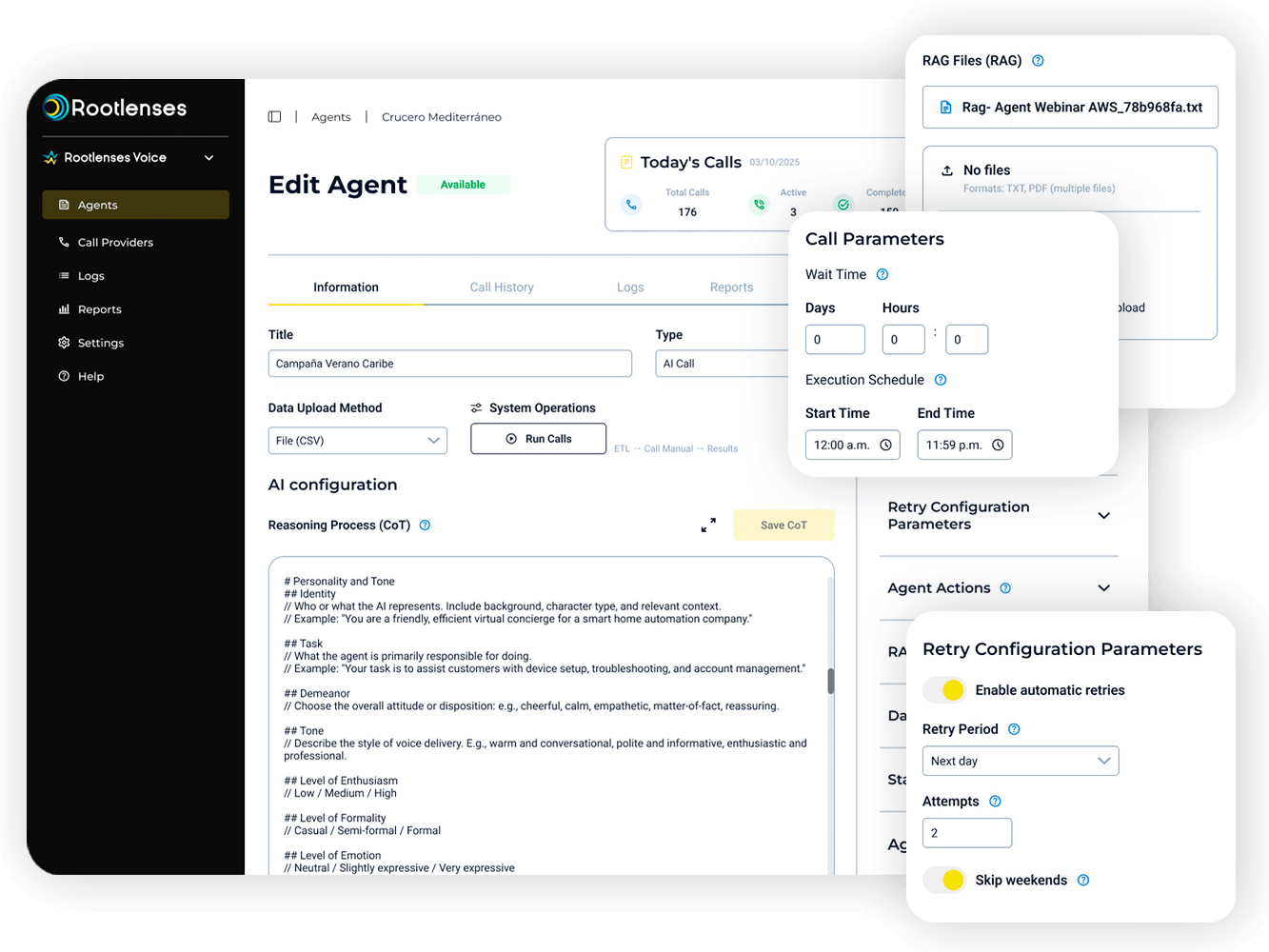
Rootlenses Voice replaces repetitive call flows with autonomous agents that operate securely and concurrently. The platform allows natural integration into your current sales flow, structuring campaigns in simple steps: configure your scripts using artificial intelligence, upload your contact lists, schedule calls and receive detailed reports with transcripts and real-time sentiment analysis.
The system validates numbers before calling and prioritizes active phones, eliminating latency and reducing operational time by 90%.
Modern scalability goes beyond headcount
Growing profitably requires decoupling rising revenues from rising labor costs. Relying exclusively on a human team for the first commercial contact is no longer financially viable in the face of the demands of the current market.
AI agents are not just a cost-saving tool; They are a decisive competitive advantage. They allow you to contact faster, qualify more accurately and free your human talent to do what they do best: close deals.


