
July 21, 2026
Managing a retail business has never been as complex as it is today. Consumers shop through physical stores, ecommerce websites, mobile applications, and marketplaces; supply chains are constantly evolving; and growing competition requires businesses to make faster decisions than ever before.
In this environment, data has become one of the most valuable assets for any organization. However, having thousands of reports does not guarantee better business outcomes. What truly matters is monitoring the Key Performance Indicators (KPIs) that help businesses understand what is happening across their operations and take action before issues impact profitability.
The good news is that AI-powered analytics platforms are transforming how retail leaders access information. Instead of navigating multiple dashboards or waiting for reports from the BI team, decision-makers can now ask questions in natural language and receive immediate answers.
Below are the ten KPIs every retail manager should monitor using an AI data analytics platform such as Rootlenses Insight.
Why Use Artificial Intelligence to Monitor KPIs?
Traditionally, KPI tracking relied on scheduled reports and manual analysis. This approach is time-consuming, and in many cases, by the time decision-makers receive the information, it is already too late to take corrective action.
With AI-powered data analytics, business leaders can monitor KPIs in real time, automatically detect anomalies, identify trends, and drill down into the root causes of changes without writing SQL queries or depending on specialized analysts.
This enables faster, more accurate, and data-driven decision-making.
1. Sales by Store
One of the most important retail KPIs is understanding the performance of each store individually.
Beyond total sales volume, artificial intelligence can quickly identify which stores are experiencing unusual declines, which locations are outperforming expectations, and which factors may be influencing those results.
With an AI retail analytics platform, a manager can simply ask:
Which stores experienced the largest sales decline last week?
And receive the answer in just a few seconds.
2. Average Transaction Value
Average transaction value measures how much each customer spends per purchase and is one of the most important indicators of commercial profitability.
Artificial intelligence helps identify differences between stores, product categories, and customer segments, making it easier to evaluate the effectiveness of promotions and cross-selling strategies.
3. Inventory Turnover
Holding too much inventory ties up capital, while running out of products leads directly to lost sales.
Continuously monitoring this KPI helps retailers identify slow-moving products, excess inventory, and categories that require adjustments to replenishment strategies.
Predictive analytics for retail can even anticipate shifts in demand by analyzing historical data and purchasing patterns.
4. Stockout Rate
One of the most expensive problems for any retailer is not having products available when customers are ready to buy.
Monitoring stockouts in real time enables businesses to react quickly, reduce lost revenue, and improve the customer experience.
Artificial intelligence can identify which products are most likely to run out before the issue actually occurs.
5. Gross Margin by Category
Not every sale generates the same level of profitability. Analyzing gross margin by category helps retailers identify which product lines contribute the most value and which require adjustments in pricing, promotions, or operational costs.
This KPI is especially valuable for developing more profitable commercial strategies.
6. Promotion Conversion Rate
Promotions represent a significant investment for every retail business.
Artificial intelligence makes it possible to measure which campaigns actually increased sales, which boosted average transaction value, and which simply reduced margins without generating meaningful business value.
This enables retailers to optimize future marketing strategies based on data rather than assumptions.
7. Best- and Worst-Performing Products
Simply knowing which products sell the most is no longer enough.
Retail managers need to identify which products are losing market share, which are experiencing rapid growth, and which present opportunities to increase sales through promotions or improved product distribution.
Thanks to conversational analytics, these insights can be obtained simply by asking questions in natural language.
8. Sales by Channel
Today's consumers interact with multiple channels before making a purchase.
Monitoring sales across physical stores, ecommerce websites, marketplaces, and mobile applications helps retailers understand how each sales channel is performing and where future investments should be focused.
AI-powered data analytics platforms make it easy to compare channel performance and uncover new growth opportunities.
9. Customer Retention and Repeat Purchase Rate
Acquiring new customers is typically more expensive than retaining existing ones.
For this reason, one of the most valuable retail KPIs is measuring how many customers make repeat purchases, how frequently they return, and which customer segments are at the highest risk of churn.
Artificial intelligence uncovers behavioral patterns that would be nearly impossible to detect using traditional reporting methods.
10. Sales Forecasting
Perhaps one of the most valuable capabilities for retail leaders is the ability to anticipate future demand.
Modern predictive analytics platforms leverage artificial intelligence to forecast sales by analyzing historical trends, seasonality, promotional campaigns, and customer purchasing behavior.
This enables retailers to plan inventory, marketing initiatives, staffing, and operations with far greater accuracy.
How AI Is Transforming KPI Analysis
The difference between a traditional dashboard and an AI-powered analytics platform goes far beyond data visualization.
Modern solutions enable users to have conversations with their business data.
Instead of reviewing dozens of reports, a manager can simply ask:
- Which product categories experienced the largest profitability decline this month?
- Which stores are at the highest risk of stockouts?
- Which promotions generated the highest return on investment?
- Which products recorded the highest sales growth compared to last quarter?
The platform interprets the question, analyzes the underlying business data, and delivers reliable answers in just seconds.
This approach, known as conversational analytics, significantly accelerates decision-making while reducing dependence on manual reporting and technical teams.
Rootlenses Insight: AI-Powered Retail Analytics for Smarter Decisions
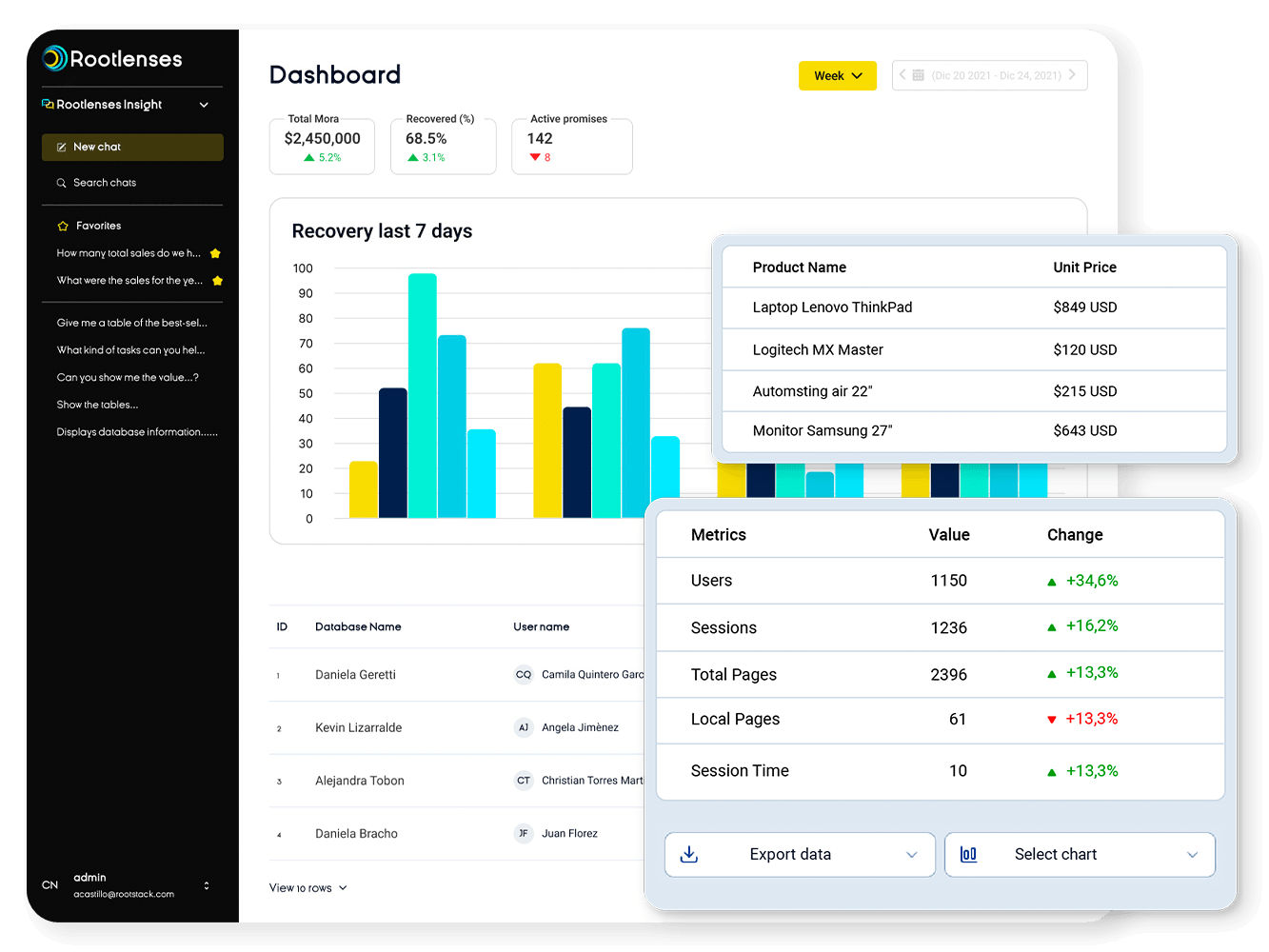
Rootlenses Insight helps retail organizations transform massive volumes of business data into actionable insights using artificial intelligence.
The platform allows business users to query data using natural language, automatically understand database context, generate validated SQL queries, and deliver accurate answers for commercial, financial, and operational teams.
From sales and inventory analysis to promotion performance and demand forecasting, Rootlenses Insight provides a faster, smarter way to access critical business information and make data-driven decisions.
Turn Your Retail KPIs into Smarter Business Decisions
Monitoring KPIs is no longer enough. Leading retailers use artificial intelligence to interpret their data, identify opportunities before competitors do, and respond faster to changing market conditions.
If you're looking for an AI-powered retail analytics platform that allows you to query data using natural language and transform business information into strategic decisions, Rootlenses Insight is built for you.


