March 25, 2026
In the implementation of AI voice agents in healthcare, one of the most common mistakes is not in the technology, but in the design: poorly structured call flows, disconnected from clinical reality and full of friction.
For leaders in hospitals, clinics, and care networks, this has a direct impact on outcomes:
- Low call resolution rates
- Patient frustration
- Operational inefficiency
- Loss of trust in automation
The difference between a voice agent that works and one that fails lies in how conversational flows (call flows) are designed.
This article breaks down how to build effective call flows focused on critical healthcare processes: scheduling, reminders, triage, and follow-up.
What defines an effective call flow in AI voice agents for healthcare
An effective call flow is not just a decision tree. It is a conversational representation of a real clinical process.
It must meet three key principles:
1. Clarity
The patient must understand what is happening at every step.
2. Low friction
Each step should minimize cognitive effort and time.
3. Clinical alignment
The flow must reflect how the institution actually operates.
Signs of a poorly designed call flow
- Redundant questions
- Too many simultaneous options
- Unnecessary technical language
- Lack of context at each step
- Failure to account for exceptions
Good design removes these issues and creates a fluid, intuitive, and efficient experience.
Call flows for appointment scheduling with AI voice agents
Scheduling is one of the most critical and high-impact use cases.
Flow objective
Enable the patient to book an appointment quickly and without confusion.
Recommended structure
1. Contextual opening
- “I’m calling to help you schedule your medical appointment”
2. Minimal required identification
- Name / ID (only if necessary)
3. Define the need
- Specialty or type of consultation
4. Availability proposal
- Offer concrete options (not open-ended)
- “I have availability Tuesday at 10am or Thursday at 3pm”
- “I have availability Tuesday at 10am or Thursday at 3pm”
5. Confirmation
- Repeat date, time, and details
6. Clear closing
- Additional information (location, preparation, etc.)
Best practices
- Limit options to 2–3 per interaction
- Avoid unnecessary open-ended questions
- Real-time calendar integration
Impact
- Higher appointment conversion rates
- Reduced call abandonment
- Optimized provider utilization

Call flows for automated medical reminders
Reminders are key to reducing no-shows, but they must be properly designed to be effective.
Flow objective
Confirm, reschedule, or cancel with minimal patient effort.
Recommended structure
1. Clear identification
- “I’m calling from the medical center to remind you of your appointment…”
2. Specific information
- Date, time, specialty
3. Direct action
- “Would you like to confirm, reschedule, or cancel?”
4. Immediate resolution
- Execute the action within the same call
Best practices
- Avoid repeating information unnecessarily
- Allow quick responses (“yes”, “no”, “change”)
- Handle intelligent retries if there is no response
Impact
- Significant reduction in no-shows
- Improved operational planning
- Increased call center efficiency
Call flows for initial triage with AI voice agents
Triage is one of the most sensitive use cases, where flow design is critical.
Flow objective
Correctly classify the patient and direct them to the appropriate level of care.
Recommended structure
1. Empathetic opening
- “I want to help you understand the next step based on what you’re experiencing”
2. Guided questions
- Specific symptoms
- Duration
- Severity level
3. Classification
- Low risk → scheduling
- Medium → medical recommendation
- High → immediate escalation
4. Escalation
- Transfer to a human or provide urgent instructions
Best practices
- Use simple and clear questions
- Avoid ambiguity
- Always include an option to speak with a human
Impact
- Better allocation of medical resources
- Reduced emergency room overload
- Increased patient safety
Call flows for post-consultation follow-up with AI
Post-care follow-up is where many institutions fail due to lack of operational capacity.
Flow objective
Monitor the patient and detect potential complications.
Recommended structure
1. Context
- “I’m calling to check how you’ve been doing since your consultation…”
2. Key questions
- General condition
- Specific symptoms
- Treatment adherence
3. Evaluation
- Normal → close
- Alert → escalation
4. Empathetic closing
- Reinforce availability and support
Best practices
- Keep the flow short and clear
- Prioritize risk detection
- Integrate with clinical systems
Impact
- Improved clinical outcomes
- Reduced readmissions
- Higher patient satisfaction
Cross-functional principles for designing frictionless call flows in healthcare
Beyond each use case, there are universal principles:
1. Design for conversation, not the system
Flows should feel natural, not like spoken forms.
2. Minimize steps
Every question must have a clear purpose.
3. Anticipate edge cases
- Patients who don’t understand
- Ambiguous responses
- Out-of-flow situations
4. Always include human handoff
A good system doesn’t try to solve everything.
5. Measure and continuously optimize
- Completion rate
- Abandonment
- Conversion
- Interaction time
Call flows are not static; they are living systems that must evolve.
From operational flows to efficient experiences
When call flows are well designed:
- Calls become shorter and more effective
- Patients easily understand what to do
- Staff are freed from repetitive tasks
- Operations become more predictable
For healthcare leaders, this means moving from fragmented processes to orchestrated and efficient operations.
Conclusion: design defines AI success in healthcare
Implementing AI voice agents alone does not guarantee results.
The real impact depends on:
- How call flows are designed
- How aligned they are with real clinical processes
- How easy they are for patients to interact with
Systems that prioritize clarity, simplicity, and clinical context are the ones that truly work.
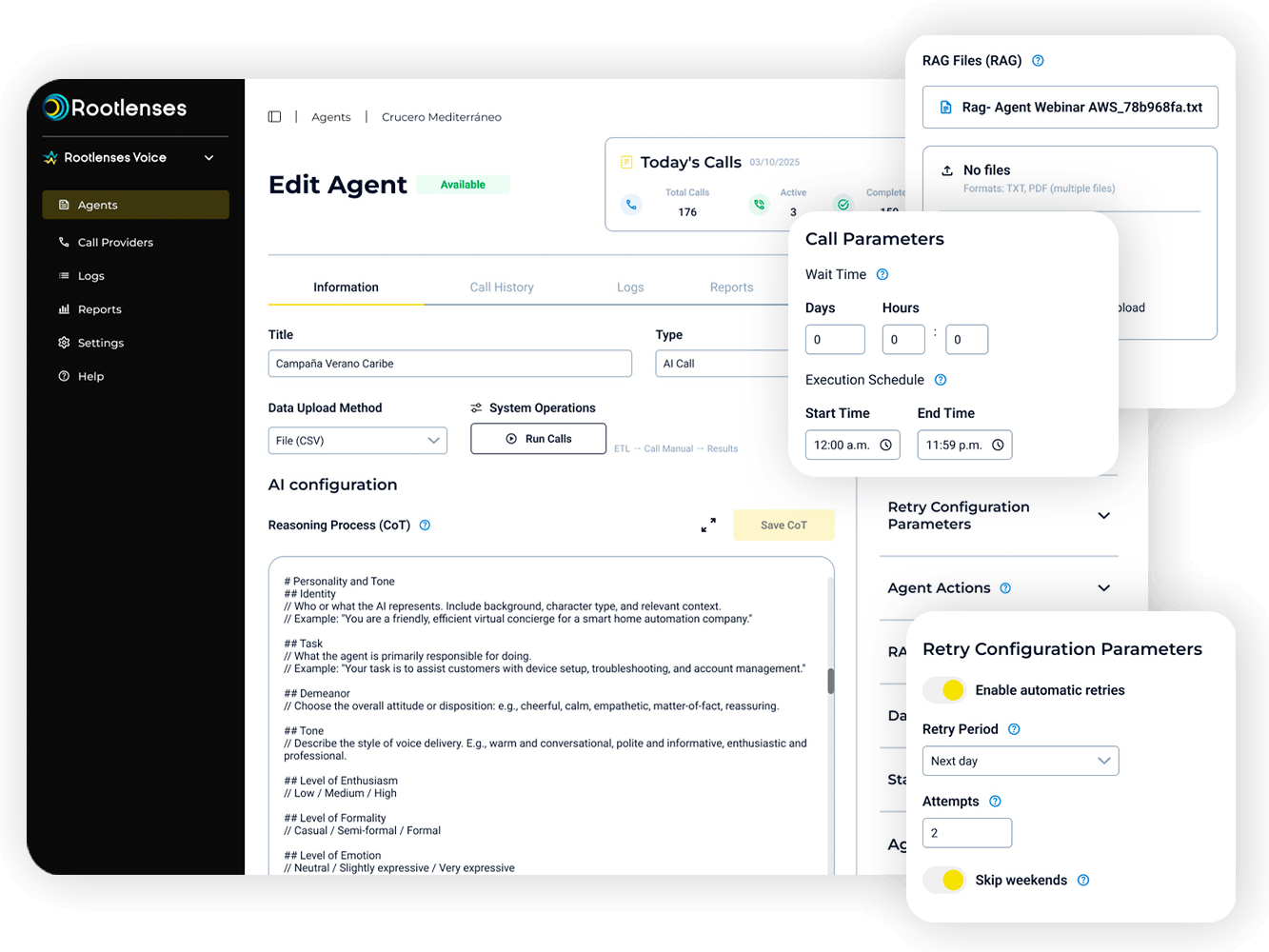
Optimize your call flows with Rootlenses Voice
Rootlenses Voice enables you to design and deploy AI voice agent call flows tailored to the realities of the healthcare industry.
With capabilities such as:
- Modular conversational flow design
- Integration with calendars, CRMs, and clinical systems
- Edge case handling and intelligent escalation
- Real-time metrics for continuous optimization
You can build voice experiences that not only automate, but actually perform in production.


