
July 15, 2026
Implementing an AI voice agent represents an opportunity to transform how businesses serve customers, manage sales, automate processes, and optimize operations. However, many organizations discover that the success of this technology does not depend solely on choosing a strong artificial intelligence model or a natural-sounding voice.
A conversational AI project requires strategy, data preparation, clearly defined objectives, technology integration, and effective change management.
The most common mistake is assuming that implementing Voice AI simply means connecting a platform and starting to make automated calls. In reality, a successful AI voice agent must understand the business, follow defined processes, integrate with existing systems, and deliver an experience that aligns with customer expectations.
In this article, we examine the most common mistakes companies make when implementing AI voice agents and how to avoid them.
The Most Common Mistakes When Implementing AI Voice Agents
1. Implementing Voice AI Without Defining a Clear Business Objective
One of the most frequent mistakes is starting an automation project without answering one fundamental question:
What problem are we trying to solve?
Some companies implement an AI agent simply because artificial intelligence is a trend, but they have not defined the specific outcomes they expect to achieve.
Before designing a conversational workflow, it is essential to establish clear business objectives, such as:
- Reducing wait times.
- Increasing sales.
- Improving customer service.
- Automating repetitive processes.
- Increasing debt recovery rates.
- Reducing operational costs.
For example, a company looking to improve its sales process may focus on automated sales, while a financial institution may prioritize automated debt collection.
Without a clear objective, it becomes difficult to measure the project's success.

2. Designing Conversations That Are Too Rigid
One of the biggest mistakes is treating a modern AI agent like a traditional IVR system.
Legacy systems operated through decision trees:
"Press 1 for Sales. Press 2 for Support."
However, today's users expect natural conversations.
An AI voice agent should be able to:
- Understand different ways of expressing the same need.
- Handle interruptions.
- Ask for clarification.
- Adapt to the conversation's context.
- Respond to unexpected questions.
An overly rigid conversation flow creates frustration and makes the experience feel unnatural.
The key is to design flexible conversations in which the AI follows clear rules while retaining the ability to adapt.
3. Failing to Properly Train the Agent with Business Information
An AI voice agent cannot provide high-quality answers if it does not have access to the company's relevant information.
Another common mistake is deploying a solution without properly preparing:
- A knowledge base.
- Frequently asked questions.
- Internal policies.
- Product information.
- Business processes.
- Legal constraints.
- Customer information.
The quality of every conversation depends directly on the quality of the knowledge available.
A robust conversational AI platform should enable organizations to continuously train and update the agent to ensure accurate responses.
4. Ignoring the Importance of Voice and the Conversational Experience
Voice is one of the most important elements of any phone interaction.
Users may accept automation if the conversation feels natural, but a poor voice experience can lead to immediate rejection.
Some critical factors include:
- Voice quality.
- Intonation.
- Speaking pace.
- Natural pauses.
- Interruptibility.
- Adaptation to language and accent.
A virtual voice assistant should feel like an efficient conversation, not like listening to a prerecorded message.

5. Overlooking Response Latency
Latency is one of the factors that most significantly affects the perception of natural conversation.
When people speak on the phone, they expect a prompt response. Long periods of silence create the impression that the AI lacks intelligence or fails to understand the conversation.
For this reason, a professional Voice AI implementation should consider:
- Processing time.
- Model speed.
- Technology infrastructure.
- External integrations.
An AI voice agent must respond smoothly to maintain a balanced and natural conversation.
6. Choosing a Platform Without Evaluating Integrations
A standalone AI voice agent provides limited value.
To generate real business outcomes, it must connect with the tools the company already uses, including:
- CRM.
- ERP.
- Payment platforms.
- Ticketing systems.
- Calendars.
- Databases.
For example, an AI agent that schedules appointments should be able to check availability and automatically record the appointment details.
An agent used for automated debt collection should integrate with financial systems to retrieve outstanding balances and update payment statuses.
Integration is what transforms a conversation into a business action.
7. Trying to Automate Overly Complex Processes from the Start
Another common mistake is attempting to automate highly complex processes during the initial implementation phase.
A more effective strategy is to begin with well-defined use cases, such as:
- Appointment confirmations.
- Frequently asked questions.
- Sales follow-ups.
- Reminders.
- Lead qualification.
Once these are successful, the organization can move toward more complex processes such as negotiations, consultative selling, or specialized customer support.
A phased implementation enables organizations to learn, optimize, and reduce risk.
8. Failing to Properly Prepare Human Agent Handoffs
Even when the goal is automation, there will always be situations where human intervention is necessary.
A well-designed system should define:
- When a call should be transferred.
- Which team should receive the transfer.
- What information should be shared.
- How to prevent customers from having to repeat everything again.
A poor handoff can undo an otherwise positive customer experience.
AI should complement human teams, not create a barrier between the business and its customers.
9. Failing to Measure Results and Establish KPIs
Implementing an AI voice agent without measuring results is one of the most expensive mistakes organizations can make.
Before deployment, companies should define key performance indicators such as:
- Resolution rate.
- Conversion rate.
- Average call duration.
- Customer satisfaction.
- Call transfers.
- Cost per interaction.
- Debt recovery rate.
- Return on investment (ROI).
These KPIs make it possible to understand what is working and where improvements are needed.
As discussed previously, measuring the ROI of Voice AI requires evaluating both financial benefits and operational and customer experience improvements.
10. Failing to Establish a Continuous Improvement Strategy
An AI voice agent should never be considered a finished project after deployment.
The most successful implementations continuously evolve through:
- Conversation analysis.
- Error reviews.
- Ongoing training.
- Prompt optimization.
- Workflow refinements.
- New use cases.
Every call generates valuable information that can be used to improve the system's performance.
Artificial intelligence learns from day-to-day operations, but it still requires continuous oversight and optimization.
11. Neglecting Data Security and Compliance
Business phone calls often involve sensitive customer information.
For that reason, every implementation should consider:
- Personal data protection.
- Access control.
- Conversation logging.
- Regulatory compliance.
- Information governance.
This is especially critical in industries such as banking, healthcare, and insurance, where security must be built into the solution from day one.
How to Implement Voice AI Successfully
A successful AI voice agent implementation requires combining technology, business strategy, and domain expertise.
Best practices include:
- Define a clear business objective.
- Select the right use case.
- Prepare business knowledge and data.
- Design natural conversations.
- Integrate existing systems.
- Measure KPIs from the beginning.
- Continuously optimize.
Artificial intelligence does not replace business strategy. It strengthens it.
The Success of Voice AI Depends on How It Is Implemented
AI voice agents represent a new generation of business automation. However, the difference between a successful implementation and one that fails to deliver results lies in the planning.
The organizations that generate the greatest value are not necessarily those with the most advanced technology, but those that understand their processes, know their customers' needs, and use artificial intelligence to solve real business challenges.
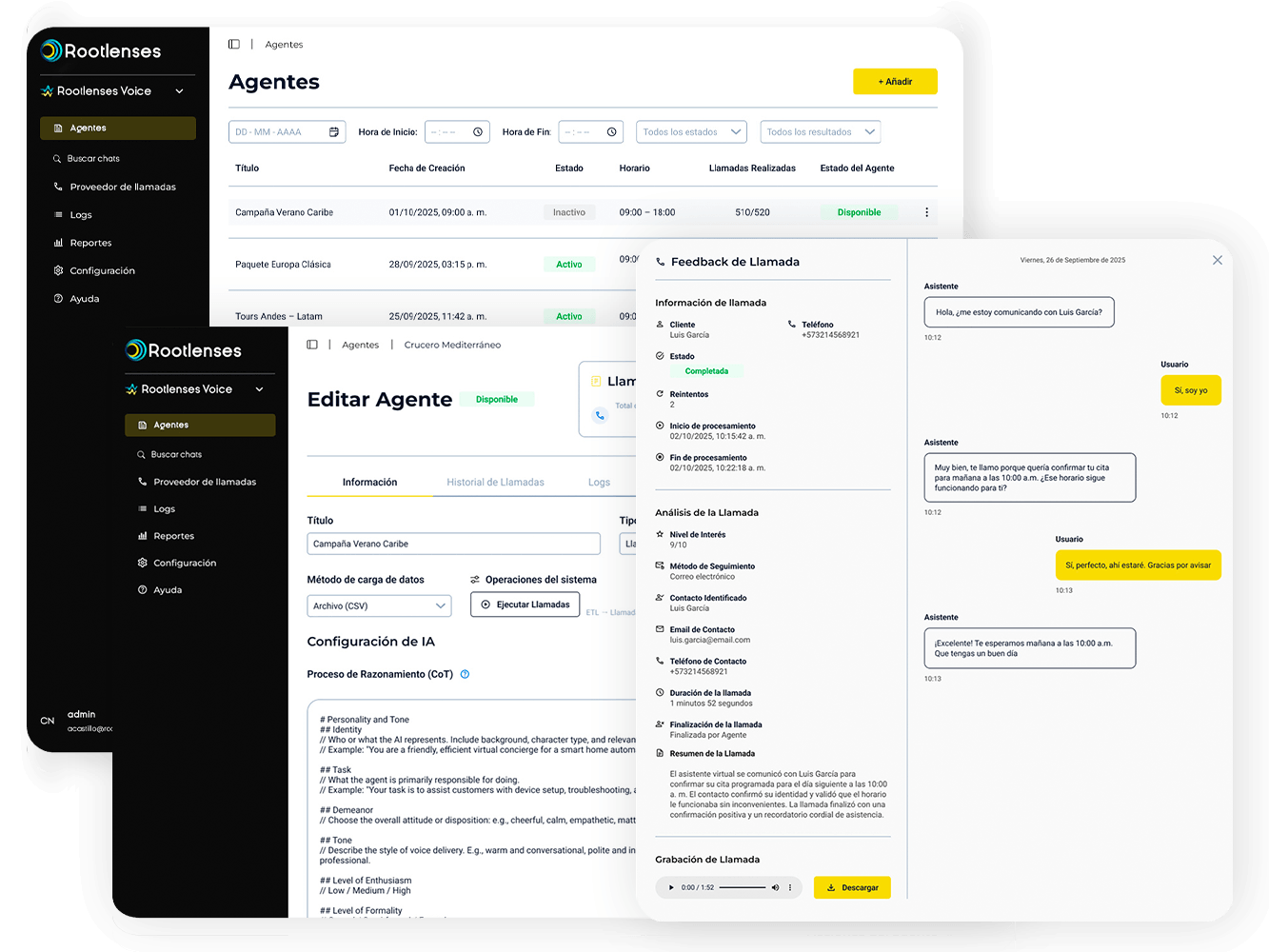
At Rootlenses Voice, we help organizations implement AI voice agents tailored to their business objectives. Our platform enables companies to create natural conversations, automate customer service, support automated sales, automated debt collection, run high-volume outbound calling campaigns, and streamline operational processes through seamless integration with enterprise systems.


