21 de abril de 2026
Artificial Intelligence in banking has ceased to be a future trend to become an immediate competitive advantage. Today, traditional banks, fintechs, cooperatives, and financial entities are implementing AI for banking, banking automation, predictive models, and conversational assistants to reduce costs, improve customer experience, and strengthen regulatory compliance.
In an environment where users expect immediate responses, simple processes, and total security, banking needs to operate with more speed and precision. That is where AI makes the difference.
What is AI in banking?
AI in banking consists of applying machine learning algorithms, natural language processing, intelligent automation, and advanced analytics to optimize financial operations.
This includes everything from fraud detection with AI, automated credit evaluation, virtual banking assistants, predictive scoring, regulatory monitoring, to collections automation and omnichannel customer service.
Key benefits of AI for banks and fintechs
1. Reduction of operating costs
Many repetitive tasks consume thousands of human hours: validations, follow-up calls, documentation, and application classification. AI allows these workflows to be automated, drastically reducing human error and freeing up staff for tasks of greater strategic value. By implementing language and data processing systems, financial institutions can process in minutes what previously took days.
2. Better customer experience
Today's users demand immediate and personalized attention. With AI, banks can offer 24/7 support, resolve transactional doubts without friction, and offer financial product recommendations that truly fit the user's profile. Immediacy is now the key factor for customer retention.
3. Greater financial security
Predictive models detect anomalies in real time, analyzing behavioral patterns that would be invisible to the human eye. This is essential to prevent fraud, stop money laundering, and mitigate suspicious operations before they impact the institution's balance sheet.
4. More precise decisions
AI analyzes thousands of variables simultaneously—from traditional credit history to alternative data—to improve credit approvals and segmentation. This allows banks to be more aggressive in their growth without compromising their risk exposure.
5. Scalability
Technology allows a bank to grow in number of users without needing to proportionally increase its operational structure. An AI system can serve ten or ten thousand people simultaneously with the same quality of response.
In this context of innovation, tools like Rootlenses Voice are helping institutions bridge the gap between technological efficiency and the warmth of human interaction, allowing voice to be the engine of these new financial experiences.

Main use cases of AI in banking
1. AI for banking fraud detection
One of the most profitable uses of financial AI is identifying suspicious patterns in payments, transfers, access, and transactional behavior.
Examples:
- Cards used in unusual locations
- Transfers outside of historical patterns
- Multiple failed access attempts
- Accounts with anomalous activity
AI detects this in seconds and activates alerts or preventive blocks.
2. AI for credit risk analysis
Traditional models are no longer enough. AI allows evaluating:
- Financial history
- Variable income
- Payment behavior
- Macroeconomic variables
- Alternative data
This improves financial inclusion and reduces delinquency.
3. Collections automation with AI
Collecting efficiently without deteriorating the customer relationship is key. AI allows:
- Prioritizing accounts by probability of payment
- Choosing the best contact channel and time
- Personalizing messages
- Automating calls and follow-up
- Escalating complex cases to humans
4. Banking customer service with AI
Virtual assistants and voicebots resolve:
- Balance inquiries
- Card status
- Theft reporting/blocking
- Installment rescheduling
- Appointments and branches
- Frequently asked questions
5. Regulatory compliance and adherence
Financial regulation requires traceability, controls, and constant monitoring. AI helps with:
- Automated KYC
- AML monitoring
- Detection of suspicious operations
- Document auditing
- Regulatory classification
Automation opportunities in banking
Front office
Everything related to the customer:
- Sales
- Service
- Digital onboarding
- After-sales support
- Retention
Middle office
Analytical and control processes:
- Risk
- Compliance
- Pricing
- Forecasting
Back office
Internal processes:
- Document loading
- Reporting
- Reconciliations
- Administrative management
Conversational AI: the great opportunity in banking
Many banks still rely on large call center teams with high costs and inconsistent experiences.
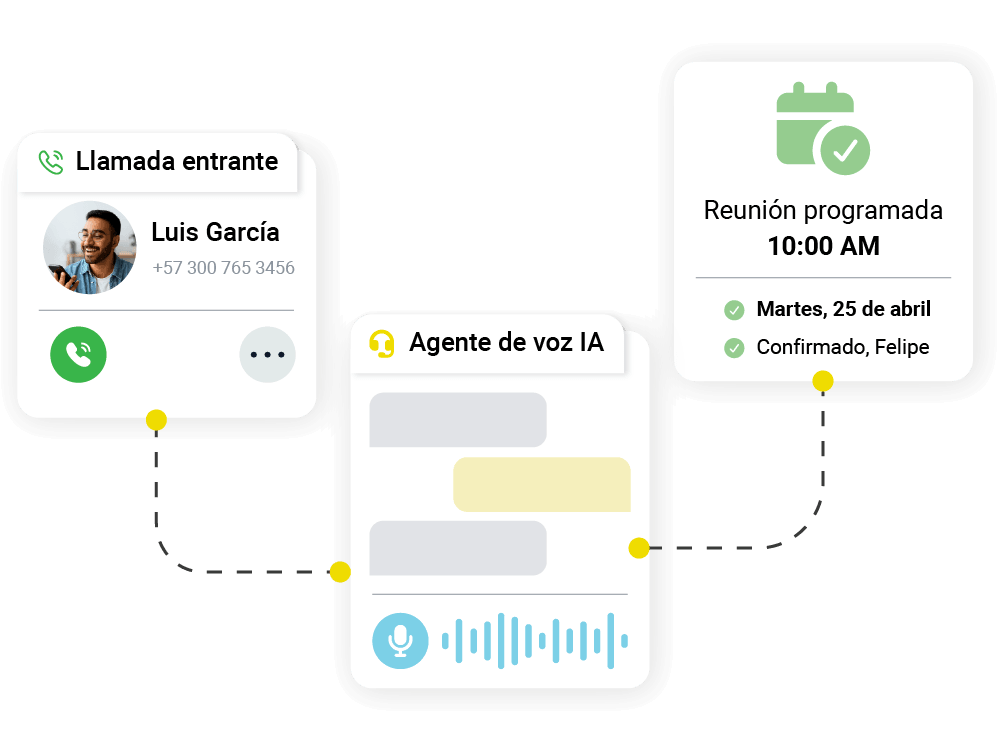
Voice AI for banking allows the automation of thousands of simultaneous conversations using natural language.
Concrete cases:
- Payment confirmation
- Expiration reminders
- Lead recovery
- Identity verification
- Satisfaction surveys
- 24/7 Support

Regulatory compliance: how to implement AI without risk
Adopting AI in banking requires governance.
Best practices:
1. Transparency and explainability
Every automated decision must be explainable, especially in credit, pricing, or segmentation processes.
For example, if an application was rejected, the institution must be able to justify relevant variables such as:
- debt level
- payment history
- documentary inconsistencies
- estimated payment capacity
"Black box" models without a clear explanation can generate regulatory observations and friction with customers.
Recommendation:
Use interpretable models or explainability layers that allow complex decisions to be translated into language understandable for business, audit, and the customer.
2. Data security and privacy
AI models often require large volumes of information. In banking, that includes highly sensitive data:
- identity
- income
- financial behavior
- credit history
- recordings
- digital interaction
This requires compliance with local and international data protection regulations.
Recommendation:
- anonymization where possible
- access control
- data encryption
- usage traceability
- clear retention policies
AI must not become a back door for information risk.
3. Human supervision in critical decisions
Total automation is not always recommended. In high-impact processes, AI should assist, not completely replace human judgment.
Examples where supervision is appropriate:
- credit rejection
- account freezing
- complex fraud alerts
- debt restructurings
- sensitive claims
Recommended model:
Human-in-the-loop, where AI prioritizes, recommends, or detects, but a person validates key decisions.
This reduces errors and improves regulatory acceptance.
4. Auditing and full traceability
A bank must be able to answer questions such as:
- Which model made this decision?
- With which version?
- What data did it use?
- What score did it generate?
- Who approved the change?
- How has that model performed in recent months?
Without traceability, scaling AI in banking becomes risky.
Recommendation:
Record:
- model versions
- relevant inputs and outputs
- performance metrics
- changes made
- internal responsible parties
- detected incidents
This strengthens internal and regulatory audits.
5. Ethical management and bias control
Models learn from historical data. If that data contains unfair patterns, AI can replicate or amplify them.
Examples:
- excluding historically underserved segments
- penalizing informal profiles with real payment capacity
- indirect geographic or demographic bias
Recommendation:
Perform periodic fairness tests and review sensitive variables or hidden proxies.
Efficiency must not compromise equity.
How to start a banking AI project
Step 1: Detect repetitive processes
Look for high-volume tasks.
Step 2: Prioritize fast ROI
Choose cases with immediate impact.
Step 3: Integrate existing channels
CRM, core banking, call center, and WhatsApp.
Step 4: Measure results
Recommended KPIs:
- CAC
- AHT (TMO)
- Contactability
- Recovery
- NPS
- Delinquency (Mora)
- Cost per interaction
AI trends in banking for the coming years
- Voice AI for customer service and collections
- Financial hyper-personalization
- Predictive fraud prevention
- Real-time credit
- Assisted autonomous compliance
- Multichannel AI agents
Rootlenses Voice as an option for banking
For banks, fintechs, insurers, and financial entities seeking to modernize their customer contact operation through voice, Rootlenses Voice allows the deployment of conversational AI agents capable of automating high-volume interactions with a natural, efficient, and measurable experience.
The platform is designed to accompany critical processes where speed, traceability, and scalability are decisive, allowing the operation of massive campaigns without depending exclusively on traditional call center structures.