March 24, 2026
The conversation around AI voice agents in healthcare has evolved rapidly: it’s no longer just about automating calls, but about optimizing clinical, operational, and financial outcomes.
For healthcare leaders—such as directors, administrators, operations managers, and patient experience leaders—the question is no longer whether to implement AI, but where it generates the greatest measurable impact.
Below, we explore 5 concrete use cases where AI voice agents consistently outperform humans, both in efficiency and service quality.
5 use cases where AI voice agents outperform humans in healthcare
1. AI appointment reminders: reducing no-shows in healthcare
One of the biggest operational challenges in clinics and hospitals is the high rate of no-shows.
AI voice agents outperform human teams in this scenario for three key reasons:
- Scalability: they can make thousands of calls simultaneously without increasing costs
- Smart persistence: automated retries at optimal times
- Real conversational interaction: allowing patients to confirm, reschedule, or cancel in real time
Result:
No-show reductions of up to 30–50%, directly impacting revenue and schedule efficiency.
Unlike traditional call centers, where follow-ups depend on limited human capacity, AI ensures full coverage of the patient base.
2. Automated patient follow-up with AI voice agents
Post-consultation or post-procedure follow-up is critical for clinical outcomes, yet it is rarely executed consistently.
AI voice agents enable:
- Automated check-ins after consultations or surgeries
- Detection of warning symptoms through conversational flows
- Real-time escalation of critical cases to medical staff
Why they outperform humans:
- They eliminate execution variability
- They are not affected by staff workload
- They enable 100% patient coverage
Key impact:
- Improved treatment adherence
- Reduced complications
- Higher patient perception of care and support
This transforms healthcare from reactive to proactive and continuous.
3. Post-care surveys with AI: higher response rates and better data
Satisfaction surveys often have low participation when relying on traditional channels (email, forms).
AI voice agents change this by:
- Conducting surveys via phone calls with natural interaction
- Adapting questions based on patient responses
- Capturing qualitative feedback in real time
Advantages over humans:
- Eliminate interviewer bias
- Maintain consistency in questioning
- Operate at scale without quality degradation
Results:
- Significant increase in response rates
- Deeper insights into patient experience
- Better decision-making in quality management
For leaders, this means moving from surface-level metrics to actionable intelligence.
4. Automated insurance verification with AI voice agents
Insurance verification is one of the most costly, slow, and error-prone processes in healthcare operations.
AI voice agents can:
- Automatically contact insurers
- Verify coverage, eligibility, and co-pays
- Update systems in real time
Why they outperform humans:
- Reduce wait times and hold times
- Execute repetitive processes without errors
- Operate 24/7 without fatigue
Direct impact:
- Fewer billing rejections
- Improved cash flow
- Reduced administrative burden
This frees up staff to focus on higher-value tasks, such as direct patient care.
5. Mass scheduling with AI: operational efficiency at scale
When it comes to scheduling campaigns (vaccinations, preventive checkups, specialty care), humans simply cannot compete in speed and volume.
AI voice agents enable:
- Execution of mass outbound calling campaigns
- Patient qualification and automatic appointment booking
- Real-time integration with scheduling systems
Key advantages:
- Reach thousands of patients in hours, not weeks
- Drastically reduce conversion times
- Optimize medical schedule utilization
Strategic outcome:
Higher utilization of clinical resources and revenue growth without increasing headcount.

Why are AI voice agents outperforming humans in healthcare?
Beyond specific use cases, there is a clear pattern:
AI voice agents excel in processes that require:
- High repetition
- Scalability
- Consistency
- Continuous availability
While humans remain essential in:
- Diagnosis
- Complex empathy
- Clinical decision-making
The combination of both creates highly efficient hybrid models, where AI optimizes operations and human staff focus on critical tasks.
From operational efficiency to competitive advantage
For healthcare leaders, implementing AI voice agents is no longer just an operational improvement:
It is a strategic decision that impacts:
- Revenue (fewer no-shows, more completed appointments)
- Costs (automation of administrative processes)
- Patient experience (faster and more consistent interactions)
- Service quality (continuous follow-up and actionable data)
Organizations that adopt this technology early don’t just optimize—they differentiate their care model.
How to effectively implement AI voice agents in healthcare
To maximize results, it is key to:
- Integrate with existing systems (EHR, CRM, scheduling)
- Define conversational flows tailored to each use case
- Ensure compliance (HIPAA, GDPR, etc.)
- Measure clear KPIs: no-shows, contact rate, conversion, satisfaction
Proper implementation turns AI into a multiplier of operational capacity, not just another tool.
Conclusion: the time to adopt AI in patient communication
AI voice agents are already proving they can outperform humans across multiple critical processes in healthcare.
This is not about replacing people, but about redefining how care scales.
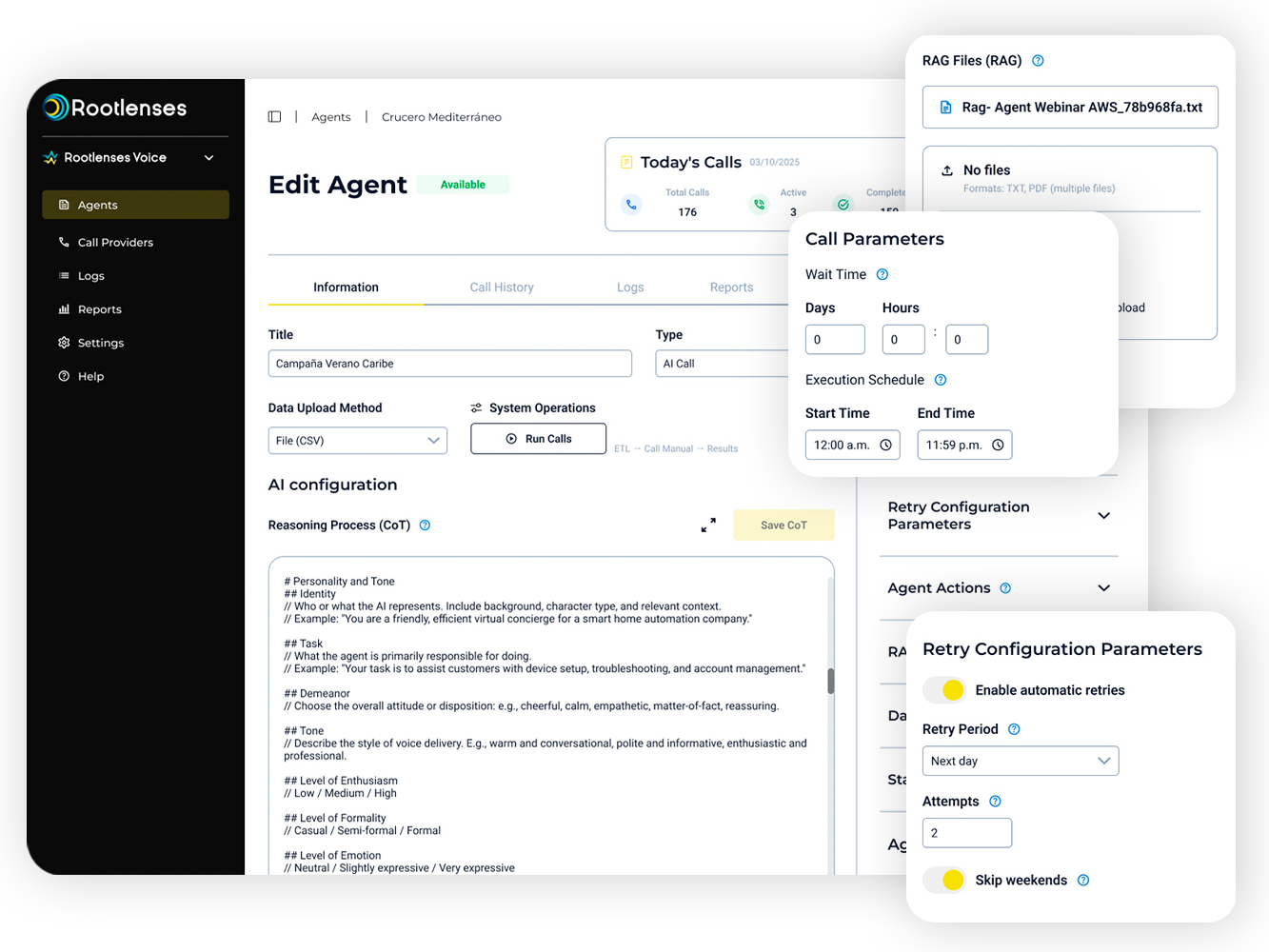
Power your operations with Rootlenses Voice
Rootlenses Voice is an AI voice agent designed to automate calls in complex industries like healthcare, enabling organizations to:
- Reduce no-shows with intelligent reminders
- Execute automated patient follow-ups
- Gather actionable feedback through surveys
- Verify insurance seamlessly
- Scale mass scheduling campaigns
All of this with integrations, real-time metrics, and full operational control.
If you're looking to improve efficiency, patient experience, and financial outcomes, now is the time to take the next step.


