
May 20, 2026
The customer service experience is entering a new stage. For years, companies relied almost exclusively on human receptionists to manage calls, answer questions, and route requests. However, the growth of conversational agents powered by artificial intelligence is changing the rules of modern customer service.
Today, one of the most relevant questions for companies of all sizes is: AI vs human receptionist: who responds better to customers?
The answer does not depend solely on costs. It also involves accuracy, speed, availability, scalability, and operational consistency.
In addition, user expectations changed radically. Customers no longer want to wait minutes on the line or receive incomplete answers. Studies from McKinsey show that consumers expect fast, consistent, and real-time experiences, especially in digital and conversational environments.
The problem with relying solely on human receptionists
Human receptionists provide empathy and natural communication. However, they also have structural limitations that affect the customer experience when a company begins scaling operations.
Among the most common challenges are:
- Limited capacity to handle multiple conversations simultaneously
- Dependence on manual training
- Variability in response quality
- Operational fatigue
- Schedule restrictions
- Difficulty constantly updating information
- Problems handling large volumes of knowledge
In practice, no human can memorize all the processes, promotions, policies, and internal data of a growing organization.
This becomes especially complex in industries where information constantly changes, such as:
- healthcare,
- retail,
- logistics,
- insurance,
- SaaS,
- hospitality,
- and technical support.
McKinsey highlights that companies face increasing pressure to improve customer experience while containing operational costs, something difficult to achieve solely by increasing human staff.
AI vs human receptionist: key differences
The comparison between an AI voice agent and a human receptionist should not be seen as an absolute replacement, but rather as a difference in operational capabilities.
Knowledge capacity
A human receptionist depends on training, memory, and accumulated experience. That implies they may:
- forget processes,
- provide outdated information,
- or incorrectly interpret internal policies.
In contrast, a Voice AI system can integrate directly with:
- CRMs,
- ERPs,
- knowledge bases,
- enterprise APIs,
- calendars,
- FAQs,
- ticketing platforms,
- and internal systems.
This enables more consistent and contextualized responses.
Currently, many modern AI implementations already function as an operational layer connected to multiple enterprise systems simultaneously. (Reddit)

Accuracy of AI customer service
One of the most relevant factors today is the accuracy of AI customer service.
Organizations are no longer looking only to automate calls. They seek to reduce errors and improve response quality.
Gartner has pointed out that accuracy is one of the primary challenges and critical metrics in customer-facing AI systems, especially because of risks related to incorrect responses or “hallucinations.”
However, when systems are correctly implemented and connected to reliable information, the results can be highly effective.
For example, Salesforce indicated that its AI systems achieved accuracy levels close to 93% in handling enterprise customer service inquiries. (Business Insider)
The main advantage is consistency.
While a human may respond differently depending on fatigue, experience, or operational pressure, AI maintains uniform criteria in every interaction.
Humans cannot scale training indefinitely
One of the biggest operational problems in traditional customer service is training.
As companies grow:
- products increase,
- policies change,
- processes evolve,
- new promotions appear,
- and workflows are constantly modified.
Keeping human teams fully updated involves:
- time,
- costs,
- continuous onboarding,
- supervision,
- and operational risk.
AI conversational agents significantly reduce this problem because knowledge can be updated centrally and immediately deployed across all conversations.
This allows companies to:
- scale support,
- reduce inconsistencies,
- accelerate onboarding,
- and maintain operational alignment.
Speed and availability: where AI surpasses the traditional model
Modern customers expect immediate support.
McKinsey highlights that younger generations and digital users expect real-time responses and always-on experiences. This is where AI-powered voice agents generate a clear advantage.
A human receptionist has natural limitations:
- work schedules,
- breaks,
- saturation,
- limited concurrent capacity.
In contrast, AI can operate 24/7 and handle multiple simultaneous conversations without degrading response times.
This impacts key metrics such as:
- Customer Satisfaction (CSAT)
- First Response Time (FRT)
- Average resolution time
- Lead conversion
- Customer retention
In highly competitive markets, responding first can represent the difference between closing or losing a business opportunity.

AI does not eliminate humans: it redefines their role
One of the most common mistakes is thinking that AI seeks to completely eliminate human teams.
The most effective implementations operate under hybrid models.
AI can handle:
- frequently asked questions,
- routing,
- lead qualification,
- scheduling,
- data validation,
- follow-up,
- initial support,
- and operational automation.
While humans focus on:
- negotiation,
- emotional situations,
- complex cases,
- exceptions,
- and strategic resolution.
Various studies show that the best results appear when AI complements human capabilities instead of fully replacing them.
The future of customer service will be hybrid and intelligent
The conversation is no longer simply “AI vs human receptionist.” The real question is how to build faster, more accurate, and scalable customer service operations.
Consumers already compare the customer service experience of any company with the best digital experiences they have had in other services. (Reddit)
That means organizations that maintain completely manual processes will face greater difficulties competing on customer experience.
Conversational AI is no longer an experimental trend. It is becoming critical infrastructure for modern customer service.
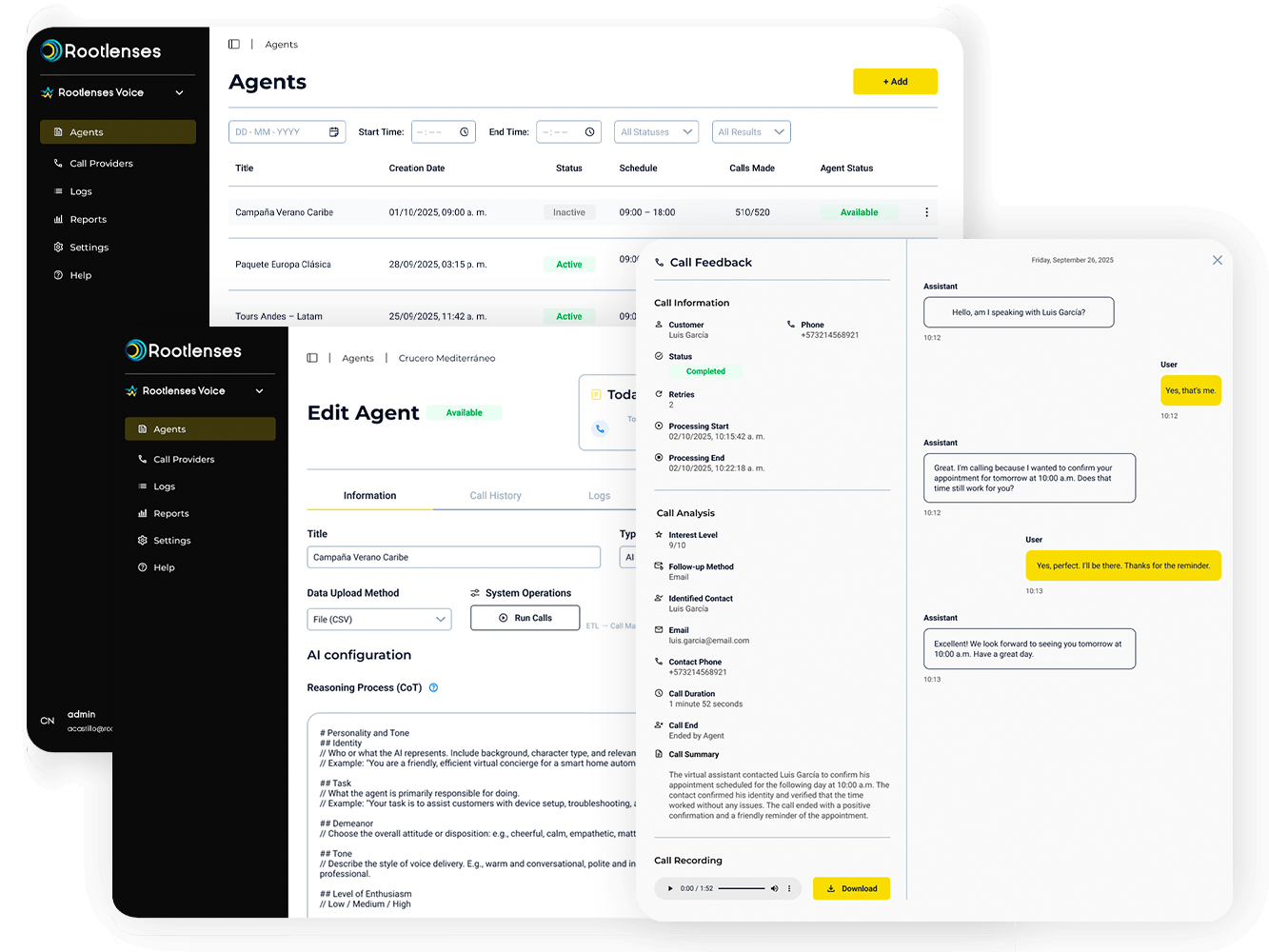
Rootlenses Voice: AI voice agents for modern enterprise customer service
At Rootlenses Voice, we develop AI-powered voice agents designed to provide real-time enterprise phone support, with accurate responses, low latency, and integration capabilities with corporate systems.
Our Voice AI Agents enable:
- 24/7 customer service,
- call automation,
- CRM and API integrations,
- contextualized responses,
- operational scalability,
- and continuous improvement of the customer experience.
Instead of relying solely on limited human training, Rootlenses Voice transforms phone support into an intelligent, scalable architecture prepared for modern user expectations.


