
May 20, 2026
The adoption of AI voice agents is growing rapidly across industries such as customer service, sales, technical support, healthcare, and internal operations. However, there is one factor that defines the success or failure of these implementations: latency.
When a user speaks with a voice agent, they expect a smooth and immediate conversation. If the AI takes too long to respond, it interrupts the natural rhythm of the interaction and creates frustration, abandonment, or loss of trust in the system.
In enterprise projects, a difference of just a few hundred milliseconds can directly impact the user experience. That is why optimizing low-latency voice AI is no longer a technical detail: it is a critical product requirement.
In this article, we will explore how to reduce latency in AI voice agents, which factors affect real-time performance, and how to design voice AI architectures capable of functioning correctly in production.
What does latency mean in AI voice agents?
Latency is the amount of time that passes between the user’s input and the voice agent’s response.
In modern AI voice agent systems, that process normally includes:
- Audio capture
- Speech-to-Text (STT)
- LLM processing
- Call flow orchestration
- Text-to-Speech (TTS)
- Audio playback
Each stage introduces delays. If the architecture is not optimized, the experience feels slow, artificial, and not conversational.
Today’s users expect real-time AI voice agents that respond at speeds similar to a human conversation. In practice, that means keeping perceived response times below 1–2 seconds.
Main causes of latency in Voice AI
Many companies assume the problem exists only in the AI model itself. In reality, latency is usually the cumulative result of multiple components.
1. Models that are too large
Not every workflow requires giant models. Using an extremely heavy LLM for simple tasks unnecessarily increases inference time.
In production environments, an efficient strategy consists of combining:
- small models for simple intents
- medium-sized models for contextual reasoning
- selective scaling for complex tasks
This architecture significantly reduces response times.
2. Sequential pipelines
One of the most common mistakes is executing each component linearly:
- STT finishes
- then the LLM starts
- then TTS starts
Modern voice agents perform better with parallel pipelines and real-time streaming.
For example:
- partial transcription while the user is speaking
- anticipatory response generation
- progressive voice streaming
This makes it possible to reduce the perception of waiting even before total processing is completed.
3. Incorrectly distributed infrastructure
Many implementations fail because:
- the model is hosted in one region
- the TTS system is in another
- the database is in a different location
Every network hop adds critical milliseconds.
To achieve low-latency voice AI, proximity between services is fundamental. Edge computing, regional inference, and processing close to the user are key strategies.
Designing call flows for voice agents that actually work in production
Latency does not depend only on infrastructure. Conversational design also directly impacts performance.
One of the biggest problems in voice AI occurs when agents must handle long, ambiguous, or non-linear conversations without a clear structure.
In production, complex call flows usually fail when:
- there are too many branches
- there is no context handling
- the agent tries to reason everything from scratch
- there are no conversational recovery mechanisms
A good call flow design should prioritize:
- clear conversational routes
- well-defined intents
- limited and efficient contextual memory
- early validations
- short and actionable responses
The most effective voice agents are not necessarily the ones that “talk more,” but the ones that solve tasks quickly.
Additionally, dividing complex processes into micro-flows helps reduce unnecessary LLM processing and improves conversational stability.

How to create voice agents that sound human (and not robotic)
Another frequent concern among companies evaluating voice AI is the naturalness of the conversation.
Users immediately notice when a system:
- responds too slowly
- uses artificial pauses
- cuts sentences incorrectly
- has robotic intonation
- does not understand interruptions
Naturalness depends as much on the voice itself as on response speed.
To create more human voice agents, we recommend:
Using neural TTS in streaming
Modern synthesis engines allow audio to be generated progressively without waiting for the complete response.
This reduces uncomfortable silences and improves the feeling of a natural conversation.
Interruption handling (barge-in)
An advanced agent must allow the user to interrupt the response without breaking the conversational flow.
This capability is essential in real-time AI voice agents.
Low conversational latency
Even the best neural voice loses naturalness if it responds late.
In voice AI, speed and human perception are completely connected.
Responses designed for voice
Many teams reuse text created for written chatbots. This often produces unnatural conversations.
Content optimized for voice should:
- use shorter sentences
- avoid complex structures
- sound conversational
- reduce redundancies
Modern architectures for real-time voice agents
The most successful voice AI implementations usually share certain technical patterns:
Streaming-based architecture
Bidirectional streaming for:
- audio
- transcription
- inference
- voice synthesis
Intelligent orchestration
Separation between:
- intent detection
- retrieval
- reasoning
- action execution
Contextual cache
Avoid recalculating repetitive information during the conversation.
Optimized retrieval
Slow access to databases or RAG systems can destroy the voice experience.
Contextual retrieval must be optimized for real-time queries.
User experience depends on milliseconds
In conversational voice interfaces, users are much less tolerant of delays than in visual interfaces.
A slow dashboard may feel annoying.
A slow voice agent completely breaks the conversation.
That is why optimizing AI voice agents requires combining:
- scalable architecture
- fast inference
- efficient conversational design
- streaming processing
- optimized models
- correctly distributed infrastructure
Companies that understand this achieve much more natural, fluid, and effective experiences.
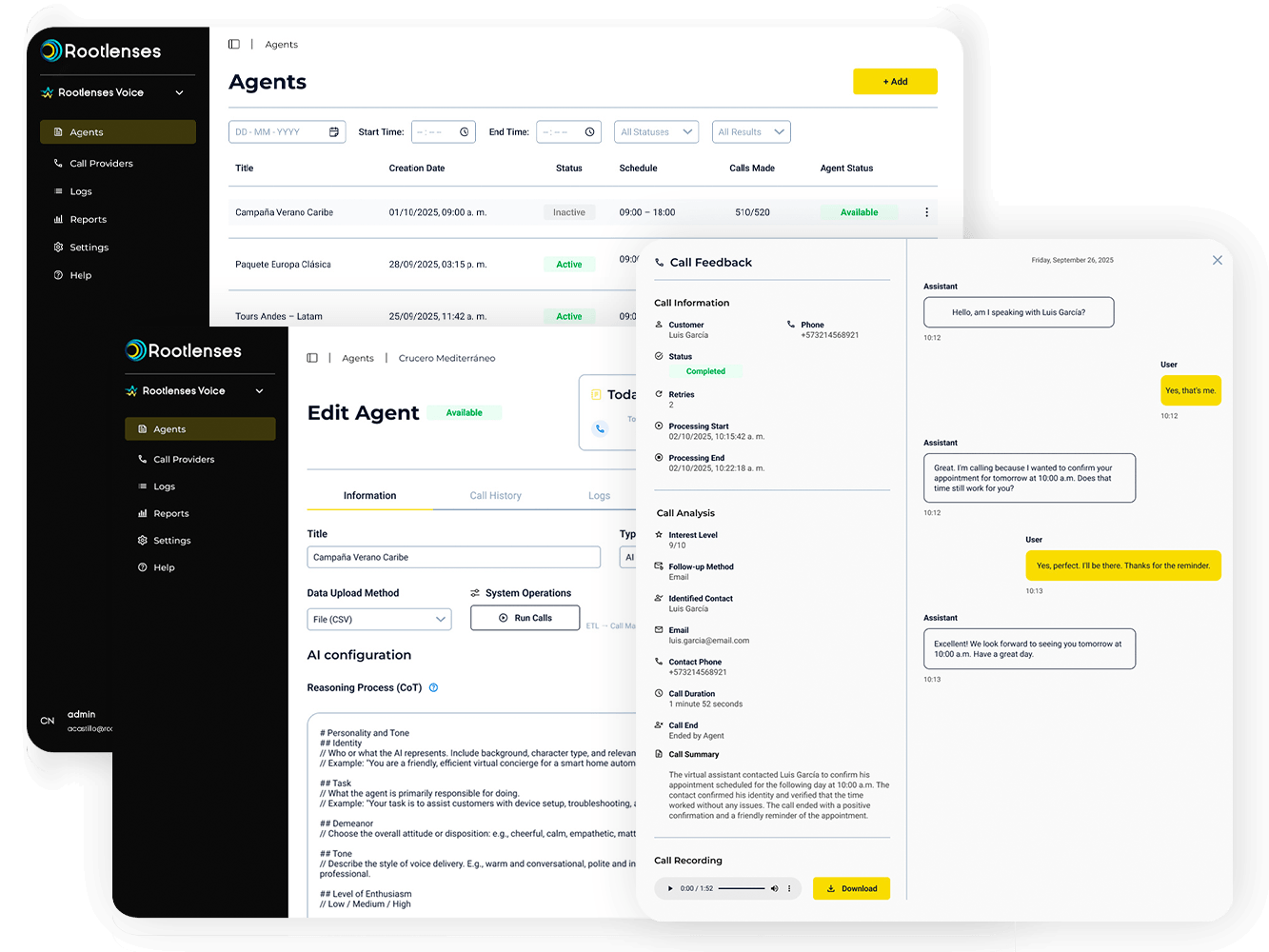
Rootlenses Voice: enterprise voice agents optimized for real time
With Rootlenses Voice, we help organizations build:
- real-time AI voice agents
- robust call flows for complex conversations
- natural and human voice experiences
- scalable enterprise integrations
- architectures optimized for low latency
Our approach combines AI engineering, cloud architecture, and conversational design to create agents capable of operating stably even in high-demand scenarios.
If your organization is evaluating the implementation of enterprise voice AI, conversational automation, or intelligent voice assistants, this is the ideal time to build a truly fast and usable experience.


