
October 12, 2026
What Is an AI Data Analytics Consulting Service?
An artificial intelligence data analytics consulting service helps companies transform their data into useful information for decision-making, automate analytical tasks, and identify business opportunities. In Latin America, these services enable organizations to leverage information distributed across enterprise systems, spreadsheets, and databases to improve operational efficiency and reduce reliance on manual processes.
Unlike traditional data consulting, AI analytics consulting can incorporate natural language queries, report automation, pattern detection, and visualization generation to facilitate access to relevant information.
The goal is not simply to implement artificial intelligence, but to turn it into a business capability that delivers measurable results.
Why Hire an AI Data Analytics Consulting Service in Latin America?
Companies continuously generate information through their sales, financial, logistics, and customer service operations. However, having data does not guarantee that they can use it effectively.
Teams may rely on manually updated spreadsheets, reports that take days to prepare, or technology departments that must respond to every information request.
This situation represents an opportunity for artificial intelligence adoption across the region. The Economic Impact of Artificial Intelligence in Latin America report by ECLAC examines the economic opportunities offered by this technology and the challenges associated with developing the capabilities needed to take advantage of it.
Additionally, McKinsey's The State of AI in 2025 study reported that 88% of respondents said their organizations regularly used AI in at least one business function. However, most had not yet scaled its use across their organizations.
These findings highlight an important distinction: experimenting with AI tools is not the same as integrating them effectively into business operations.
Specialized consulting helps bridge this gap through a strategy that connects technology, data, and business objectives.
The main benefits include:
- Data-driven decisions: Identify trends, deviations, and business opportunities.
- Reduced technical dependency: Enable business users to run queries without requiring SQL or programming knowledge for every analysis.
- Analytical automation: Reduce the time spent consolidating information and preparing reports.
- Increased productivity: Allow teams to spend more time interpreting results and taking action.
- Opportunity identification: Analyze sales, inventory, costs, profitability, and customer behavior.
- Controlled access to information: Facilitate analysis across different departments through permissions and security policies.

What Services Does an AI Analytics Consulting Firm Offer?
Services depend on each organization's digital maturity, data sources, and strategic objectives.
1. Data Assessment and Strategy
The first step is to assess information sources, analytical processes, and the challenges faced by each team.
This assessment helps identify duplicate data, disconnected systems, manual tasks, and opportunities to apply artificial intelligence. Based on these findings, a roadmap is developed with priorities, resources, and success metrics.
2. Information Source Integration
Companies often distribute their data across ERP systems, CRMs, financial platforms, sales tools, Excel files, and databases.
A consulting firm can help connect these sources to build a more comprehensive view of the business. The process must account for data quality, consistency, freshness, and security.
3. Implementing AI-Powered Analytics Tools
Artificial intelligence data analytics tools make it possible to query information using natural language, generate visualizations, detect anomalies, and explore business metrics.
For example, a sales manager could ask: Which products experienced a decline in sales this quarter, and which regions saw the largest drop?
A properly configured solution can analyze available data and present results that help identify trends and guide further investigation into their causes.
4. Report and KPI Automation
AI can streamline the preparation of recurring reports and the monitoring of key performance indicators (KPIs).
This makes it possible to monitor sales, profitability, inventory, operating costs, and productivity with less manual intervention. To ensure the results are useful, they must be cross-checked against reliable sources and established business rules.
5. Governance, Security, and Training
Enterprise adoption also requires access controls, privacy policies, traceability, and procedures for validating AI-generated results.
The NIST AI Risk Management Framework provides a reference for identifying and managing risks associated with artificial intelligence systems.
A consulting engagement should consider these practices alongside applicable legal requirements, sensitive information protection, and user training.
Which Companies Need AI Data Analytics Consulting?
This type of service is particularly useful for organizations that handle large volumes of information or need to improve the speed and quality of their decisions.
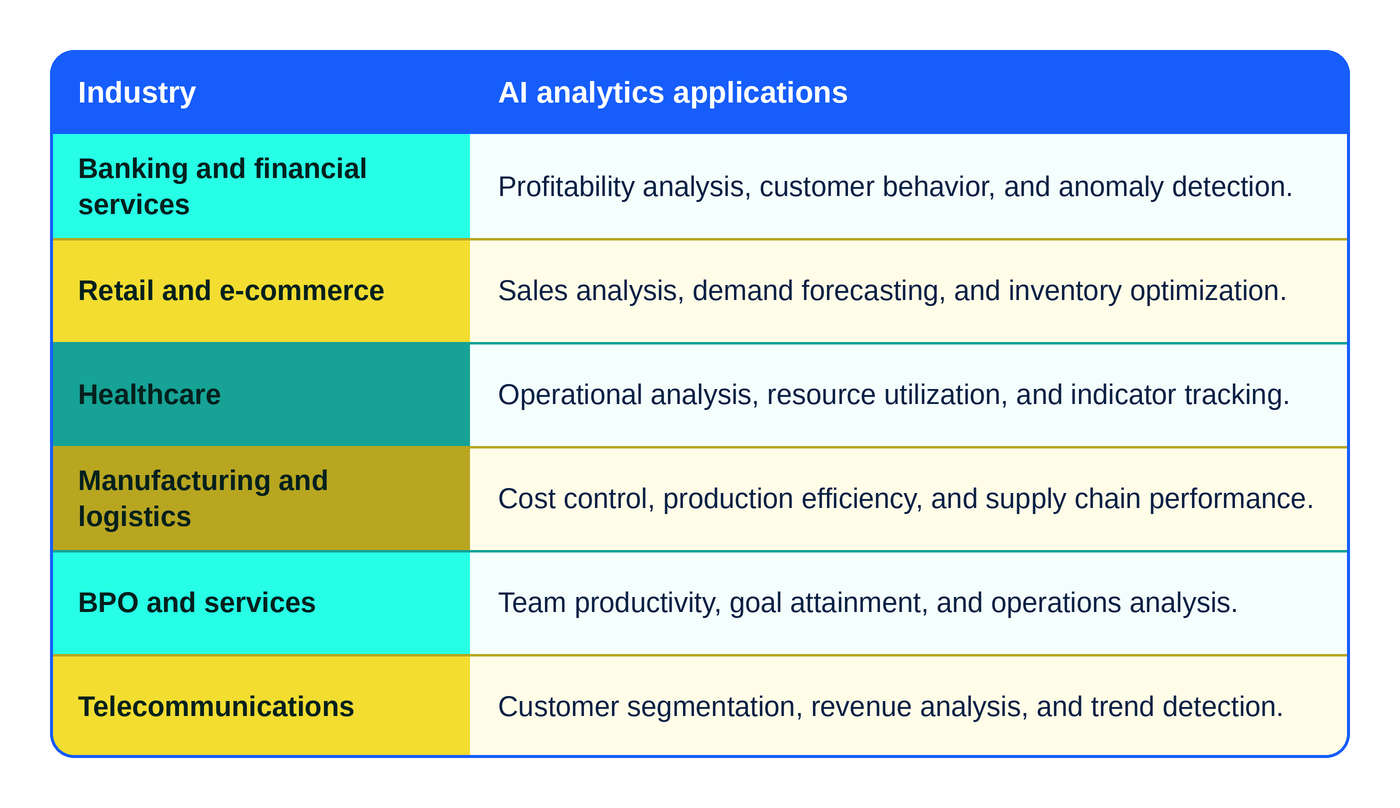
In Mexico, Colombia, Panama, and other Latin American markets, priorities may vary depending on the industry, regulatory environment, and available technology infrastructure.
The Latin American Artificial Intelligence Index (ILIA 2025), developed with the support of ECLAC and Chile's National Center for Artificial Intelligence, examines the enabling conditions, adoption, and governance of AI across 19 countries in the region.
This context reinforces the importance of adapting projects to each organization's capabilities and needs rather than applying a generic model.
How to Choose an AI Data Analytics Consulting Firm in Latin America
Before hiring a provider, it is worth evaluating its ability to solve business problems rather than focusing solely on its experience with technology tools.
Here are five essential criteria:
1. Experience with business challenges. The provider should understand the metrics, processes, and decisions the company wants to improve.
2. Integration capabilities. It is important to verify whether the provider can work with the databases, enterprise systems, and files the organization already uses.
3. Security and governance. The provider should explain how it manages permissions, sensitive information, audits, and data processing.
4. Ease of adoption. The solution should be easy to understand for users who need to access information, even if they lack advanced technical skills.
5. Measurable results. The project should define metrics to evaluate its impact, such as report preparation time, query response time, user adoption, and the reduction of manual tasks.
It is also advisable to request a demonstration based on a real use case, establish an initial scope, and verify result quality before expanding the implementation.

How Much Does AI Data Analytics Consulting Cost?
The cost of AI data analytics consulting depends on the project scope, the complexity of information sources, data quality, required integrations, and security requirements.
An implementation focused on a single use case may require fewer resources than a project involving multiple systems, departments, and critical processes.
To compare proposals, companies should distinguish between assessment, integration, licensing, infrastructure, training, and maintenance costs.
It is also worth requesting an estimated return on investment based on verifiable metrics. For example, companies can calculate the time saved on report preparation, the cost of eliminated manual tasks, and the operational impact of accessing information more quickly.
Rather than choosing solely on price, it is preferable to evaluate the total cost of ownership and the value the solution can generate over the medium term.
Rootlenses Insight: Enterprise Data Analytics with Artificial Intelligence
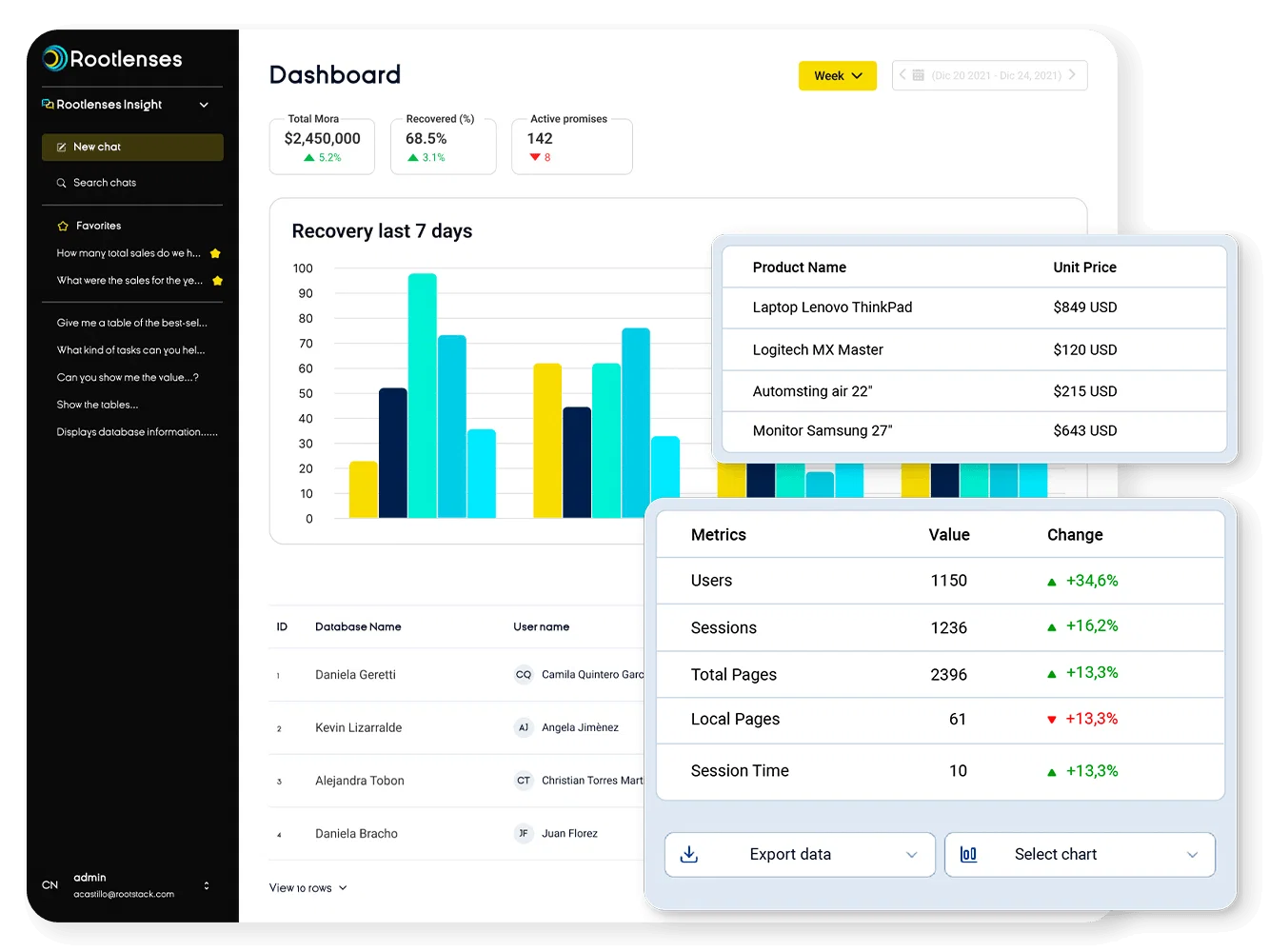
Rootlenses Insight is an artificial intelligence-powered data analytics solution designed to make enterprise information more accessible through natural language queries, without requiring users to write SQL queries.
The tool enables users to explore business information, get answers to analytical questions, and generate tables or visualizations from available data, depending on the connected sources and the capabilities of the implementation.
For organizations seeking to reduce their reliance on technical teams for everyday queries, this approach can improve access to relevant information and accelerate the analysis of business metrics.
Potential applications include:
- Querying business metrics using natural language questions.
- Exploring business information without writing SQL queries.
- Analyzing trends and detecting changes in key metrics.
- Generating tables and visualizations to make results easier to interpret.
- Facilitating access to relevant information for different business teams.
Rootlenses Insight can be part of an analytics modernization strategy in which companies leverage their existing data, establish access controls, and foster a culture of data-driven decision-making.
Before implementing any solution, it is advisable to validate compatibility with existing systems, security requirements, and priority use cases.
Looking to Improve How Your Company Analyzes Its Data?
Discover Rootlenses Insight and explore how artificial intelligence can simplify business queries, reduce manual tasks, and turn enterprise information into actionable decisions. Request a free demo!
Frequently Asked Questions About AI Data Analytics Consulting
What Does an Artificial Intelligence Data Analytics Consulting Firm Do?
It assesses a company's analytical needs, identifies automation opportunities, integrates information sources, and recommends or implements AI solutions to improve data access and decision-making.
What Is the Difference Between Data Consulting and AI Analytics Consulting?
Data consulting may focus on infrastructure, quality, integration, and visualization. AI analytics consulting incorporates capabilities such as natural language queries, pattern detection, and analytical automation, depending on the project's objectives.
Does a Company Need a Data Science Team to Use AI Analytics?
Not necessarily. AI analytics tools enable business users to run certain queries without programming. However, integration, governance, and complex use cases may require technical specialists.
How Can You Measure the ROI of an AI Data Analytics Solution?
Companies can measure time saved on reporting, reductions in manual tasks, query response times, user adoption, and improvements in operational metrics. The evaluation should compare a baseline with the results achieved after implementation.
How Can You Start an AI Data Analytics Project in Latin America?
The first step is to select a specific business problem, identify the required information sources, and establish success metrics. Next, it is advisable to run a controlled pilot, validate result accuracy, and expand the solution based on the outcomes.
How Can You Query Enterprise Data Using Artificial Intelligence Without Knowing SQL?
You can use AI analytics tools that interpret natural language questions and translate them into queries against connected data sources. The availability and accuracy of results depend on the data structure, user permissions, and solution configuration.


