
March 25, 2026
In the healthcare industry, the difference between a functional interaction and a truly effective experience lies not only in what is said, but in how it is said.
AI voice agents in healthcare have reached a technical level where they can automate calls at scale. However, the true competitive differentiator lies in their ability to sound human, empathetic, and trustworthy, especially in contexts where patients may feel anxious, vulnerable, or confused.
For healthcare leaders, this is not a minor detail: Patient perception is directly tied to the quality of the conversational interaction.
This article explains how to design AI voice scripts that build trust, reduce anxiety, and improve the patient experience.
Why it’s critical for AI voice agents to sound human in healthcare
Unlike other industries, every interaction in healthcare carries an implicit emotional weight.
A robotic-sounding agent can lead to:
- Distrust
- Frustration
- Call abandonment
- Low adherence to processes (appointments, treatments, follow-ups)
In contrast, a human-sounding agent achieves:
- Greater patient cooperation
- Higher response rates
- Increased appointment confirmations
- Positive service perception
Key takeaway:
Voice naturalness is not aesthetic—it is a direct driver of operational and clinical outcomes.
Empathy in AI voice agent conversations in healthcare
Empathy is the most important component when designing scripts for patients.
How to translate empathy into a script
1. Acknowledge the patient’s context
Instead of going straight to the task:
- “I’m calling to confirm your appointment”
- “Hello, I understand you have an upcoming medical appointment, and I’d like to help you manage it in the easiest way possible”
2. Validate implicit emotions
- “We know coordinating healthcare can be stressful”
- “We want to make this as simple as possible for you”
3. Avoid cold or transactional language
- Replace “process,” “validation,” “system”
- With: “help you,” “support you,” “make it easier for you”
Result of applying empathy
- Reduced conversational friction
- Greater willingness to engage
- Increased engagement
Well-designed empathy turns an automated call into an experience perceived as human.

The right tone in sensitive contexts for AI voice agents
Not all healthcare calls are the same. Tone must adapt to context.
Types of context and recommended tone
1. Appointment reminders
Tone: friendly, clear, efficient
- Objective: enable quick action
2. Post-consultation or post-surgery follow-up
Tone: warm, careful, calm
- Objective: provide reassurance and support
3. Insurance validation or administrative processes
Tone: professional, clear, simple
- Objective: reduce confusion
4. Potentially sensitive cases (symptoms, complications)
Tone: empathetic, calm, with escalation options
- Objective: avoid anxiety and ensure human support
Tone best practices
- Use natural pauses
- Avoid excessive speed
- Don’t overload with information
- Prioritize clarity over technical language
A common mistake is designing a single “base tone.”
The most effective implementations use dynamic tones depending on the use case.
Building trust with AI voice agents in healthcare
Trust is the factor that determines whether the patient continues the interaction.
Key elements to build trust
1. Transparency from the start
- “I’m an automated assistant from the medical center…”
This avoids a sense of deception.
2. Clarity of intent
- Explain why the call is being made
- What is expected from the patient
3. Patient control
- Allow repeating information
- Offer options (“I can transfer you to a human agent”)
4. Consistency in responses
- Avoid contradictions
- Maintain clear conversational logic
Impact of trust
- Higher call completion rates
- Increased action compliance (confirming appointments, answering surveys, etc.)
- Reduced abandonment
Trust transforms AI from a functional tool into a reliable clinical communication channel.
How to reduce patient anxiety with AI voice agents
Many patients interact with the healthcare system during moments of uncertainty.
A well-designed script can reduce that anxiety.
Practical strategies
1. Anticipate questions
- “I will guide you step by step so everything is clear”
2. Simplify language
- Avoid complex medical terms
- Use short, easy-to-understand sentences
3. Create a sense of support
- “I’m here to help you through this process”
4. Avoid information overload
- Break the conversation into steps
- Confirm understanding before moving forward
Result
- Calmer patients
- Greater process adherence
- Better overall experience
Reducing anxiety improves not only perception, but also operational and clinical outcomes.
Recommended structure for AI voice agent scripts in healthcare
To achieve natural and effective interactions, scripts should follow a clear structure:
1. Human opening
- Natural greeting
- Clear identification
- Call context
2. Build trust
- Brief explanation of purpose
- Patient validation
3. Guided interaction
- Simple conversational flow
- Clear options
- Mid-point confirmations
4. Handling objections or questions
- Predefined responses
- Escalation to a human when needed
5. Empathetic closing
- Action summary
- Gratitude
- Future availability
Common mistakes when designing AI voice scripts in healthcare
Avoiding these mistakes is key to achieving human-like interactions:
- Overly long or rigid scripts
- Technical or impersonal language
- Lack of context adaptation
- Not accounting for edge cases
- Not offering a human fallback
These mistakes make the experience feel cold, inefficient, or frustrating.
From functional scripts to human experiences
The true value of AI voice agents in healthcare lies not only in automating tasks, but in humanizing interactions at scale.
When scripts are well designed:
- Patient experience improves
- Operational efficiency increases
- Institutional perception is strengthened
For healthcare leaders, this represents a clear opportunity to differentiate in an increasingly competitive environment.
Design conversational experiences with Rootlenses Voice
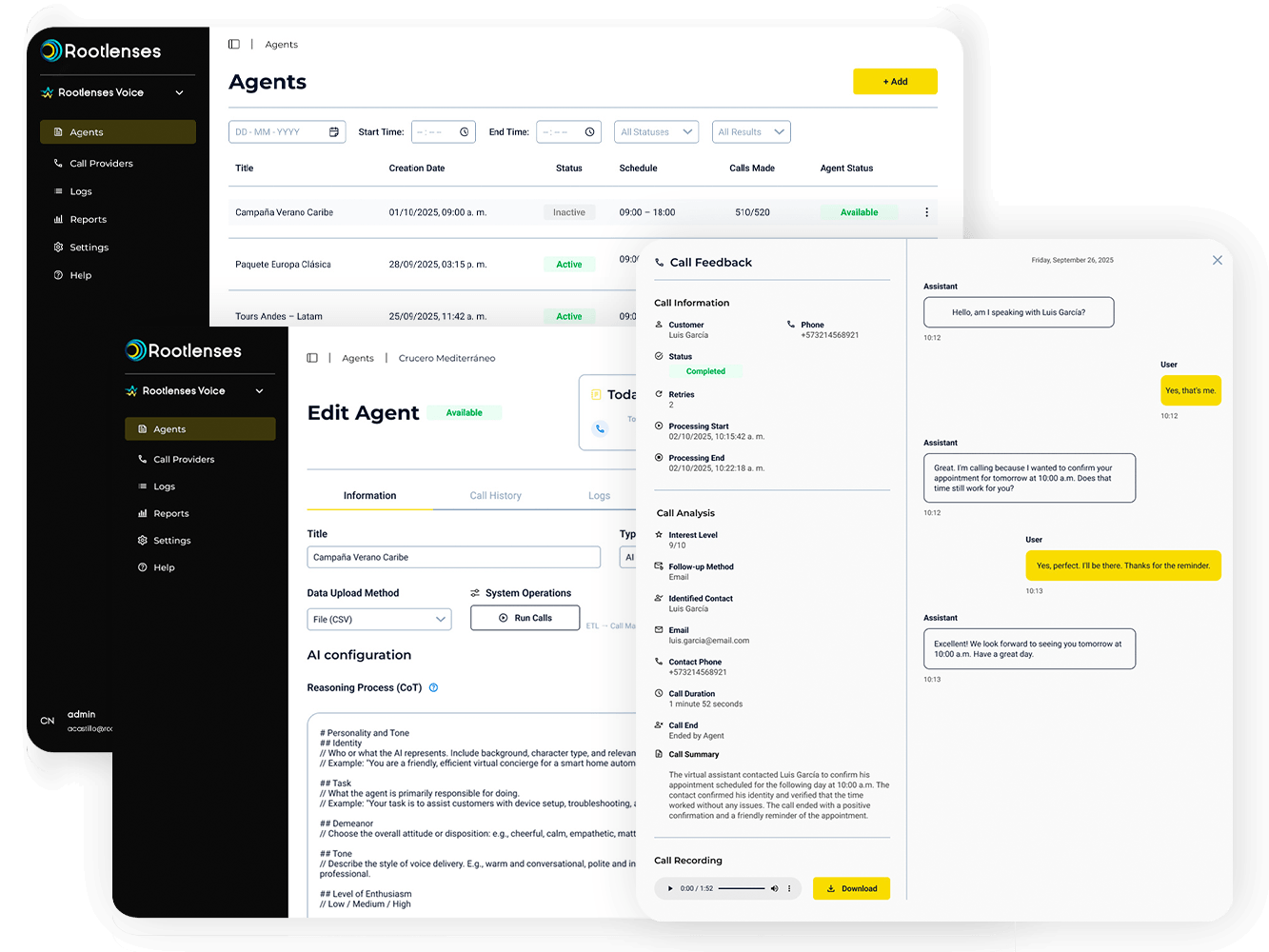
Rootlenses Voice enables the creation of AI voice agents that not only automate calls, but are designed to sound human, empathetic, and effective in healthcare contexts.
With capabilities such as:
- Advanced conversational script design
- Tone adaptation based on clinical context
- Continuous monitoring and improvement of interactions
- Integration with existing systems
- Experience and performance metrics
You can transform every call into a positive patient experience and an efficient operational interaction.


