
March 24, 2026
The conversation around AI voice agents in healthcare has moved from promise to evidence. Today, hospitals, clinics, and care networks are using this technology not just to automate calls, but to transform entire operations.
For industry leaders—such as CEOs, medical directors, operations managers, and patient experience leaders—the value is no longer measured in innovation, but in real impact on efficiency, costs, and service quality.
This article breaks down what actually happens when AI voice agents are implemented in healthcare environments, including concrete benefits, critical challenges, and how to address them strategically.
Impact on hospital call centers: from cost centers to efficiency engines
Call centers in hospitals and clinics typically operate under high pressure:
- High call volume
- Long wait times
- Limited staff
- Repetitive processes
The implementation of AI voice agents in healthcare call centers completely redefines this model.
What changes with AI voice agents
- Automation of inbound and outbound calls (appointments, validations, follow-ups)
- 24/7 availability without increasing headcount
- Reduction in average handling time (AHT)
- Decrease in wait times
Measurable impact
- Up to 60–80% automation of repetitive interactions
- Significant reduction in operational costs
- Improved SLAs and service levels
- Increased patient satisfaction
The result is clear: the call center stops being a bottleneck and becomes an efficient, scalable, and strategic channel.
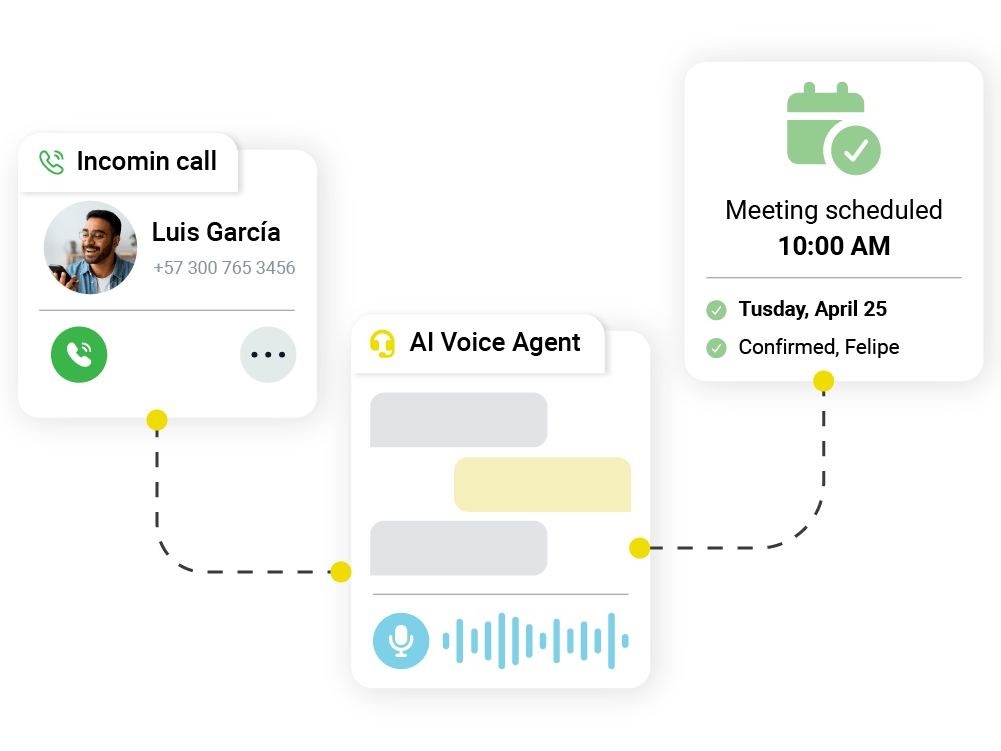
Impact on clinics and medical operations: efficiency at every touchpoint
Beyond the call center, AI voice agents impact multiple processes within clinics and hospitals:
1. Appointment and scheduling management
- Automated confirmations and reminders
- Real-time rescheduling
- Optimization of schedule utilization
Result: lower no-show rates and higher utilization of clinical resources.
2. Administrative coordination
- Insurance verification
- Patient pre-admission
- Collection of pre-visit information
Result: reduced administrative burden and fewer operational errors.
3. Patient experience
- Post-consultation follow-ups
- Satisfaction surveys
- Immediate attention with no wait times
Result: a faster, more accessible, and more consistent service experience.
Improving operational efficiency with AI voice agents in healthcare
The most relevant impact for decision-makers is operational efficiency.
Where the greatest value is generated
1. Scalability without marginal cost
Voice agents can handle thousands of interactions simultaneously—something impossible for human teams without proportional cost increases.
2. Consistency in execution
Every interaction follows defined flows, eliminating human variability.
3. Continuous availability
24/7 operation without interruptions, ideal for healthcare systems that never stop.
4. Error reduction
Automating repetitive processes minimizes failures in data capture and validations.
KPIs that improve with AI in healthcare operations
- Contact rate
- Reduction in no-shows
- Average handling time (AHT)
- Cost per interaction
- Scheduling conversion rate
- Patient satisfaction (CSAT)
For leaders, this translates into more predictable, measurable, and optimizable operations.
Real challenges when implementing AI voice agents in healthcare
Despite the benefits, implementation is not without challenges. Ignoring them is one of the main reasons some projects fail.
1. Organizational adoption
The challenge:
Staff resistance to automation and fear of replacement.
How to address it:
- Position AI as a support tool, not a replacement
- Redefine roles toward higher-value tasks
- Continuous training
Successful implementations are those where AI empowers the human team, not displaces it.
2. Compliance and regulation (HIPAA, GDPR, etc.)
The challenge:
Handling sensitive data in a highly regulated environment.
How to address it:
- Implement access controls (RBAC/ABAC)
- Ensure data encryption in transit and at rest
- Maintain full audit trails of interactions
- Select vendors with proven security standards
Compliance is not optional—it is a baseline requirement for operating in healthcare.
3. Handling edge cases in conversations
The challenge:
Complex cases, ambiguity in responses, or critical patient situations.
How to address it:
- Design robust conversational flows
- Implement real-time escalation to humans
- Train models with relevant healthcare domain data
- Continuously monitor interactions for improvement
AI voice agents should not operate in isolation, but as part of an intelligent hybrid system.
4. Integration with existing systems
The challenge:
Connecting AI with EHRs, CRMs, scheduling, and billing systems.
How to address it:
- Use APIs and integration middleware
- Prioritize interoperability by design
- Implement phased rollouts
Integration defines success: without it, AI remains a superficial layer.
From implementation to strategic impact of AI voice agents
When AI voice agents are implemented correctly, the impact goes beyond efficiency:
- Improved patient experience
- Optimized use of clinical resources
- Reduced structural costs
- Data-driven decision-making
The most advanced organizations are using this technology to redesign their operations, not just optimize them.
Conclusion: the real value of AI in healthcare
The real impact of AI voice agents in healthcare operations is tangible, measurable, and strategic.
It’s not just about automating calls, but about:
- Scaling operational capacity
- Improving service quality
- Reducing friction in every patient interaction
For industry leaders, the opportunity lies in adopting this technology with a holistic vision, considering both benefits and challenges.
Take your operations to the next level with Rootlenses Voice
Rootlenses Voice is an AI voice agent designed to transform operations in the healthcare industry, enabling organizations to:
- Automate calls in hospital call centers
- Reduce operational costs without sacrificing quality
- Improve patient experience in every interaction
- Integrate securely with existing systems
- Operate under compliance and governance standards
More than a tool, it’s a way to scale your operations with control, efficiency, and measurable results.


