
April 16, 2026
The Latin American market presents a unique challenge for the sales teams of medium and large companies. Consumers in countries like Colombia and Panama have changed their communication habits, drastically reducing response rates to traditional phone calls.
Strategies based exclusively on manual phone contact generate high operating costs and a decreasing return on investment.
To solve this sales efficiency problem, technology offers a structured solution through omnichannel automation. The combination of voice interactions and instant messaging allows for the establishment of a continuous and highly effective communication channel. Companies with a high volume of contacts need precise methodologies to scale their operations without multiplying their workforce.
The integration of automated calls and WhatsApp builds what is known as a "trust loop." This strategic model leverages the immediacy of voice and the personal touch of text to validate the company's identity, reinforce the marketing message, and facilitate the customer's decision-making process.
Below, we detail how this workflow works and its impact on profitability.
Limitations of the traditional model
Contact centers that rely solely on human operators face significant operational bottlenecks. Staff waste valuable time trying to contact invalid numbers or at ineffective times. Unanswered calls represent wasted resources that limit the ability to scale sales. Today's consumer is wary of unknown numbers. A single cold call is often perceived as intrusive, creating friction from the very first second.
The absence of a secondary support channel prevents the prospect from verifying the information received, cutting the sales cycle short before the negotiation process even begins. Consumer Behavior in Latin America WhatsApp is the primary communication tool in Latin America. Users prefer to review proposals, ask questions, and confirm transactions via text messages. However, the human voice (or a high-fidelity synthetic voice) remains crucial for conveying urgency, empathy, and authority.
Conversational sales with AI capitalizes on this duality. The Latin American customer needs the formal validation of a phone call, but requires the convenience of WhatsApp to follow up at their own pace. Combining both channels eliminates friction and fosters faster, more positive responses.

The trust loop in AI sales automation
Implementing a trust loop requires a synchronized communication architecture. This process consists of three fundamental stages designed to maximize the effectiveness of contact.
1. The initial call
The process begins by using AI sales agents to make the initial contact call. These agents validate the number, contact the user during the time of day when they are most likely to respond, and communicate the main value of the offer. If the customer does not answer or requests additional information, the system instantly categorizes the result.
2. The automated follow-up
Immediately after the call, the system triggers a WhatsApp message. This message refers to the previous call, delivers the requested documentation, or proposes scheduling a new appointment. This action demonstrates professionalism and provides the prospect with a secure way to interact.
3. Omnichannel reinforcement and closure
The customer interacts with the text message, resolving their initial doubts asynchronously. The WhatsApp sales integration allows the platform to register the user's level of interest and, if necessary, schedule a callclosing call with a specialized human agent.
Use cases for Voice AI in sales
Call automation with AI is especially cost-effective in sectors that manage large databases and standardized processes.
- Financial Services and Collections: Agents issue payment reminders simultaneously. They then send secure payment links via WhatsApp, reducing delinquency and improving the user experience.
- Education and Admissions: Universities contact thousands of prospective students interested in academic programs. The system provides initial voice responses and sends digital brochures via message, filtering out the most qualified candidates.
- Insurance: Insurance companies are automating policy renewals. The system notifies policyholders of expiration dates by phone and simplifies the acceptance process with a quick and direct text message.
Frequently asked questions about business automation
Is integrating these systems complex?
No advanced technical expertise is required. Enterprise platforms facilitate script configuration and contact validation through intuitive interfaces, seamlessly connecting with existing phone infrastructure.
Can AI handle customer objections?
Yes. Voice agents have contextual decision logic. They identify the customer's intent in real time and adapt their responses or transfer the communication to the appropriate text channel according to established business rules.
How is the effectiveness of the trust loop measured?
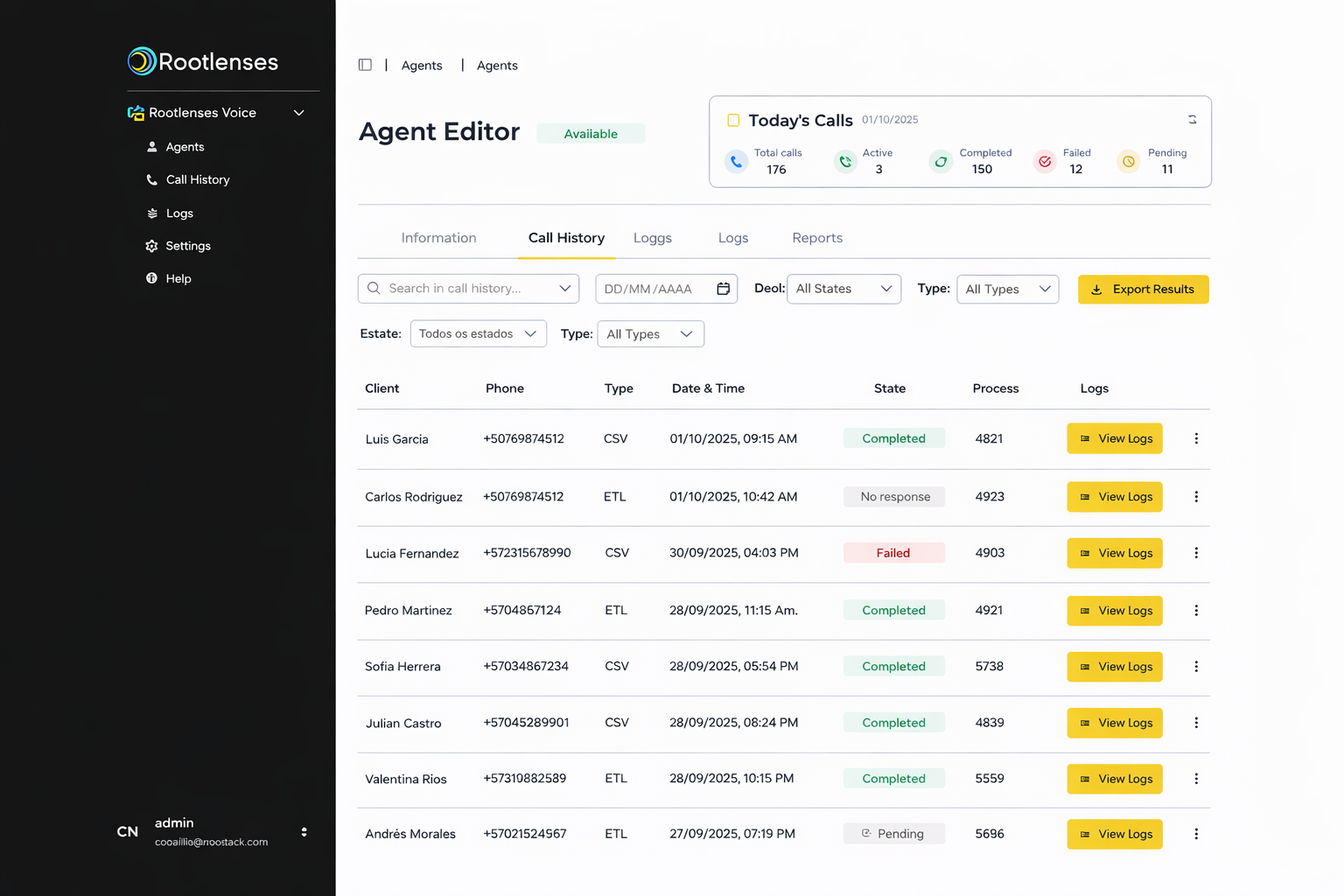
Analytics tools provide automatic transcriptions, sentiment analysis, and live conversion metrics. This allows you to optimize messages and contact times based on concrete data.
Consolidating the business standard
Selling in the Latin American market is inherently omnichannel. Relying on a single point of contact is a serious competitive disadvantage in an environment where agility defines success.
The combined use of automated calls and structured messaging is no longer a future technological projection, but the current operating standard.
To achieve the efficiency demanded by today's market, companies must adopt technologies that offer scalability without increasing personnel costs.
Solutions like Rootlenses Voice allow the implementation of autonomous workflows that contact, engage, and follow up with thousands of prospects simultaneously.


