May 19, 2026
The relationship between companies and their data is changing rapidly. For years, accessing strategic information depended on complex dashboards, manual SQL queries, or specialized technical teams. Today, thanks to advances in generative AI and natural language processing (NLP), organizations can literally converse with their data.
Instead of writing complex queries, a user can ask:
- “Which branch had the highest growth this quarter?”
- “Show me the customers with the highest churn risk”
- “Which products decreased their sales in Central America?”
And receive precise, contextualized, and actionable answers in seconds.
This new paradigm, known as AI Chat with databases or Natural Language Data Interaction, is redefining how companies access, interpret, and democratize information.
At Rootlenses Insight, we have observed that companies adopting this approach reduce the operational dependency on BI teams and significantly accelerate data-driven decision-making.
What does it mean to “converse” with a database?
Conversing with a database means using natural language to query, analyze, and explore information stored in enterprise systems.
Technically, this is achieved through a combination of:
- Large Language Models (LLMs)
- Text-to-SQL engines
- Retrieval-Augmented Generation (RAG) systems
- Semantic data layers
- APIs and enterprise connectors
- Authorization and governance engines
The simplified workflow usually works like this:
- The user writes a question in natural language.
- The model interprets the intent.
- The system translates that intent into SQL or another structured logic.
- The database executes the query.
- The AI transforms the results into an understandable response.
For example:
Question:
“What were the 5 best-selling products in Mexico during April?”
Internal result:
An optimized SQL query over sales, inventory, and regional tables.
Final response:
A conversational explanation accompanied by metrics and context.
This approach drastically reduces friction between business and data.

Read this blog about: What is Text-to-SQL and how does it allow you to query databases in natural language?
Why this model is growing so fast
The explosion of generative AI accelerated the expectation of conversational interfaces across virtually all enterprise systems.
According to McKinsey & Company, organizations integrating generative AI into analytics and automation processes can significantly increase productivity in knowledge-based functions.
Likewise, Gartner projects that AI-powered conversational interfaces will become a central part of modern analytics and business intelligence platforms.
The reason is simple: SQL does not scale organizationally.
Although SQL remains the standard language for querying databases, not every business profile can write complex queries, interpret joins, or understand advanced relational models.
Conversational interfaces remove that barrier.
The evolution of Business Intelligence: from dashboards to conversations
Traditional Business Intelligence was built around static dashboards.
Although tools like Power BI, Tableau, or Looker transformed data visualization, there is still a major limitation: the user must manually navigate to find insights.
With conversational AI, the paradigm changes completely.
Now the system can:
- Interpret ambiguous questions
- Generate dynamic analyses
- Detect patterns automatically
- Explain results in natural language
- Maintain context between questions
For example:
“Why did sales decline in March?”
The AI can correlate variables, review historical data, and respond:
“Sales decreased by 14% in the northern region due to inventory shortages and increased logistics times.”
This transforms the analytics experience into something much closer to conversing with a senior analyst than navigating reports.
- Related reading:
From dashboards to conversations: the evolution of BI with generative AI
Technical architecture of an AI Chat with databases
From an engineering perspective, building this type of solution requires much more than connecting a chatbot to a database.
A robust enterprise architecture usually includes:
1. Language model (LLM)
The interpretive brain of the system.
Common options include:
- OpenAI
- Anthropic
- Google Gemini
- Open source models such as Llama by Meta
2. Semantic layer
One of the biggest challenges is that enterprise databases are not designed for human language.
For example:
- tbl_cust_tx_2025
- rev_amt_q1
- usr_id_fk
The AI needs semantic context to understand what those fields actually represent.
This is where semantic layers, data catalogs, and metadata enrichment come into play.
3. Text-to-SQL engine
This is the component responsible for translating natural language into structured queries.
Example:
Input:
“Average sales by country this quarter”
Output:
Optimized SQL query.
This component is critical because an error in SQL generation can produce incorrect answers or security risks.
4. Governance and security
In enterprise environments, this point is mandatory.
A conversational system must respect:
- Roles and permissions
- Row-level security
- Data masking
- Compliance
- Auditing
- Traceability
The AI should never expose information that the user is not authorized to access.
In fact, IBM Research and Microsoft Azure AI have emphasized that governance is one of the most important factors for enterprise adoption of generative AI.
Real challenges companies face
Although the concept seems simple, enterprise implementation comes with major challenges.
Language ambiguity
Humans constantly ask incomplete questions.
Example:
“Show me premium customer sales”
What does “premium” mean?
Does such a column exist?
Is it a calculated category?
AI needs business context.
Data quality
An AI Chat does not fix inconsistent data.
If the source has issues, the response will too.
Garbage in, garbage out.
Hallucinations
LLMs can invent answers when they do not have enough context.
That is why modern architectures use RAG, SQL validations, and controlled restrictions.
Scalability
Poorly optimized queries can generate high costs or affect operational performance.
This requires implementing:
- Query optimization
- Caching
- Guardrails
- Contextual limits
- Observability

Most relevant enterprise use cases
Organizations are already using AI Chat with databases for:
Conversational analytics
Conversational analytics enables querying enterprise data in natural language without depending on dashboards or BI support. Users can ask questions such as “sales evolution by region” and receive dynamically generated answers through SQL queries and semantic layers. This approach democratizes data access and accelerates insight exploration across the organization.
Executive support
At the executive level, AI Chat with databases acts as a synthesis layer for strategic KPIs for C-level executives. It enables real-time querying of metrics such as EBITDA or business unit performance by integrating multiple data sources. The system generates consistent summaries aligned with governed business definitions.
Finance
In finance, this approach enables budget analysis, variance tracking, and forecasting through natural language. Teams can query variations or projections without writing complex queries, always under strict governance and traceability controls. This improves the speed of financial analysis without compromising accuracy.
Customer Success
In Customer Success, AI Chat enables identifying churn risks and customer behavior patterns through natural language. Using historical data and predictive scoring, teams can detect at-risk accounts and act proactively to improve retention.
Retail
In retail, sales, inventories, and product performance can be queried in near real time through simple questions. This facilitates the detection of stock shortages, high-turnover products, and campaign impact, improving operational decision-making.
Operations
In operations, AI Chat acts as a conversational monitoring layer over logistics processes and ERP systems. It enables querying delays, process statuses, and operational alerts in real time, improving visibility and incident response.
Why this model represents the future of data access
We are entering a stage where the primary interface of enterprise systems will be conversational.
Just as search engines transformed access to public information, AI Chats are transforming access to private enterprise data.
The difference is enormous:
Before:
- The user learned how the system works.
Now:
- The system understands how the user speaks.
That change completely redefines the enterprise analytics experience.
The role of Rootlenses Insight in this transformation
At Rootlenses Insight, we see AI Chat with databases as the natural evolution of modern Business Intelligence.
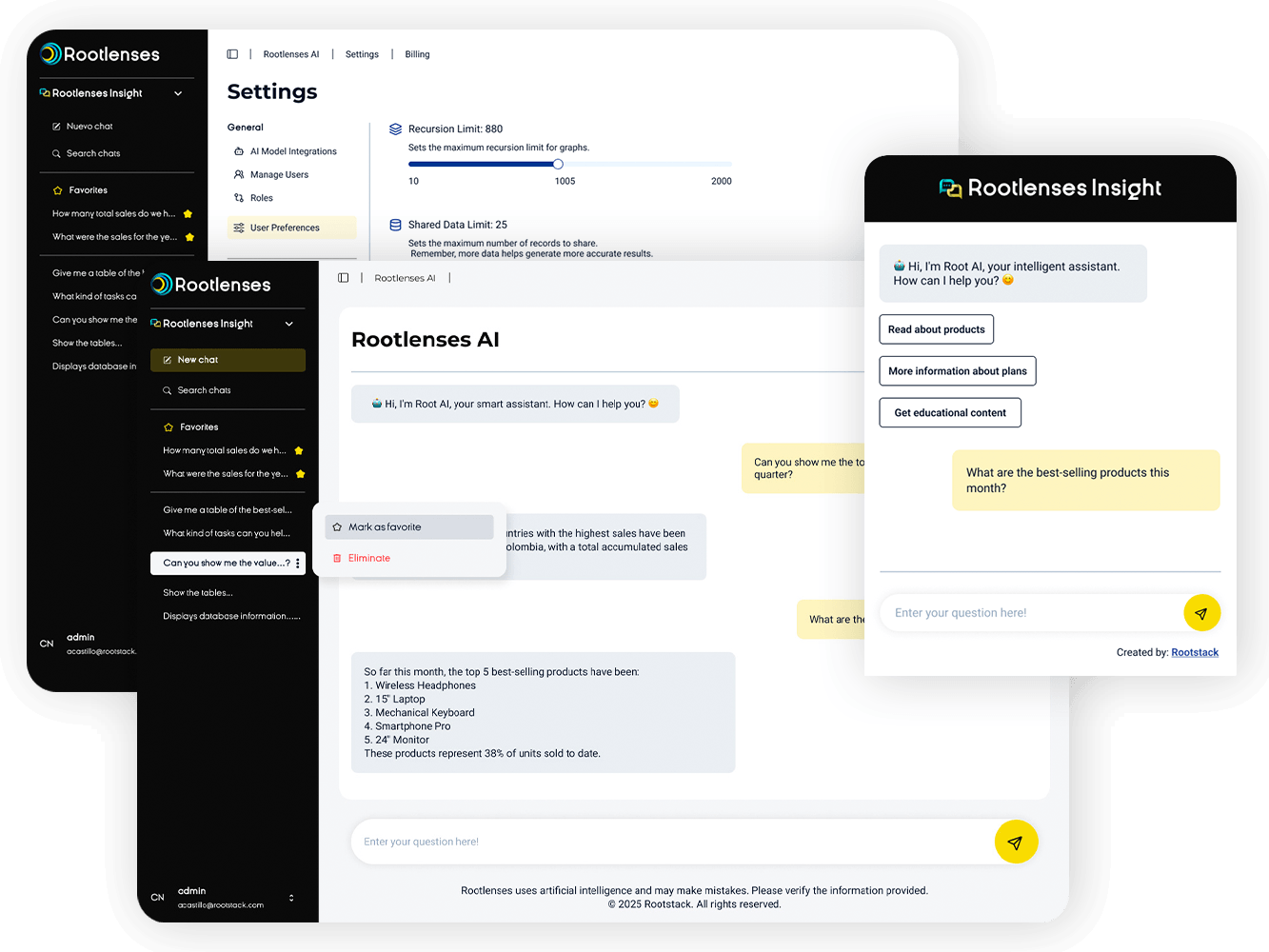
The goal is not only to generate automated answers, but to build platforms where:
- Data is truly accessible
- AI respects governance and security
- Users can explore information without friction
- Technical teams maintain architectural control
Companies that adopt this approach correctly will not only improve their analytics capabilities; they will also reduce the distance between data and decisions.
And in a business environment driven by speed, that advantage can be decisive.


