
May 20, 2026
For years, traditional call centers were the core of customer service. However, in 2026 we are seeing an accelerated transition: more and more companies are migrating toward AI-powered voice agents.
It is not only about reducing costs. The real driver behind replacing call centers with AI is the need to offer a faster, more consistent, and scalable customer experience.
Many organizations discovered that the problem was not just “handling calls,” but ensuring consistent quality in every interaction. That is where AI began to overcome several human operational limitations.
According to IBM watsonx Assistant, today’s customers expect immediate, personalized, and frictionless responses, while traditional systems often operate with fragmented tools, inconsistent training, and long wait times.
The problem is not the human: it is operational inconsistency
Most users do not prefer “talking to a machine.” They prefer solving their problem quickly.
That detail completely changes the conversation.
Many companies began adopting AI for customer service because they were facing recurring problems in their human operations:
- Agents with insufficient training.
- Poor support in secondary languages.
- Inconsistent responses between operators.
- Long wait times.
- Constant staff turnover.
- Operational fatigue during long shifts.
- Limited scalability during peak hours.
In practice, two customers could receive different answers for the same problem depending on which agent responded.
That type of friction deteriorates the customer experience and affects critical metrics such as:
- Customer Satisfaction Score (CSAT)
- First Call Resolution (FCR)
- Net Promoter Score (NPS)
- Average resolution time
Conversational AI is being adopted precisely because it enables operational quality to be standardized at scale.
AI already responds better in many scenarios
Modern AI voice agents no longer function like old robotic IVRs.
Today they use:
- Large Language Models (LLMs)
- Real-time Voice AI
- Contextual understanding
- Conversational memory
- CRM and ERP integrations
- Intent and sentiment detection
This enables much more natural and effective conversations.
IBM highlights that today’s AI agents can handle complex conversations, adapt to the user’s tone, and scale multilingual support without increasing operational headcount.
In other words: a company can manage thousands of simultaneous conversations while maintaining consistency, something extremely difficult in a traditional call center.

Poor human experiences are accelerating adoption
There is an uncomfortable factor that many companies already recognize: some customers prefer interacting with AI rather than going through poor human experiences.
Especially when the user faces:
- Operators who do not understand the problem.
- Language barriers.
- Poor pronunciation.
- Endless transfers.
- Constant repetition of information.
- Errors caused by lack of knowledge.
- Excessive wait times.
In fact, one of the greatest advances of AI in customer experience is the ability to maintain operational accuracy even under high demand.
McKinsey points out that generative AI is simultaneously improving productivity and customer experience within customer operations. In a study cited by the firm, AI-assisted agents increased problem resolution per hour by 14% and reduced handling times by 9%.
Additionally, the research “Generative AI at Work” found significant improvements in productivity and quality especially among less experienced agents, as well as improvements in English fluency and reductions in escalations to supervisors.
That is particularly relevant for global companies operating international support.
AI does not get sick, does not churn, and does not forget processes
One of the biggest hidden costs of traditional call centers is staff turnover.
Every departure implies:
- New onboarding processes.
- Retraining.
- Loss of operational knowledge.
- Temporary quality reduction.
- Administrative costs.
AI agents eliminate a large part of that problem.
Once trained:
- They maintain consistency.
- They operate 24/7.
- They scale automatically.
- They do not forget policies.
- They do not depend on emotional state.
- They can be updated in real time.
This is especially valuable in industries with critical operations such as:
- Insurance
- Healthcare
- Logistics
- Retail
- Telecommunications
- Banking
But leading companies are not eliminating humans completely
The most successful change is not “AI vs humans.”
It is AI + humans.
The most advanced organizations are using AI to automate:
- Repetitive questions.
- Validations.
- Scheduling.
- Frequent inquiries.
- Status updates.
- Transactional processes.
While humans focus on:
- Complex cases.
- Retention.
- Negotiations.
- Emotional situations.
- Critical escalations.
IBM defines this as “Effortless escalation”: AI transfers the complete context to the human, avoiding the need for the customer to repeat information.
That hybrid model is proving to be far more efficient than traditional call centers.

The real change is strategic
The conversation is no longer focused solely on call center automation.
Now we are talking about:
- AI-powered customer experience.
- Enterprise Voice AI.
- Intelligent omnichannel support.
- Real-time conversational agents.
- AI for customer support.
- AI customer operations.
- Autonomous contact centers.
- AI voice agents.
Companies are realizing that customer experience can no longer depend solely on the human ability to answer calls.
They need systems capable of:
- Scaling instantly.
- Learning continuously.
- Integrating with enterprise data.
- Operating in multiple languages.
- Maintaining consistent accuracy.
And that is where AI is completely transforming the industry.
Rootlenses Voice
At Rootlenses Voice, we help companies build AI voice agents capable of transforming customer service operations, automating conversational processes, and improving user experience in real time.
Our systems enable:
- AI-powered multichannel support.
- Low-latency Voice AI.
- Enterprise integrations.
- Intelligent escalation to humans.
- Call automation.
- Multilingual support.
- Conversational workflow orchestration.
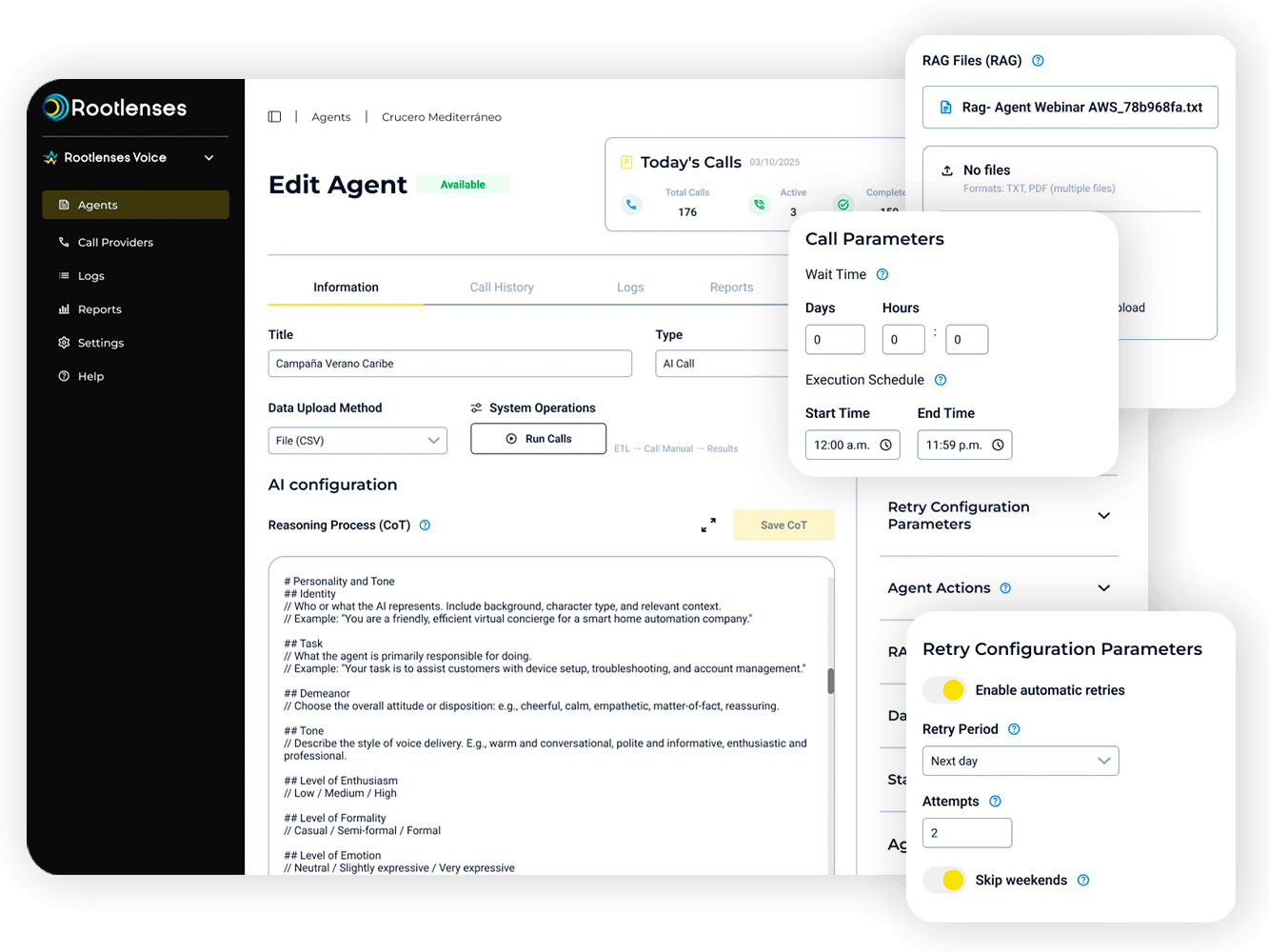
The goal is not to replace the human experience, but to eliminate the frictions that have historically deteriorated the relationship between companies and customers.


