
January 14, 2026
In modern retail operations, the volume of information generated on a daily basis is massive. Every transaction, inventory movement, point-of-sale interaction, and promotional campaign generates data. However, there is a fundamental operational paradox: having access to terabytes of information is not the same as having clarity about the business.
For retail leaders, commercial directors, and operations managers, the challenge is no longer data collection, but the speed of interpretation. The gap between data generation and decision-making is precisely where silent sales losses occur. When visibility is not immediate, operational issues turn into sunk costs before they are even detected.
This article analyzes how traditional retail data analytics fails to illuminate these blind spots and how artificial intelligence is redefining operational efficiency.
Why data exists but does not drive sales
Most retail companies operate with static dashboards and weekly or monthly reports. These reports, while accurate, are operational autopsies: they explain what happened, but rarely provide the agility needed to course-correct in real time.
The problem lies in accessibility. Data is often fragmented across silos (ERP, CRM, logistics systems) and requires specialized Business Intelligence teams to be processed. When a commercial manager has a specific question about category performance, the answer can take days to arrive. In a data-driven retail environment, that latency is unacceptable.
The inability to quickly cross complex variables prevents teams from seeing the correlation between availability, pricing, traffic, and conversion. This is where sales loss becomes invisible.
Where sales are really being lost: Practical cases
Revenue leakage in retail rarely happens because of a single catastrophic event. It occurs due to the accumulation of operational inefficiencies that traditional analytics overlook. Below are the most common scenarios identified through AI analytics in retail:
Stockouts not detected in time
The system may indicate that theoretical inventory exists, but the reality on the shelf or in the distribution center is different. The lack of immediate correlation between a drop in SKU sales velocity and its theoretical stock prevents the detection of phantom inventory. The customer wants to buy, the product is not physically available, and the sale is lost without leaving a trace in the transactional system.
Inefficient promotions and cannibalization
Launching mass discounts without understanding real-time price-demand elasticity often results in margin erosion. Frequently, products are promoted that would have sold at full price, or demand spikes are generated that the logistics chain cannot support, resulting in a poor customer experience.
Performance dispersion across stores
In multi-store chains, averages hide reality. A store may be meeting its sales quota thanks to a high average ticket, while masking a declining conversion rate or sharply falling traffic. Without the ability to break down these indicators instantly, it is impossible to apply localized corrective actions.
Abandonment due to service friction
In both digital and physical channels, slow processes drive abandonment. Detecting the exact point in the sales funnel where the customer drops off requires processing large volumes of behavioral data—something that exceeds the capabilities of manual reports.
How conversational analytics illuminates blind spots
Artificial intelligence in retail has evolved from complex predictive models to direct-use interfaces. This is where technology changes the operational dynamic. Conversational analytics allows users to query data using natural language, eliminating the technical barrier between business users and the database.
Instead of waiting for a report, an executive can ask the system directly: “Which stores experienced a stockout in the electronics category yesterday?” or “What is the correlation between applied discounts and sales volume in the northern region?”
This ability to query instantly transforms raw data into actionable answers. By reducing analysis time to seconds, the organization moves from a reactive model to a proactive one.
The functional value of Rootlenses Insight
Rootlenses Insight is a tool specifically designed to eliminate friction in access to information. It works as an intelligence layer that connects directly to the company’s databases, structuring and transforming information to make it accessible through an AI-powered chat interface.
Rootlenses Insight’s functionality is built around three operational pillars:
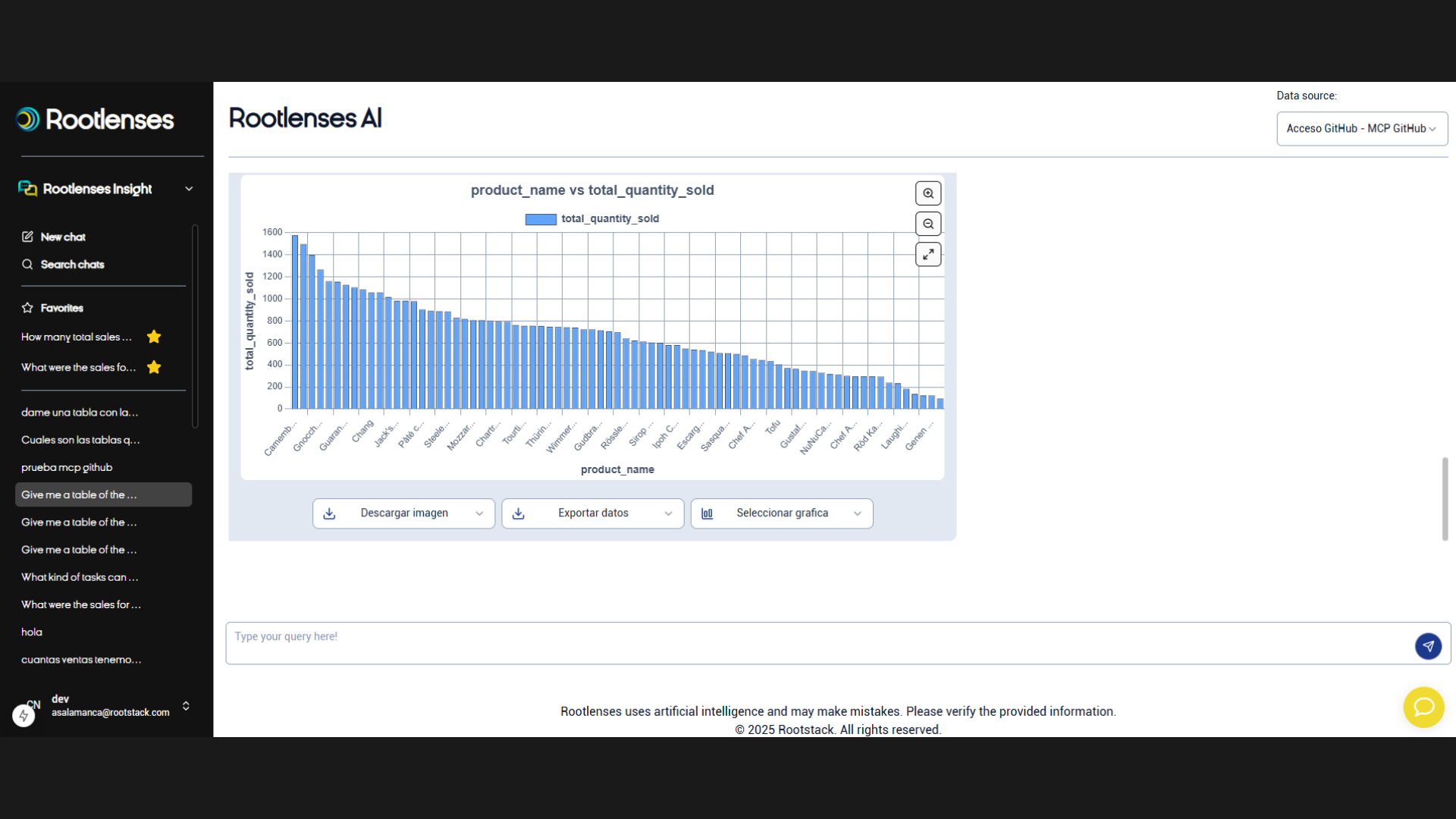
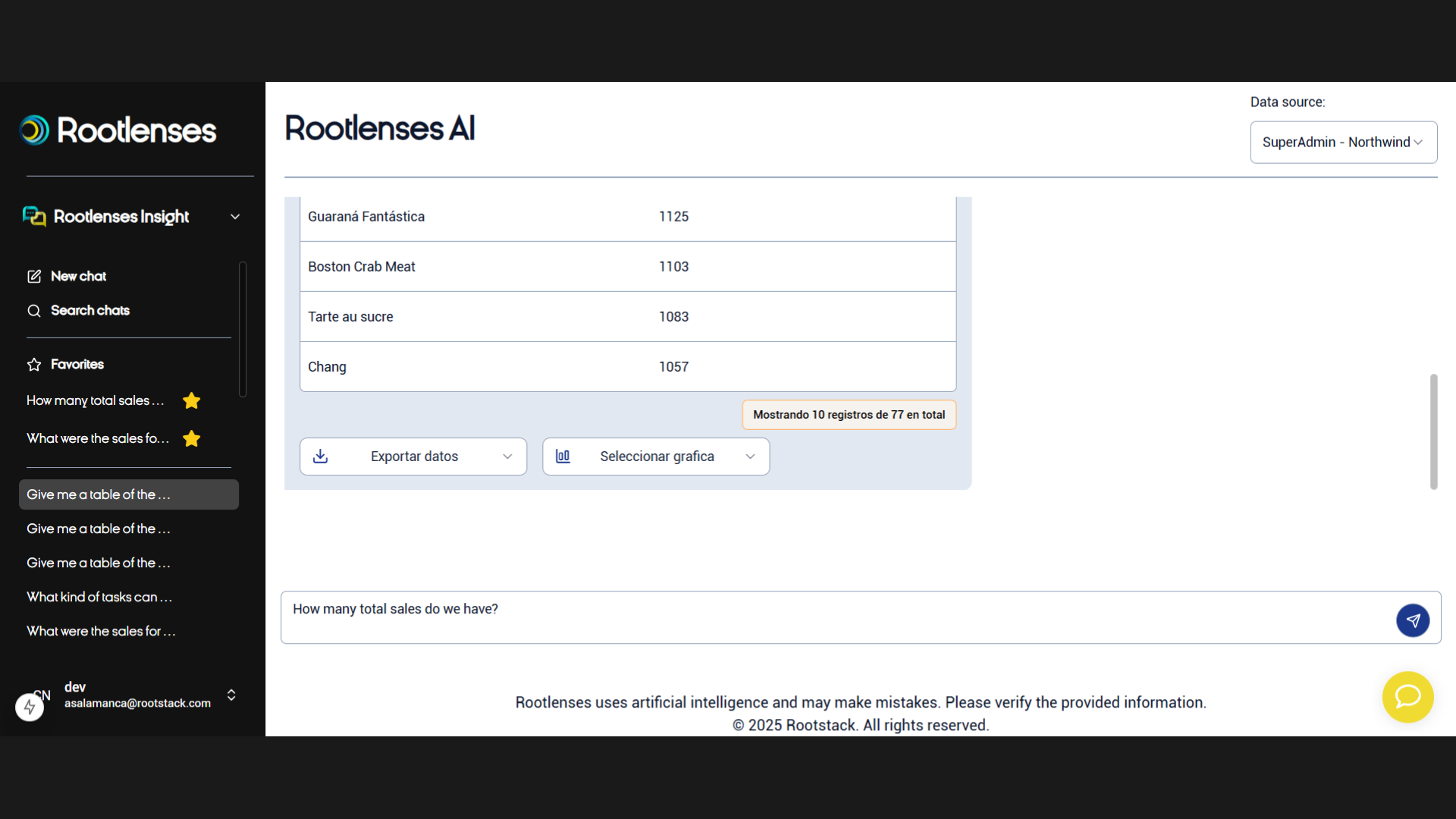
- Real-time data exploration: Enables business users to detect patterns and anomalies without relying on IT teams. The tool interprets complex questions and instantly returns accurate data and visualizations.
- Bottleneck detection: By facilitating the correlation of variables (inventory vs. sales, traffic vs. conversion), Rootlenses makes visible the inefficiencies that cause sales loss.
- Data democratization: Empowers store managers, regional supervisors, and executives to make data-driven decisions, aligning strategy with daily operational execution.
By integrating Rootlenses Insight, retail companies eliminate the “black box” in their operations. The platform not only answers what happened, but also allows teams to investigate root causes in an iterative and fast manner.
Impact on decision-making and commercial efficiency
The implementation of conversational analytics solutions has a direct impact on the bottom line. By restoring visibility across operations:
- Inventory is optimized: Immobilized working capital is reduced and stockouts are minimized.
- Promotional effectiveness improves: Marketing resources are allocated only where data indicates a real positive return.
- Operational agility increases: Commercial teams can respond to changes in demand within hours, not weeks.
Artificial intelligence in retail is not about replacing human judgment, but about enhancing it with immediate evidence. Rootlenses Insight acts as an efficiency enabler, ensuring that no sales opportunity is lost due to lack of information.
Turning data into profitability
Today’s retail market does not forgive inefficiency. The data needed to correct course, optimize assortments, and capture every sales opportunity already resides on your servers. The challenge is unlocking it.
The organizations that will lead the sector are those capable of asking the right questions of their data and obtaining immediate answers. Current technology makes it possible to close the gap between strategy and execution.
If today you cannot confidently explain why one store sells less than another or how much phantom inventory is impacting your revenue, it is time to reassess your analytics tools.


