
February 6, 2026
The role of the finance department has changed dramatically over the past decade. The traditional function of accounting and historical reporting has evolved into a strategic position that must guide the future of the organization.
However, the speed at which data is generated in banks, fintechs, and large enterprises often exceeds human capacity to process it using conventional tools.
For CFOs and FP&A (Financial Planning and Analysis) leaders, the challenge is no longer a lack of data, but rather accessibility and interpretation. This is where AI-powered financial analytics comes into play.
High-performing teams are adopting artificial intelligence tools to eliminate technical dependency and transform complex databases into immediate answers.
This article explores how artificial intelligence applied to business is redefining data analysis, enabling data-driven decision-making that is fast, autonomous, and free of technical friction.
The limitations of the traditional model: From Excel to rigid BI
Historically, the workflow of a financial analyst has been fragmented. The standard process involves extracting data from an ERP or core banking system, cleaning that information, and loading it into massive spreadsheets or waiting for the IT team to update a Business Intelligence (BI) dashboard.
This model presents three critical bottlenecks:
- Technical dependency: If a Head of Financial Planning needs a data view that does not exist in the current dashboard, it must be requested from the data or IT team. This involves support tickets and waiting times that can last days.
- Static data: Reports in Excel or PDF are snapshots of the past. They do not allow real-time drill-down or follow-up questions without reprocessing the data.
- Human error and manual work: Manually consolidating multiple data sources increases the risk of errors in financial figures, compromising report integrity.
In this scenario, financial talent spends 80% of its time on data preparation and only 20% on strategic analysis.
What defines a modern finance team?
A modern finance team is defined by agility and technological autonomy. Unlike their predecessors, these teams do not act as mere auditors of the past, but as architects of future growth.
Key characteristics of these teams include:
- Data autonomy: The ability to query complex information without relying on data engineers or SQL experts.
- Speed of response: The ability to answer board or CEO questions in minutes, not days.
- Predictive focus: Using information to model scenarios and assess risk in real time.
- Technological integration: Adopting tools that connect directly to data sources (SQL Server, Oracle, Postgres) to ensure a single source of truth.
The role of AI in modern financial analysis
AI in finance is not about replacing analysts, but augmenting their capabilities. Artificial intelligence acts as an abstraction layer between database complexity and business needs.
The fundamental shift is the transition from rigid graphical interfaces (static dashboards) to conversational data analysis. Instead of learning complex menus or writing code, financial leaders can now interact with their data using natural language.
This democratizes access to information: any authorized team member can ask complex questions about profitability, expenses, or cash flow and receive accurate answers instantly.
Conversational analytics: The Rootlenses Insight model
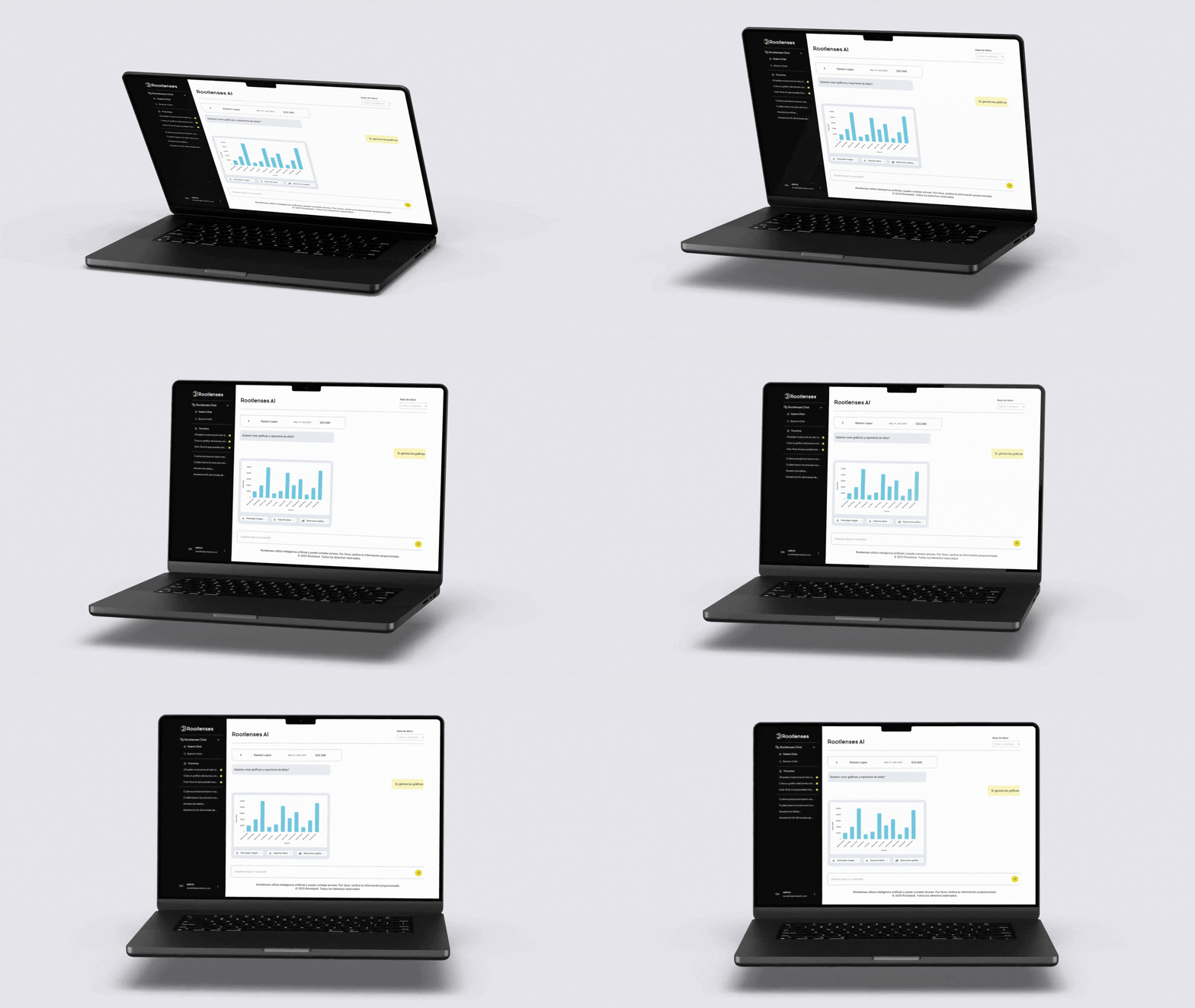
A representative tool of this new paradigm is Rootlenses Insight. This solution functions as an AI-powered financial analyst available 24/7, designed to remove technical barriers from data querying.
Rootlenses Insight connects directly to company databases and uses advanced language models to understand data context without requiring prior human training or extensive manual configuration.
Key functionalities for the financial sector
- Natural language queries: Users do not need SQL knowledge. They can ask, “Show me the revenue trend by product for the last quarter compared to budget,” and the platform interprets intent, executes the query, and delivers results.
- Automatic visualization: The platform does not just return raw data; it instantly generates financial charts and tables, making patterns easier to identify.
- Intelligent suggestions: Based on analyzed data, the AI proposes follow-up questions that help users explore dimensions they may not have initially considered.
- Flexible export: Generated reports can be immediately exported in standard formats such as CSV, JPG, or PNG for executive presentations.
- Security and governance: Given the critical nature of banking and fintech data, the platform includes role-based access controls and end-to-end encryption.
Use cases in banking, fintech, and corporate finance
The practical application of these intelligent financial reports spans multiple critical business areas. Below are use cases where speed and accuracy are decisive.
1. Profitability and P&L (Profit and Loss) monitoring
A CFO can query disaggregated profitability in real time.
- Query: “What is the EBITDA margin by business unit year to date?”
- Result: An immediate comparative table that highlights which business lines are underperforming and require corrective action.
2. Risk management in fintech
Risk teams can monitor credit portfolio health without waiting for month-end close.
- Query: “List the top 10 customers with delinquency greater than 30 days and their total exposure.”
- Result: A detailed, real-time list enabling immediate action by collections teams.
3. Budget variance analysis (FP&A)
During financial close, speed is critical.
- Query: “Compare actual operating expenses vs. budget for the marketing department in Q3 and show the percentage variance.”
- Result: A bar chart visualizing deviations, allowing financial controllers to immediately investigate anomalies.

Strategic benefits for financial leaders
Adopting tools like Rootlenses Insight delivers tangible advantages that directly impact organizational performance:
Elimination of technical friction
By enabling direct queries on SQL databases (MySQL, SQL Server, Postgres, Oracle), the “broken telephone” effect between finance and IT is eliminated. Finance teams regain control of their data.
Accelerated decision-making
Time-to-insight is reduced from days to seconds. In volatile markets, the ability to react quickly to changes in interest rates, exchange rates, or consumer behavior becomes a real competitive advantage.
Optimization of human talent
By automating data extraction and visualization, senior financial analysts move beyond being “Excel generators” and become true strategic business partners—focused on interpreting data and recommending actions.
The future of AI-driven finance teams
Modernizing the finance function is inevitable. Organizations that cling to manual processes and static reports will lose agility compared to competitors that adopt AI-powered financial analytics.
The future belongs to teams that successfully integrate artificial intelligence into daily workflows, using tools like Rootlenses Insight to transform data repositories into immediately accessible strategic assets.


