
February 6, 2026
In today’s financial environment, the speed of information determines strategic agility. For CFOs, planning directors, and FP&A leaders in banking and fintech, access to data is not a luxury—it is a daily operational necessity.
However, there is a structural barrier that slows this process down: dependence on technical teams to extract, process, and visualize information.
Traditionally, answering a complex question about revenue behavior or cohort-level profitability requires a request cycle between the business team and the data team (IT, BI, or Data Engineering).
This article explores how artificial intelligence applied to data eliminates this friction and how tools like Rootlenses Insight enable financial teams to operate with full autonomy.
The bottleneck: When the business depends on IT
The conventional financial analytics workflow presents clear inefficiencies. When a financial leader needs a non-standard report, the process typically follows these steps:
- Request: The finance team defines the requirement and submits a ticket to IT or BI.
- Wait: The request enters a technical prioritization queue.
- Execution: A data engineer writes SQL queries to extract the information.
- Iteration: The delivered report often requires adjustments because the business context was not perfectly translated into technical language.
This cycle creates latency that modern organizations cannot afford. Technical dependency creates silos where context owners (Finance) lack direct access to the source of truth (Databases), while those with access (IT) lack the strategic context needed to interpret financial nuances.
The impact of latency on Banking and Fintech
In highly regulated and volatile sectors such as banking and fintech, a “data-driven decision” loses value if the data arrives three days late. Technical dependency impacts critical areas:
- Risk Management: The inability to monitor risk exposure or changes in customer payment behavior in real time.
- Forecasting and Planning: Difficulty adjusting financial projections quickly in response to market changes due to slow access to historical data.
- Opportunity Costs: Loss of commercial agility by not being able to instantly identify profitability trends by product or segment.
The solution is not to hire more data engineers, but to change the interface through which the business interacts with information.
AI for financial analysis: Natural language queries
The evolution of AI-driven financial analytics has enabled the development of conversational interfaces. The goal is to eliminate the programming language barrier (SQL, Python) and replace it with the natural language of the business.
This technology allows an executive to ask, “What was the EBITDA variation in the last quarter compared to the previous year?” and receive a precise answer pulled directly from the database—without human intermediaries. This transforms the role of the finance team from information requesters to autonomous analysts.
Rootlenses Insight: Operational autonomy for financial teams
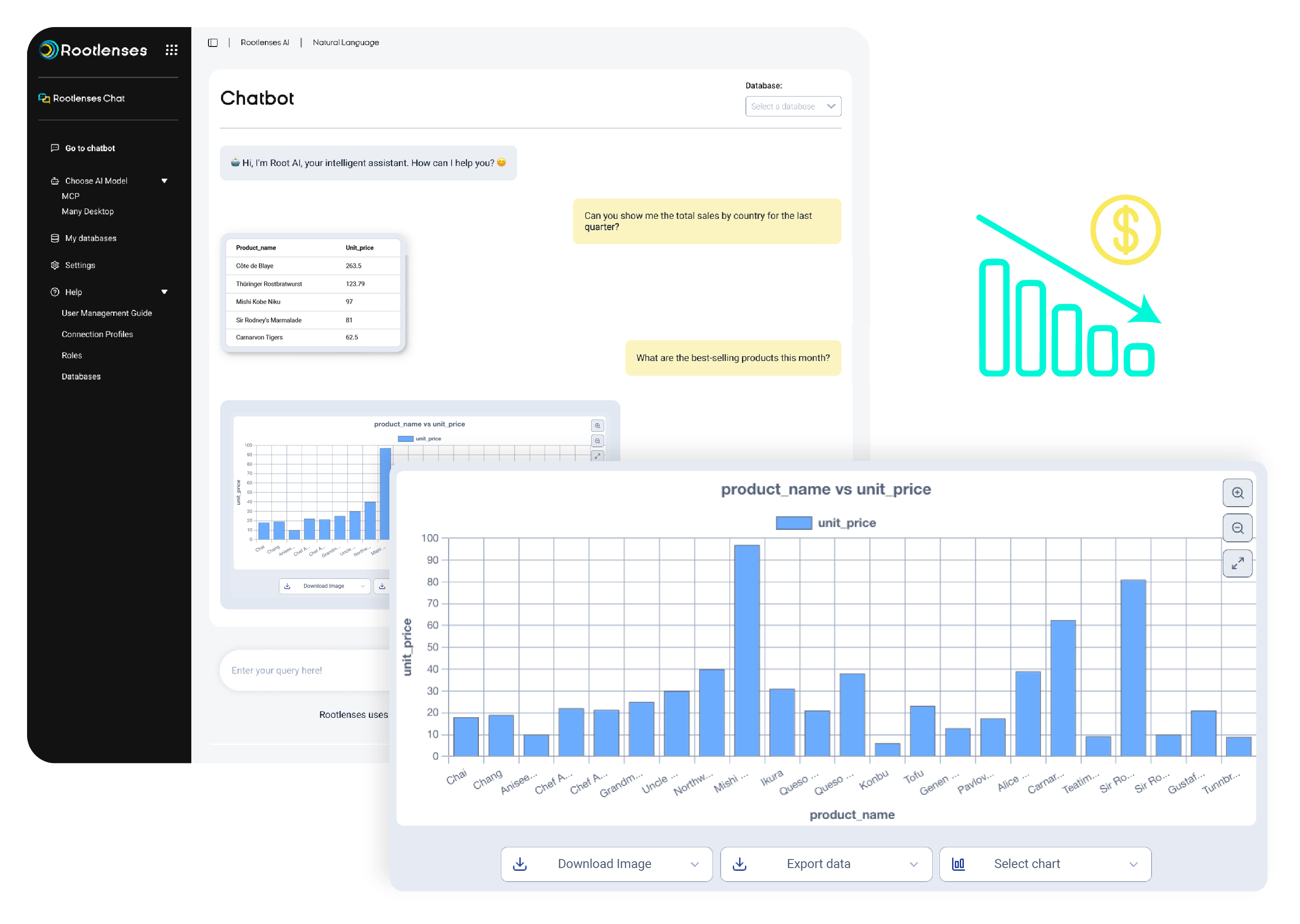
Rootlenses Insight is a tool that enables companies to query and analyze their data instantly using AI. It works by connecting directly to the client’s databases and transforming the information so users can access it through questions in a chat interface.
This platform acts as a virtual financial analyst, eliminating the need for technical knowledge or SQL expertise on the part of the end user.
Key technical features
For technology and finance leaders evaluating integration feasibility, Rootlenses Insight offers specific capabilities designed for enterprise environments:
- Database Integration: Connects with MySQL, SQL Server, Postgres, and Oracle.
- Automatic Contextual Understanding: The AI analyzes the database schema and understands the context of the information without extensive prior human training.
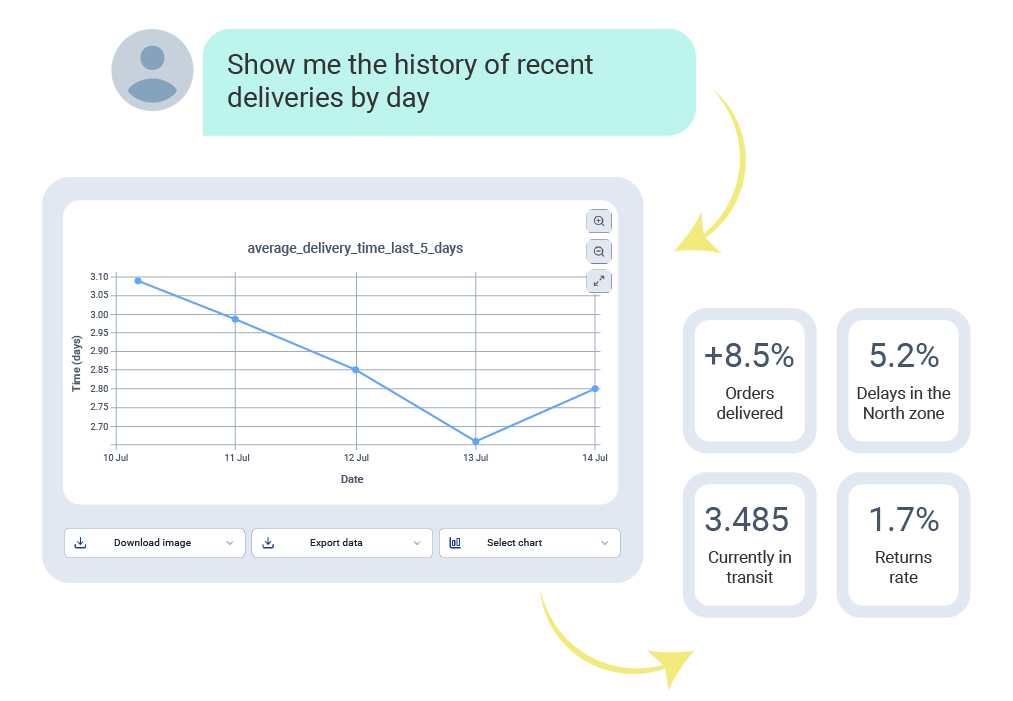
- Visualization Generation: Instantly creates reports, charts, and tables based on the query performed.
- Data Export: Allows results to be downloaded in standard operational formats such as CSV, XLS, JPG, or PNG for presentations or further analysis.
- Security: Implements end-to-end security with access control and role management, ensuring sensitive information is only accessible to authorized personnel.
Use cases: Accelerating decision-making
Implementing automated financial reporting through Rootlenses Insight changes the day-to-day dynamics of finance departments. Below are practical scenarios where technical dependency disappears.
1. Profitability and margin analysis
Instead of waiting for month-end close or requesting an updated dashboard from BI, a CFO can ask directly:
“Show gross margin broken down by product line for Q1 and compare it against the budget.”
Rootlenses Insight interprets cost and sales structures within the database and returns a comparative table and bar chart, enabling real-time deviation detection.
2. KPI and SaaS metrics monitoring
For companies with recurring models or fintechs, tracking unit economics is critical. The FP&A team can ask:
“Calculate the average Customer Acquisition Cost (CAC) for the last 6 months and chart it against Lifetime Value (LTV).”
The tool cross-references marketing and sales expenses with revenue per user to deliver precise metrics.
3. Cash flow and vendor management
Management control is simplified by querying data on immediate operational states:
“List the top 10 vendors with the highest volume of invoices overdue by more than 30 days.”
This allows the treasury team to take immediate corrective actions without manually cross-referencing multiple spreadsheets.
Strategic benefits for financial leadership
Adopting an AI-based query tool like Rootlenses Insight delivers clear competitive advantages:
- Reaction Speed: Reducing data retrieval time from days to seconds allows strategies to be adjusted before trends fully materialize.
- Operational Efficiency: Frees IT and Data Engineering teams from ad-hoc reporting workloads, allowing them to focus on infrastructure and data governance.
- Accuracy and Confidence: By eliminating manual Excel manipulation, the risk of human error is reduced. Rootlenses Insight delivers accurate responses by directly understanding the database schema and content.
- Opportunity Detection: The tool provides intelligent data suggestions, helping financial leaders uncover correlations or anomalies they may not have been actively seeking.
The future of analytics in Banking and Fintech
Digital transformation in banking demands tools that close the gap between technical capability and business vision. The ability to run natural language queries democratizes access to information, empowering financial leaders to fulfill their strategic role without technical constraints.
Rootlenses Insight represents the step toward a truly data-driven organization, where the barrier to deep analysis is not knowledge of SQL code, but the ability to ask the right questions.


