
January 5, 2026
In the Colombian business environment, the speed of making informed decisions has become a decisive competitive advantage. Sectors such as finance, retail, logistics, telecommunications, and services share a common challenge: large volumes of data that exist, but are not always available when the business needs them.
For years, accessing corporate information has been a slow process dependent on the IT department. Report requests, waiting times, rigid dashboards, and analyses that arrive too late to match real business needs have limited operational agility. Today, this model is no longer sustainable.
For this reason, more and more companies in Colombia are adopting artificial intelligence applied to database querying, a technology that allows them to interact with business information using natural language and obtain real-time answers.
The structural problem: relying on IT to understand data
For roles such as CFOs, COOs, sales managers, or operations leaders, the situation is recurring:
- The data exists, but is not directly accessible.
- Queries require technical knowledge (SQL, data models).
- The IT team is overloaded with critical tasks.
- Decisions are made using outdated information.
This dependency creates operational bottlenecks that directly impact profitability, efficiency, and the ability to react to changes in the Colombian market, characterized by its dynamism and volatility.
The consequence is clear: the strategic value of data remains underutilized.
Limitations of traditional Business Intelligence in Colombia
Business Intelligence (BI) tools have been fundamental to digital transformation, but they present important limitations when the business requires flexibility.
Traditional dashboards:
- Work well for predefined KPIs.
- Do not answer new or contextual questions.
- Require technical intervention to modify reports.
- Do not scale at the pace of the business.
For example, questions such as:
“What impact did a specific logistics disruption have on sales in a particular region?”
Are usually not contemplated in a standard dashboard. In these cases, traditional BI loses effectiveness compared to conversational analytics solutions powered by AI.
What is conversational AI applied to databases?
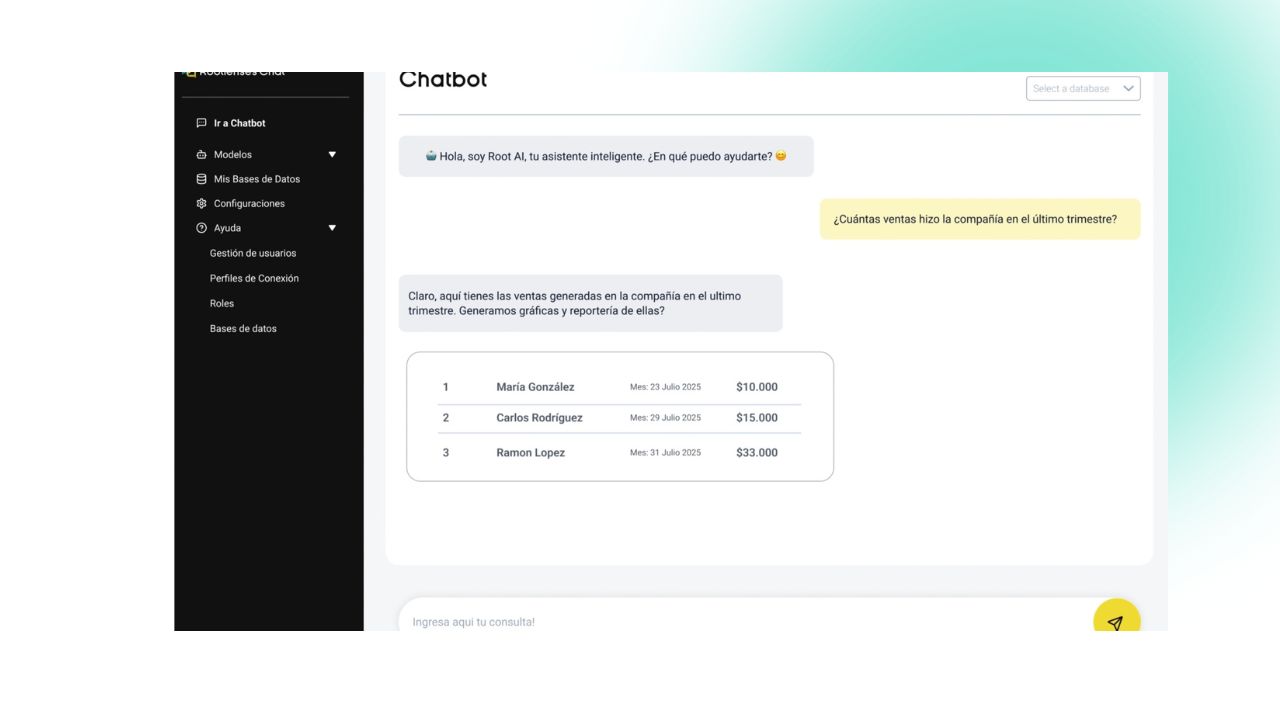
Conversational AI for enterprise databases allows users to interact with their information using natural language, without writing code or knowing the technical structure of the system.
Instead of SQL queries, users ask questions such as:
- “How did sales perform by channel last quarter?”
- “Show me employee turnover by location in 2024.”
- “Which customers show the highest churn risk this month?”
AI interprets intent, understands business context, builds the required queries, and delivers clear results in seconds.
This approach eliminates friction between the business and its data.
Self-service data for non-technical teams
One of the greatest benefits of this technology is the democratization of access to information.
Modern AI solutions:
- Automatically analyze the database schema.
- Understand relationships between tables (customers, billing, inventory).
- Do not require lengthy manual training.
- Adapt to the Colombian business context.
This enables a true self-service data model, where:
- Finance analyzes revenue, costs, and margins.
- Human Resources evaluates turnover, absenteeism, and performance.
- Operations monitor timelines, efficiency, and bottlenecks.
- Sales and marketing access actionable insights in real time.
IT stops being a constant intermediary and focuses on strategic initiatives.
Automatic generation of insights, charts, and reports
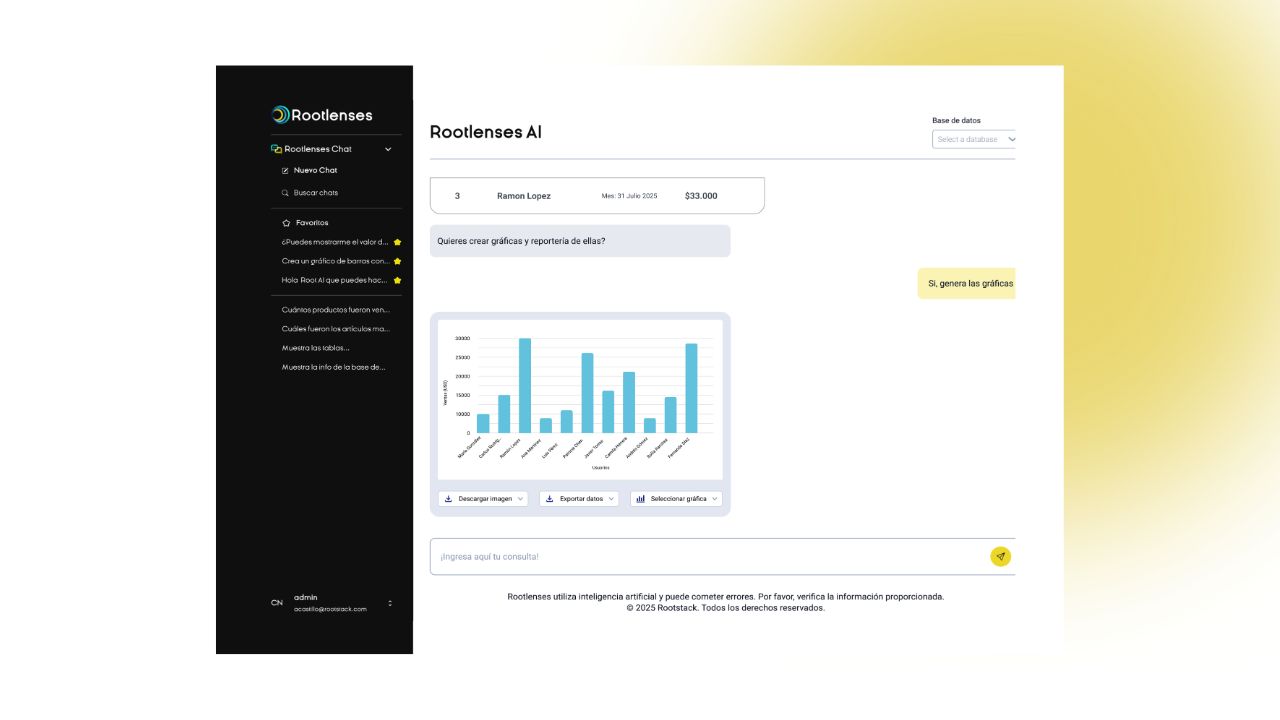
AI not only answers questions, but also interprets the best way to present information.
When context requires it, it generates:
- Comparative charts.
- Dynamic tables.
- Historical trends.
- Downloadable reports ready for executive meetings.
This accelerates internal communication and improves decision quality, especially in organizations with multiple management layers.
Security, data governance, and access control
A critical aspect for companies in Colombia is information security. Modern enterprise AI solutions are designed under strong data governance principles:
- Role- and profile-based access segmentation.
- Respect for existing database permissions.
- Protection of sensitive information.
- Compliance with corporate and regulatory standards.
AI does not break the rules; it respects them. It only facilitates access for authorized users, maintaining data integrity and confidentiality.
AI for querying databases: a real competitive advantage
Organizations that adopt conversational AI for data:
- Make faster decisions.
- Reduce operational dependency.
- Improve cross-team alignment.
- Increase return on data investment.
In a market like Colombia’s, where agility defines leadership, turning questions into immediate answers makes the difference.
Take control of your data with Rootlenses Insight
Breaking free from tickets, static reports, and slow processes is possible.
Rootlenses Insight allows your company to directly converse with its databases using AI, obtaining:
- Reliable answers in seconds.
- Automatic charts and reports.
- Secure, governed access.
- True self-service for non-technical teams.


