
January 5, 2026
Costa Rica has established itself as a technology and business services hub in Latin America. Multinationals, shared services companies, and leading local organizations operate with massive volumes of information. However, an increasingly evident paradox exists: the speed at which data is converted into strategic decisions remains low.
CEOs, CFOs, and operations leaders know that the information exists. Their organizations generate and store terabytes of data every day. The real problem is not the lack of data, but the difficulty of accessing it in an immediate, understandable, and actionable way without relying on technical profiles.
In this context, conversational artificial intelligence applied to databases is positioning itself as a key competitive advantage for companies in Costa Rica seeking agility, operational efficiency, and better business decisions.
The real problem: data available, slow decisions
In many Costa Rican companies, answering a strategic question still follows a bureaucratic path:
- The business leader identifies a key question.
- They request a report from the IT or data analytics team.
- The request enters a prioritized queue among critical technical tasks.
- The report arrives days or weeks later.
In a dynamic market, that delay invalidates the information. The opportunity to adjust pricing, optimize inventory, or refine a commercial strategy has already passed.
The issue is not the technical team’s capability. It is the operating model. Constant dependence on the IT department turns data into a passive asset, when it should be a living tool serving the business.
Breaking dependence on the IT department
A common scenario in board meetings in Costa Rica:
A COO needs to know the profitability by product line for the last quarter, compared to the previous period.
The data exists. It lives in the financial database.
But access is mediated by technical queries.
While the IT team focuses on infrastructure, security, integrations, and support, business questions accumulate. Unintentionally, IT becomes an operational bottleneck.
The direct consequence is clear:
- Delayed decisions
- Slow market reactions
- Frustration among business leaders
- Underutilization of the real value of data
The solution is not hiring more analysts, but changing how the business interacts with information.
The limitations of traditional Business Intelligence
For years, companies invested in Business Intelligence (BI) tools, dashboards, and visual reports. These solutions serve an important purpose, but they have a structural limitation:
= They only answer predefined questions.
A dashboard shows known KPIs. But when a question arises outside the script—an ad hoc query—the system stops being useful.
Common examples:
- Why did sales drop in Guanacaste last Tuesday?
- Which salespeople impacted margin the most this month?
- How are certain discounts related to returns?
Answering these questions requires:
- Modifying dashboards
- Rewriting queries
- Technical intervention
In a volatile environment, leaders need to explore data, not just observe it.
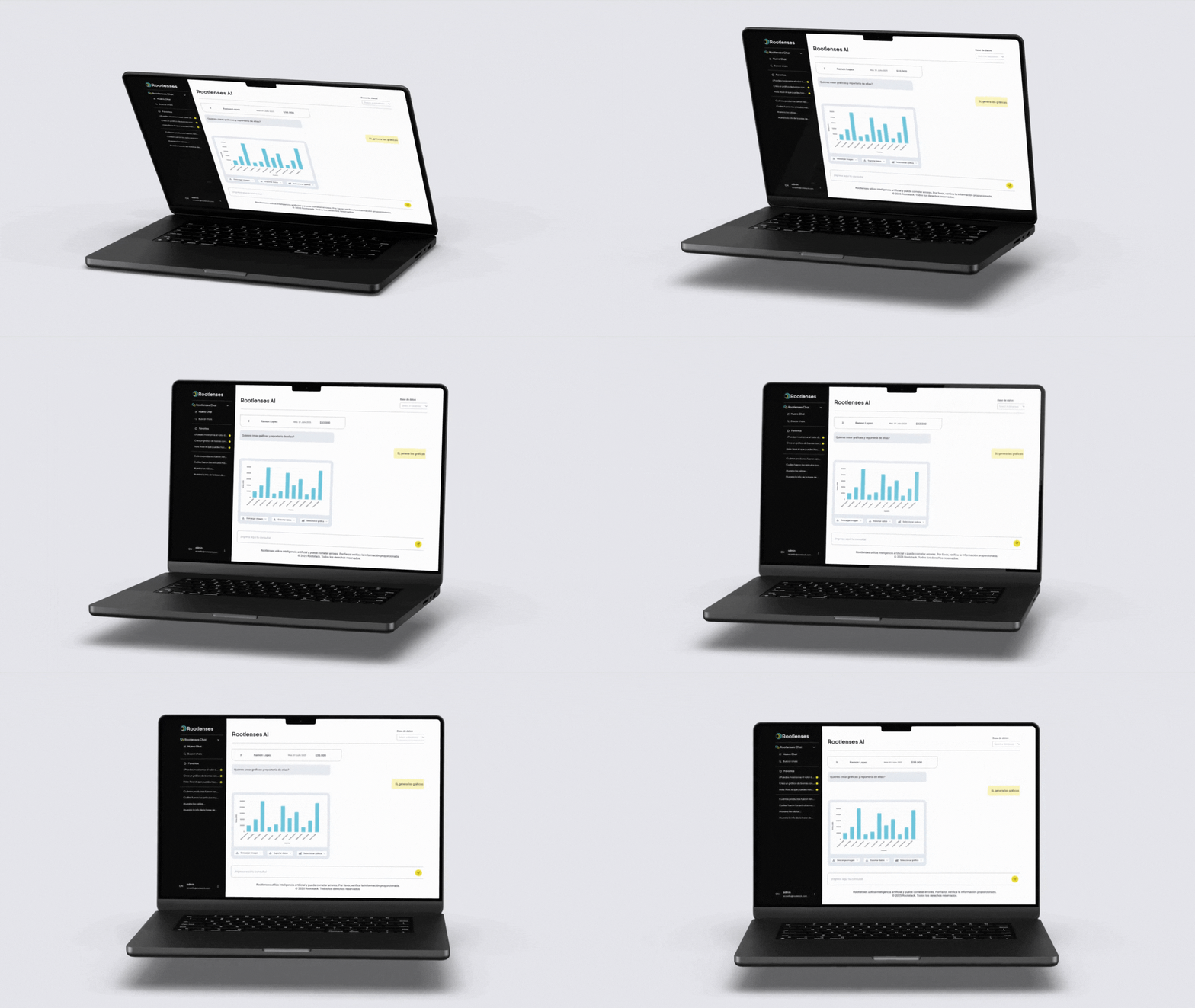
Conversational AI: talking to databases
Conversational AI applied to data analysis represents the natural evolution of traditional BI.
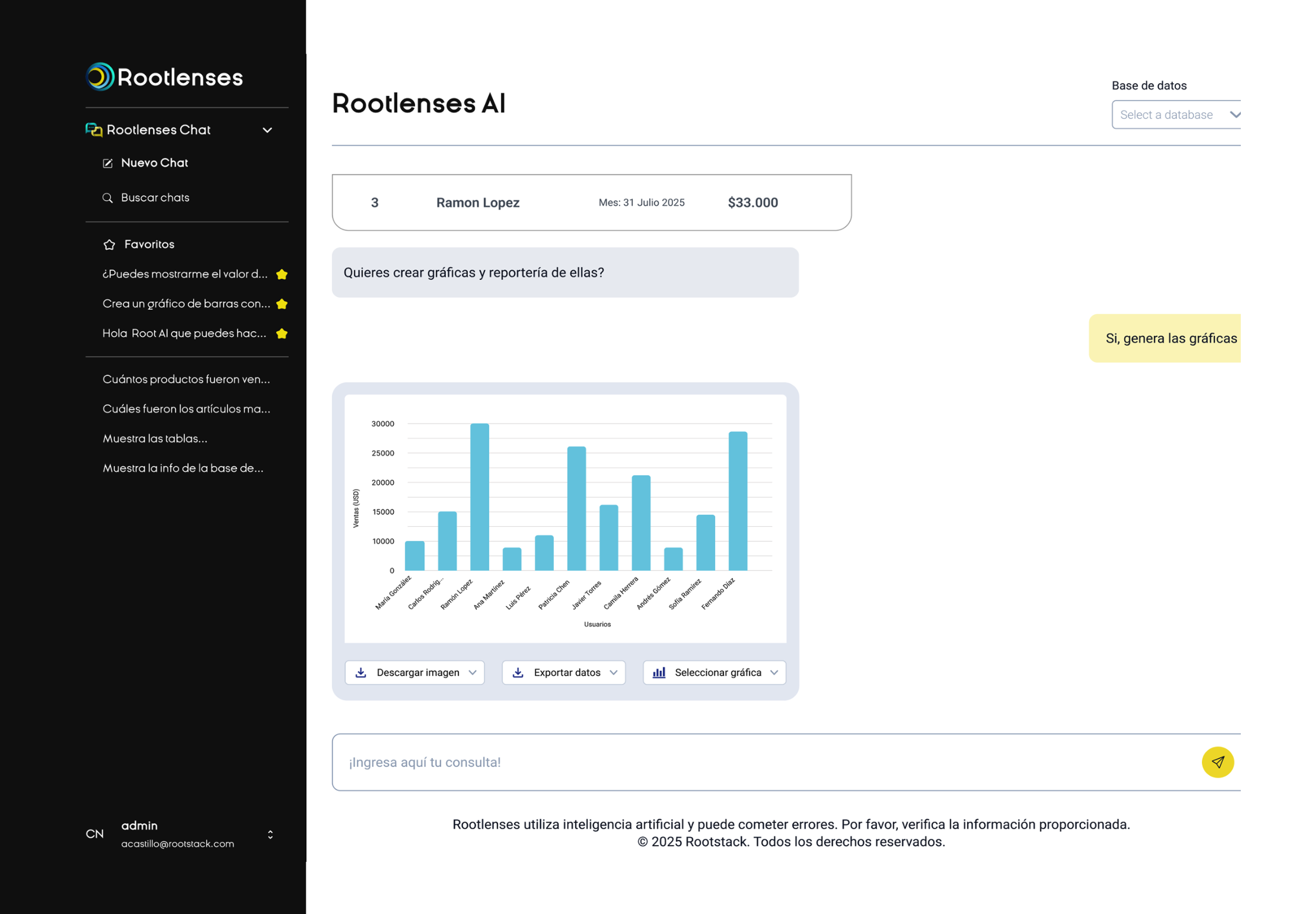
Instead of navigating rigid dashboards, leaders can ask questions in natural language, as if they were speaking to an analyst:
“Show me March sales grouped by salesperson and sort them from highest to lowest.”
“Compare this month’s revenue with the same month last year.”
In seconds, the AI:
- Interprets intent
- Queries the database
- Performs complex calculations
- Delivers precise answers
All without requiring SQL, technical knowledge, or understanding of data architecture.
The AI acts as a 24/7 virtual analyst, removing friction and accelerating real-time decision-making.
Self-service data with contextual understanding
One of the greatest advances in modern AI is its ability to understand data context without intensive human training.
The AI analyzes tables, fields, and relationships, understanding that:
- “sales,” “revenue,” and “billing” are related
- Financial data has temporal hierarchies
- Operational metrics connect across departments
This enables a true data self-service model across the organization:
Finance
- Cash flow analysis
- Budget variances
- Profitability by unit or channel
Human Resources
- Employee turnover
- Payroll costs
- Absenteeism trends
Marketing
- Campaign ROI
- Relationship between leads and sales
- Real revenue impact
In addition, the AI does not respond with text only. It generates automatic visualizations—charts, trends, and comparisons—when information is better understood visually.
Security, governance, and access control
Greater access does not mean less control.
Enterprise AI platforms are designed under strict principles of security, governance, and role-based access control:
- Each user only accesses the information they are authorized to see
- Existing permissions are respected
- The AI acts as an interface, not a security bypass
Example:
- A regional manager sees only their territory
- The CFO accesses global financials
- HR keeps sensitive information protected
This allows companies to achieve agility without sacrificing confidentiality or regulatory compliance.
AI for faster decisions and better results
Adopting AI to query databases is not just a technological upgrade. It is a cultural shift.
Companies in Costa Rica that eliminate friction between business questions and data-driven answers:
- React faster to the market
- Reduce operational costs
- Empower their leaders
- Free IT to focus on innovation
Data stops being a technical resource and becomes a strategic asset accessible across the organization.
Conclusion: the future is talking to data
If your company is looking to make faster decisions, eliminate bottlenecks, and truly leverage its information, it is time to change how you interact with your databases.
Rootlenses Insight enables companies in Costa Rica to integrate artificial intelligence directly on top of their databases, delivering reliable answers, contextual analysis, and automatic visualizations in minutes, without relying on technical teams.


