
April 16, 2026
As Tech Lead at Rootlenses Voice, I observe a recurring operational problem in companies on a daily basis. Traditional automation systems operate under predefined flows that limit interaction. When a customer diverts the conversation, these systems fail. They create immediate friction and lose valuable business opportunities.
The fundamental question for business teams is whether a machine can truly negotiate like a human. The technical answer depends on the underlying architecture. Conventional approaches are limited to processing audio and returning static responses. To achieve true artificial intelligence in sales, the system must be able to evaluate the context and adapt its strategy in real time.
This is where structured reasoning comes into play. Through this article, I will explain how Chain of Thought (CoT) technology transforms call automation with AI. Understanding this technical mechanism will allow you to evaluate advanced solutions and obtain solid competitive advantages in your operational processes.
What is Chain of Thought (CoT)?
Chain of Thought (CoT) is a natural language processing method. It allows AI models to break down complex problems into logical steps before issuing a response.
Instead of generating an immediate answer based on superficial patterns, the system executes a step-by-step reasoning process.
This methodology makes the technical difference between simply responding and truly reasoning. A system without CoT identifies a keyword and triggers a prerecorded message. A system equipped with CoT operates differently.
First, evaluate the user's intent. Then, analyze the history of the conversation. Then, formulate an internal strategy. Finally, articulate a consistent response.
For language models (LLMs) and intelligent voice agents, this capability reduces logical errors and improves accuracy. The AI evaluates multiple contextual variables before speaking, emulating the cognitive process of a human sales agent.
Limitations of script-based systems
Historically, contact centers have relied on decision trees to manage their interactions. These structured models present severe operational constraints for scaling complex businesses.
- Rigid predefined flows: Require the customer to respond exactly what the system expects (such as pressing a button or saying "yes" or "no").
- Incapacity for deviations: If a user asks a question outside the established script, the system collapses or transfers the call unnecessarily.
- Lack of context retention: They forget the information shared minutes before in the same call, forcing the client to repeat data.
These technological limitations prevent effective AI objection handling. Sales conversations are rarely linear. They require an adaptability and understanding of context that traditional scripts simply do not possess.

How CoT changes the game in sales conversations
The implementation of Chain of Thought gives advanced voice AI dynamic capabilities to manage real negotiations. The system processes the information in successive layers to maintain control of the call.
First, perform an interpretation of the context. Analyze not only the user's words, but the exact stage of the negotiation. Second, perform an intent assessment. Accurately determine whether the prospect is searching for information, making an excuse, or showing genuine purchasing interest.
Third, it generates dynamic responses. AI builds a specific message for itto particular situation in milliseconds. Finally, navigate non-linear conversations without difficulty. It allows the user to interrupt, change the subject and return to the original point without losing the thread of the sale.
Practical application in Voice AI
To understand the impact of CoT, let's analyze the behavior of AI conversational agents against common sales objections.
Faced with the objection "I don't have time", a traditional bot would say: "I understand, can I call tomorrow?" An agent equipped with CoT reasons internally: The user is busy now. I must be brief, generate immediate value and propose a concrete follow-up alternative.
The response generated would be: "I understand. In just 30 seconds I tell you that our tool reduces your operating costs by 40%. Would you prefer that I send you the information by mail or call you on Thursday at 10 AM?"
When faced with a "I'm not interested", the system evaluates whether it is a definitive rejection or a lack of information. Internally processed: The customer does not perceive the value of the product. I must investigate the root cause without being intrusive. The adapted response would be: "Is it because of a current budget issue or because they already have a similar solution in their company?"
This contextual decision logic directly increases business performance. Organizations experience a higher conversion rate, an optimized customer experience, and a drastic reduction in friction with every call.
How Rootlenses Voice applies structured reasoning
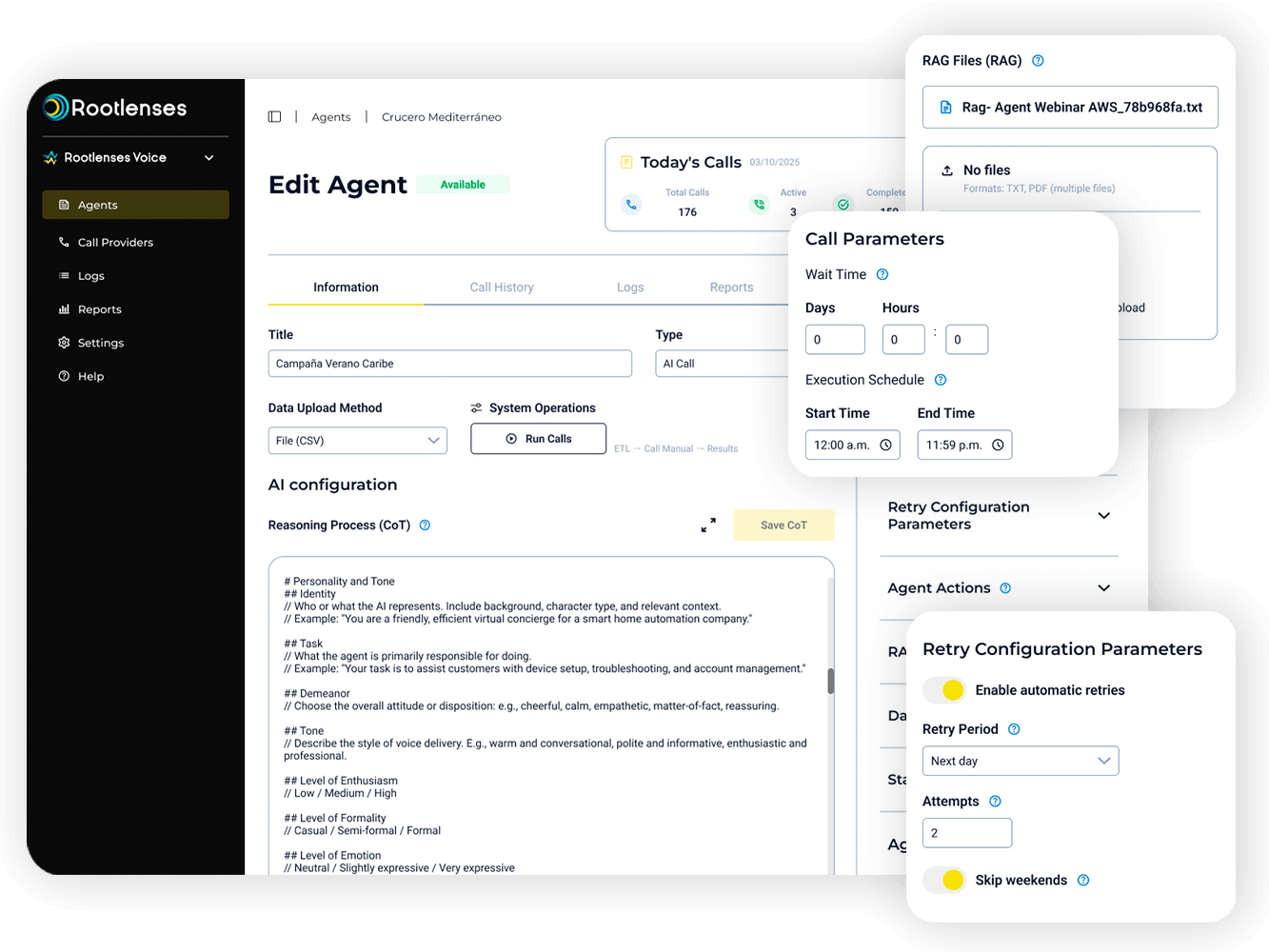
At Rootlenses Voice, we have designed an AI architecture to automate enterprise calls at scale. We integrate Chain of Thought directly into our orchestration engine. We replace repetitive call flows with autonomous agents capable of reasoning and adapting to each organization through secure cloud deployment.
Our platform allows organizations to run concurrent campaigns without sacrificing interaction quality. The operational process makes adoption easy for any team:
- Script configuration: Templates are created where the AI uses CoT to adapt the message according to the contact segment and the type of call (inbound or outbound).
- Contact upload: The system organizes specific groups, validates telephone numbers and prepares highly targeted campaigns.
- Call scheduling: The agent makes calls at defined times, managing high attendance and responses in real time.
- Report analysis: The platform delivers automatic transcriptions, live evaluation of opportunities and metrics to optimize future iterations.
This combination of technical scalability and adaptive intelligence allows manual intervention to be reduced by up to 80%. Companies manage to execute thousands of calls without increasing staff.
The future requires operational reasoning
Natural language processing has matured to the point where repeating a script is no longer enough. The future of intelligent automated sales lies in the machine's ability to reason in fractions of a second and execute consistent negotiation tactics.
Implementing technology based on Chain of Thought represents a fundamental competitive advantage. It allows companies to scale their commercial operations massively, maintaining the personalization and resolution effectiveness of human contact.
If your organization manages high volumes of interactions and is looking to optimize your business results, it is time to evaluate autonomous solutions.


