
February 6, 2026
The volatility of today’s markets and the speed at which macroeconomic environments evolve have put traditional financial planning methods under significant strain.
For Chief Financial Officers (CFOs) and leaders in banking and fintech, the challenge is no longer just collecting data, but interpreting it quickly enough to make strategic decisions. Reliance on static models and disconnected spreadsheets limits the ability to respond effectively to changing scenarios.
The natural evolution of the finance function points toward artificial intelligence—not as a replacement for expert judgment, but as a tool that removes operational friction.
AI-assisted forecasting enables a transition from a reactive, manual approach to a predictive and dynamic one. In this context, tools like Rootlenses Insight are redefining how organizations interact with their data, enabling deep analysis through natural language queries.
This article analyzes the critical differences between traditional methods and AI-assisted forecasting, exploring how technology is transforming agility and accuracy in financial decision-making.
How does traditional forecasting work?
Traditional forecasting is fundamentally based on historical data and linear projections.
Typically, this process relies on complex spreadsheets (such as Excel) and ERP systems that require manual data extraction and manipulation.
Financial analysts spend a significant portion of their time consolidating information from disparate sources before they can begin the actual analysis.
The main characteristics of this model include:
- Manual-intensive processes: Data collection and cleansing consume valuable resources.
- Long review cycles: Due to operational complexity, forecasts are often updated monthly or quarterly, which may be insufficient in volatile markets.
- Rigidity: Modifying variables in a complex model to simulate new scenarios requires time and specialized technical knowledge.
- Technical dependency: IT teams or data specialists are often required to generate custom reports or integrate new data sources.
What is AI-assisted forecasting?
AI-assisted forecasting uses advanced algorithms to analyze large volumes of data, identify non-obvious patterns, and generate projections more quickly.
Unlike static models, AI can process internal and external variables simultaneously, learning from the data context to refine its predictions.
The key innovation at this stage is natural language interaction. Tools like Rootlenses Insight allow financial executives to “converse” directly with their databases. This removes the technical barrier of writing SQL code or manipulating complex tables.
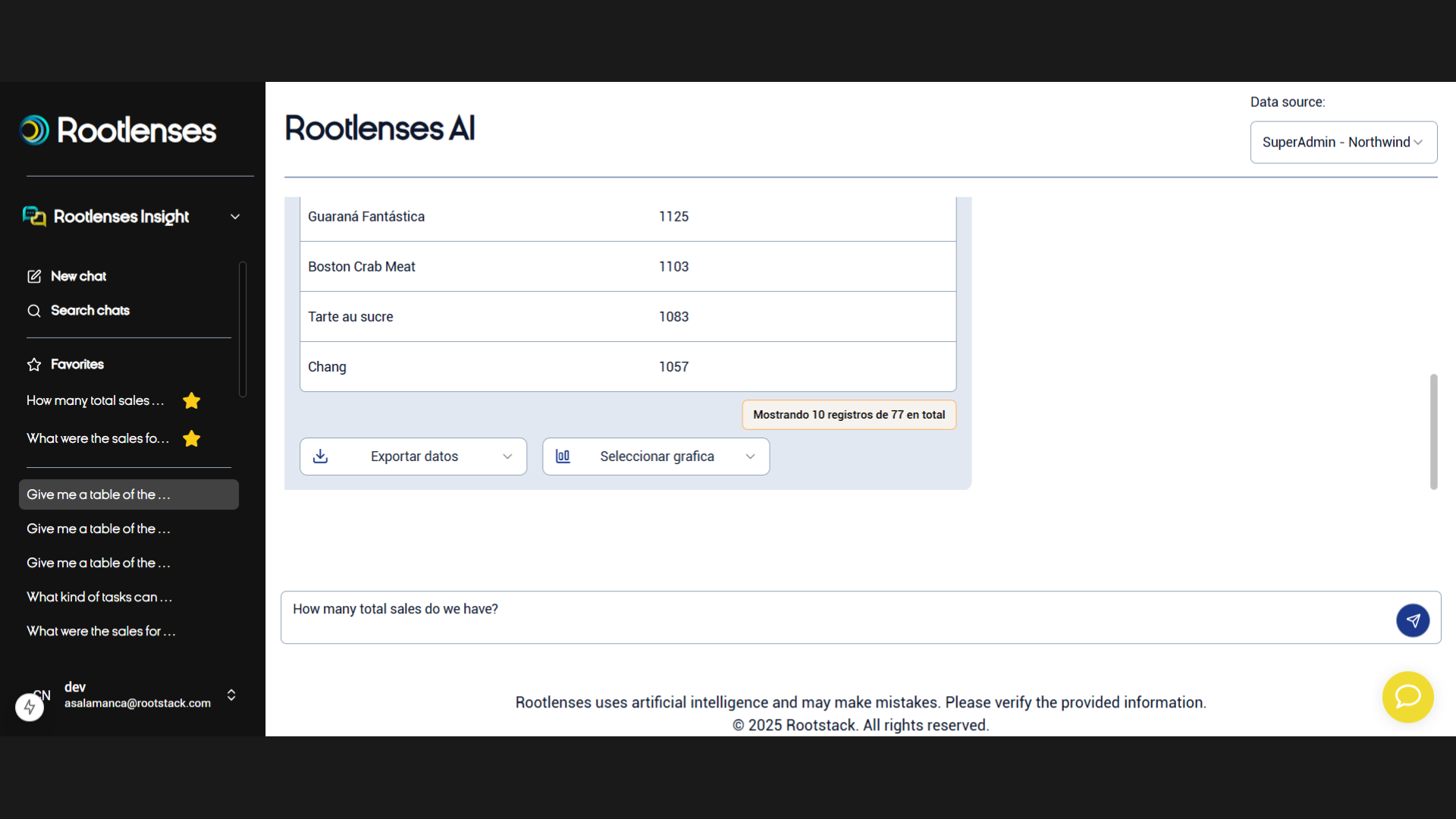
Users simply ask questions about revenue performance, expenses, or market trends, and the system analyzes the data to deliver immediate answers, charts, and structured reports.
Traditional forecasting vs forecasting with Rootlenses Insight
The difference between both approaches is not only technological, but operational. Rootlenses Insight acts as an AI agent that connects directly to databases (MySQL, SQL Server, Postgres, Oracle) and understands their structure without requiring prior human training.
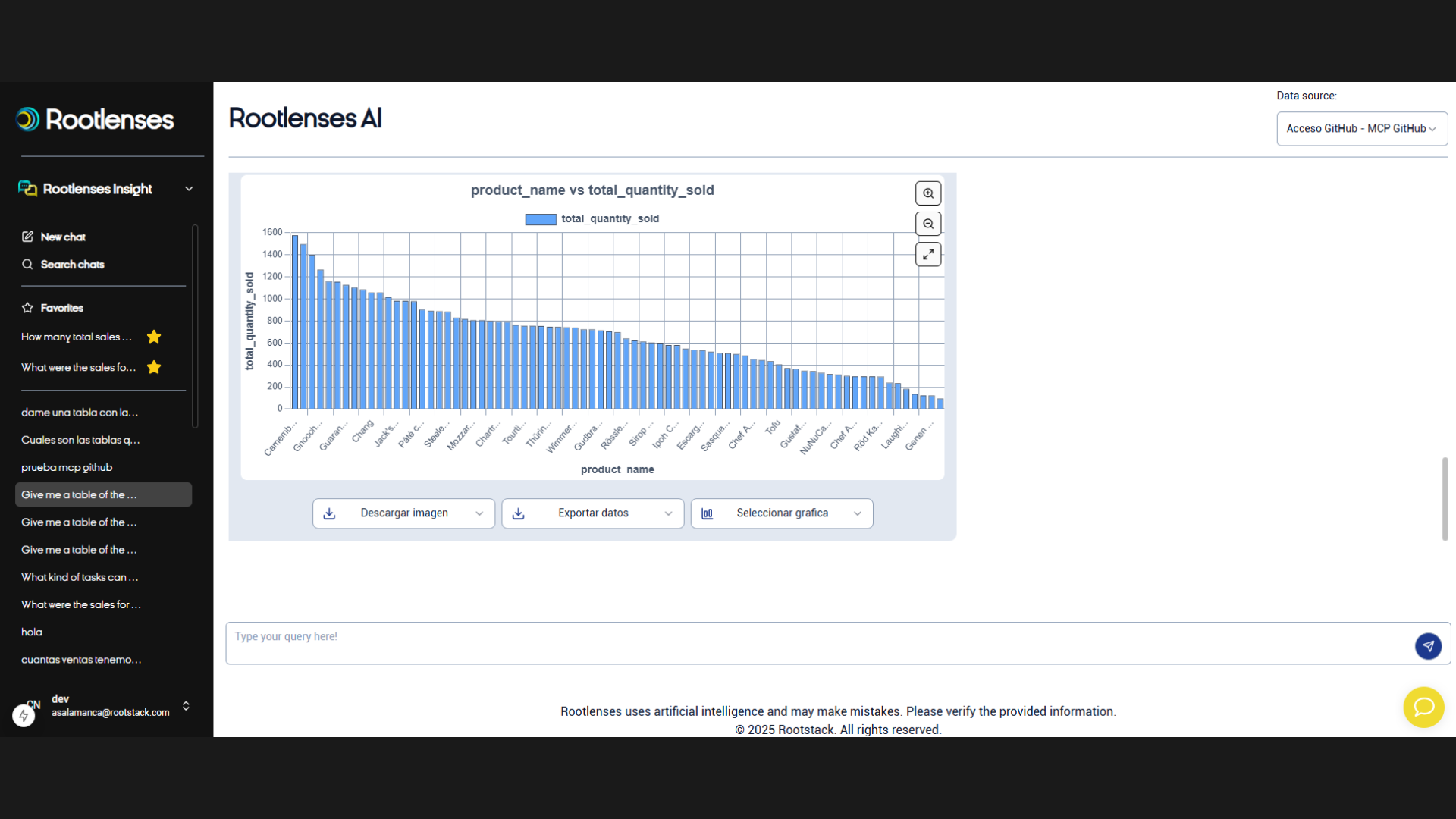
Below is a comparison of both models across critical dimensions for financial management:
Response speed
- Traditional: Generating a new scenario or report can take hours or even days, depending on analyst availability and data cleansing efforts.
- Rootlenses Insight: Responses are immediate. By processing natural language queries, the system delivers analysis and visualizations in seconds, enabling real-time iteration across multiple hypotheses.
Accuracy and context
- Traditional: Relies on predefined formulas that may fail to capture complex correlations or sudden market shifts.
- Rootlenses Insight: Automatically analyzes databases with contextual understanding. It provides intelligent data-driven suggestions to uncover opportunities or risks that may be overlooked in manual analysis.
Flexibility and autonomy
- Traditional: There is a high dependency on expert analysts or IT teams to extract specific information.
- Rootlenses Insight: Democratizes access to information. Financial leaders can generate their own reports, charts, and tables without technical programming knowledge, and export results (CSV, JPG, PNG) for immediate presentation.
Data visualization
- Traditional: Requires manual dashboard creation or exporting data to external visualization tools.
- Rootlenses Insight: Automatically generates visual representations tailored to each query, enabling instant interpretation of trends and anomalies.
Use cases in the financial industry
Implementing Rootlenses Insight enables practical applications that streamline daily operations in financial institutions and corporate finance teams:
Revenue projections by product
Instead of waiting for month-end close, a CFO can ask in real time: “Show the revenue trend for the mortgage lending product over the last quarter compared to the previous year.” The tool processes the request and delivers a comparative chart with up-to-date data.
OPEX control and forecasting
To monitor efficiency, users can request a breakdown of expenses by department or category. The system can identify budget deviations and suggest areas that require attention, enabling quick corrective actions before fiscal period close.
Banking risk scenarios
In response to changes in interest rates or delinquency levels, executives can query the database to understand portfolio exposure. Rootlenses Insight facilitates analysis across customer segments to assess potential impacts on liquidity.
Security and financial governance with AI
AI adoption in finance must meet strict security standards. Protecting sensitive information—such as customer banking data or confidential corporate strategies—is non-negotiable.
Rootlenses Insight is designed with end-to-end security. Its architecture includes role-based segmentation, ensuring that each user accesses only the information permitted according to their authorization level.
This guarantees compliance with internal and external data governance regulations, allowing financial institutions to innovate without compromising security.
Toward strategic financial planning with Rootlenses Insight
AI-assisted forecasting represents a qualitative leap in modern financial management. It is not about replacing the CFO, but about enhancing analytical capability and execution speed.
By eliminating technical barriers and data manipulation delays, leaders can focus on strategy and profitability.
Rootlenses Insight enables this paradigm shift. By offering natural language analytics, seamless integration with existing databases, and intelligent recommendations, it positions itself as an indispensable ally for agile and accurate financial planning.
In an environment where speed of information equals competitive advantage, having the right tools is the smartest financial decision.


